













Arsenic-Munching Bacteria Doubted, But Still Alien-Like

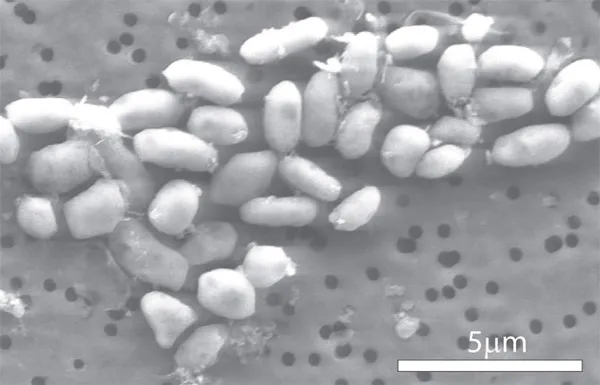
In late 2010, a NASA news conference touted the discovery of bacteria that seemed to use arsenic in place of phosphorus in their cells. Two new papers appearing in Science disputed that claim, saying that while the cells can tolerate high levels of arsenic, they don't use it or need it to grow.
The bacteria, called GFAJ-1, a variety from a family called Halomonadaceae, live in California's Mono Lake, where concentrations of arsenic are higher than in ordinary rivers and streams. Felisa Wolfe-Simon, currently working on a NASA fellowship at the Lawrence Berkeley National Laboratory, presented a paper — with much fanfare, including a news conference — in which she and her collaborators claimed that the bacteria could survive in the absence of phosphates, and in fact used arsenic in place of phosphorus in their DNA.
Even though new research rebuts this claim, Wolf-Simon told LiveScience her findings are not invalidated and that the bacteria may still incorporate tiny amounts of arsenic into their cells. Scientists who worked on the new research say she'll need to provide evidence for such ability.
All life on Earth contains six basic elements: carbon, nitrogen, oxygen, hydrogen, sulfur and phosphorus. The latter is usually seen in the form of phosphates, and is essential enough that it is a major component of fertilizer. Phosphorus and arsenic, though different elements, have similar chemical structures and can thus bind to molecules in cells in similar ways. That's one reason arsenic is toxic to humans to begin with. If Wolfe-Simon were correct, the idea that the six basic elements are essential to life would have to be reconsidered. [7 Theories on the Origin of Life]
That doesn't seem to be the case, according to the two studies conducted by two independent groups of researchers, one based in Princeton University and the University of British Columbia, and the other at the Swiss Federal Institute of Technology (ETH) in Zurich.
Arsenic and the bacteria
In one study, a team led by Marshall Reaves at Princeton placed GFAJ-1 in a medium that had high concentrations of arsenic. Wolfe-Simon's team said the bacteria grew in the presence of both arsenate and phosphates, even when more arsenate was added. The latest experiment didn't show the same result; adding phosphates increased growth and there didn't seem to be any dependence on arsenic — only the phosphate made a difference.
Get the world’s most fascinating discoveries delivered straight to your inbox.
The team then looked for arsenic in the DNA of GFAJ-1. If this bacterium were incorporating arsenic into its DNA, the arsenic would show up in various molecules after the DNA is chemically "digested." For example, an arsenic-containing nucleotide, or free arsenate, would be present. But after purifying the DNA it didn't seem to be there.
In the second study, a team led by Tobias Erb found that GFAJ-1 can grow on less phosphorus than most bacteria and less than what Wolfe-Simon's team provided. Wolfe-Simon had acknowledged very low levels of phosphate within her team's study samples, though she said this contamination would've been insufficient to allow GFAJ-1 to grow. Erb found otherwise.
When phosphorus concentrations were reduced enough the growth stopped. One thing they did find was that organic, or carbon-rich, arsenic compounds were present in the bacterium's cells, though not in its DNA, but the most likely explanation is that they formed on their own, without the cells doing anything. That's because sugar (used to feed the bacteria) and arsenate react in solution.
Julia Vorholt, a co-author of the paper, said there didn't seem to be a biochemical pathway to form arsenate-related compounds. "We saw a sugar arsenate," she said. "We didn't see it if you washed the DNA… You'd expect to see follow-on metabolites."
Despite the new research, Wolfe-Simon told LiveScience in an email that her data are not inconsistent with a creature that needs phosphorus to survive, and it's possible that arsenic may be incorporated into the cells — just in small amounts.
"The original GFAJ-1 paper emphasized tolerance to arsenic, but suggested the cells required phosphorus, as seen in these two new papers," she wrote. "However, our data implied that a very small amount of arsenate may be incorporated into cells and biomolecules helping cells to survive in environments of high arsenate and very low phosphate. Such low amounts of arsenic incorporation may be challenging to find and unstable once cells are opened." [Stunning Images of Mono Lake]
Wolfe-Simon says she is continuing her research and plans to publish in a few months. John Tainer, a senior scientist at Lawrence Berkeley National Lab, said he thinks Wolfe-Simon's original work still has merit, and that further research may reveal incorporation of arsenic.
Rosie Redfield of the University of British Columbia, an early critic of the December 2010 study and a co-author on the first Science paper, said in an email that the ball is in Wolfe-Simon's court. "If she wants anyone to believe that these bacteria adaptively incorporate arsenic in place of phosphorus she needs to provide some solid evidence."
All that said, Vorholt said a really interesting question is how GFAJ-1 survives in the environment it does. GFAJ-1 may not be using arsenic in its DNA or to run its bodily functions (called metabolism), but it has found a way to live in an environment with concentrations of arsenic that would kill most other life forms.
"The remarkable thing about this organism is that it grows in such high concentrations," she said. Even in concentrations higher than that in Mono Lake. "We used 100 times that."
Follow LiveScience on Twitter @livescience. We're also on Facebook & Google+.
