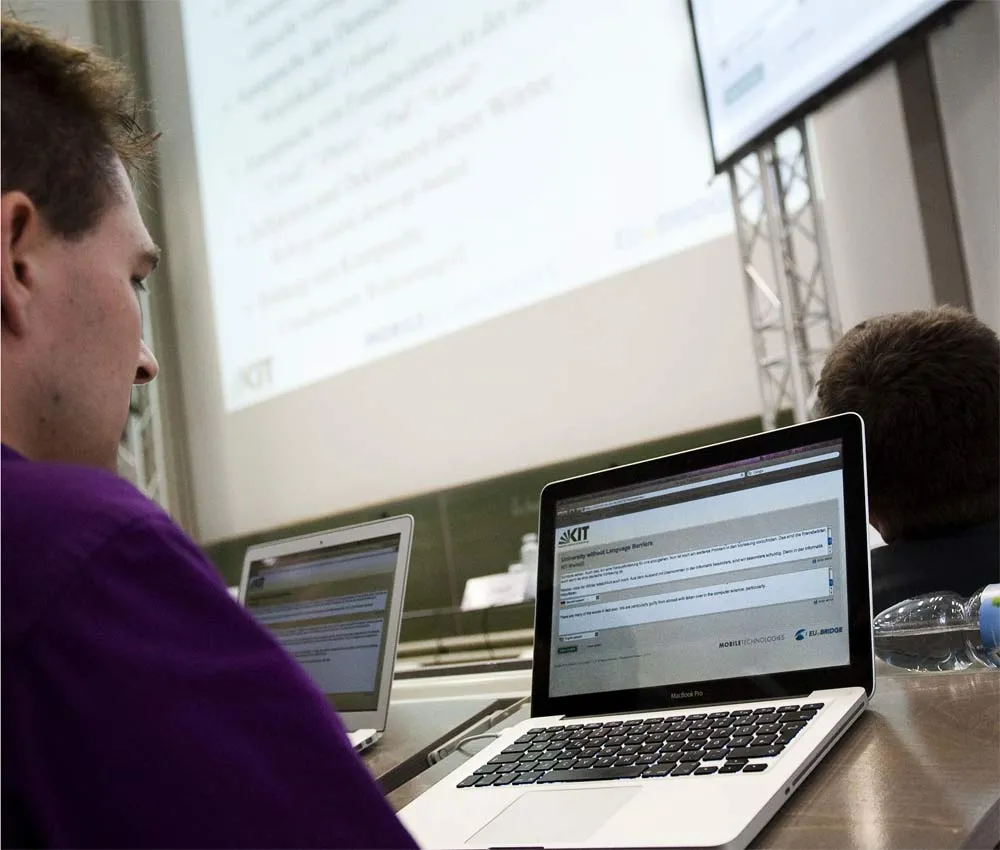
A professor has made the world's first automatic translation service for college lectures that can translate live talks instantly.
That solution for overcoming language barriers could open up universities to the most talented students from all over the world. The U.S. still leads the world in attracting international students — more than 723,000 attended U.S. universities in the fall of 2010 — but the new translation tool debuted at Karlsruhe Institute of Technology (KIT) in Germany.
"The translation is not always perfect," said Alex Waibel, a professor of computer science at Germany's KIT and Carnegie Mellon University in Pittsburgh, "but it is part of the language tools, by means of which students are enabled to better follow the lectures in spite of language barriers."
Latest Videos From
A first version of the language translator puts German lectures into English. That reflects the use of English as a standard international language among foreign students in Germany, but later versions of the translator could work across many more languages.
The translator can also read and translate written portions of past and present lectures — a relatively simple matter of jumping ahead a step in the translation process.
"The lecture translator automatically records the lecture, transcribes the text into a written version, and translates it into English in real time," Waibel explained. "Students can then follow the lecture via their PC or mobile phone."
Waibel built his translation service based on automatic speech recognition and machine translation technologies over 20 years of research. His work with Carnegie Mellon University and Mobile Technologies LLC & GmbH had funding from the European Commission and the German Excellence Initiative.
This story was provided by InnovationNewsDaily, a sister site to LiveScience. You can follow InnovationNewsDaily on Twitter @News_Innovation, or on Facebook.