 Live Science Plus





You are now subscribed
Your newsletter sign-up was successful
Want to add more newsletters?

Delivered Daily
Daily Newsletter
Sign up for the latest discoveries, groundbreaking research and fascinating breakthroughs that impact you and the wider world direct to your inbox.

Once a week
Life's Little Mysteries
Feed your curiosity with an exclusive mystery every week, solved with science and delivered direct to your inbox before it's seen anywhere else.

Once a week
How It Works
Sign up to our free science & technology newsletter for your weekly fix of fascinating articles, quick quizzes, amazing images, and more

Delivered daily
Space.com Newsletter
Breaking space news, the latest updates on rocket launches, skywatching events and more!

Once a month
Watch This Space
Sign up to our monthly entertainment newsletter to keep up with all our coverage of the latest sci-fi and space movies, tv shows, games and books.

Once a week
Night Sky This Week
Discover this week's must-see night sky events, moon phases, and stunning astrophotos. Sign up for our skywatching newsletter and explore the universe with us!
Join the club
Get full access to premium articles, exclusive features and a growing list of member rewards.
A new ancient fish with a sharklike tail discovered in Canada was a fast-moving, aggressive predator, quite unlike its sluggish relatives today.
Today's coelacanth (Latimeria chalumnae) is famous for being a "living fossil." Researchers thought these large, paddle-tailed fish had gone extinct during the Cretaceous period — until a fisherman caught a living coelacanth off the east coast of South Africa in 1938.
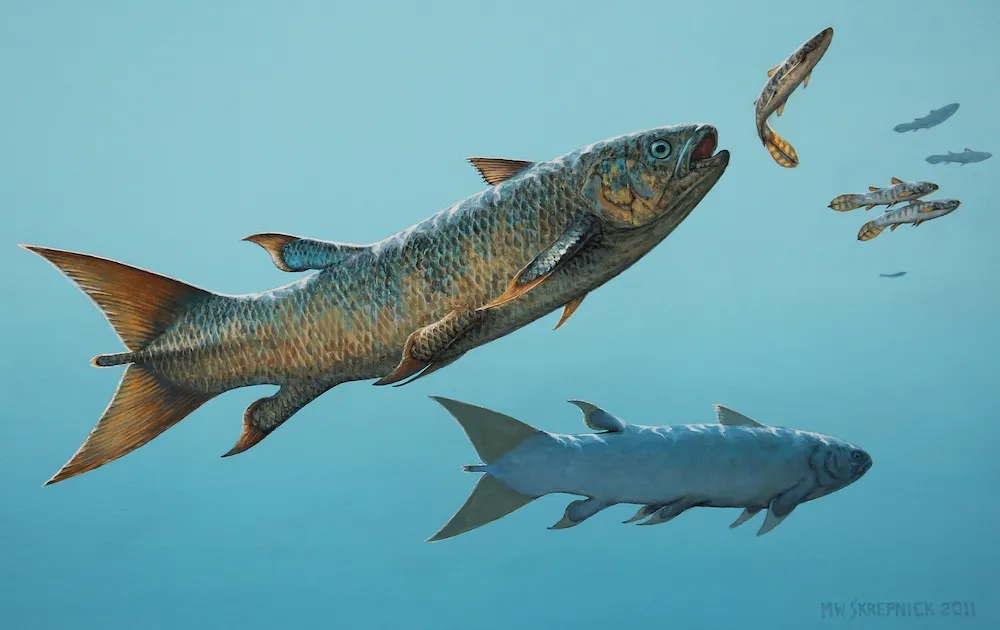
Modern coelacanths, and most fossilized species, are slow moving, "lay-in-wait" type of predators, according to study researcher Mark Wilson, a paleontologist at the University of Alberta in Canada. But the new specimen, dubbed Rebellatrix divaricerca, had a forked tail, much like today's tuna or sharks.
"Fish with forked tails are able to achieve higher speeds and sustain them over a greater period of time," study researcher Andrew Wendruff, also of the University of Alberta, wrote in an email to LiveScience. "The forked tail of Rebellatrix indicated that it was a fast-moving, aggressive predator." [Images of the Rebel Coelacanth]
No other coelacanth in the fossil record sports a forked tail, Wendruff said.
Rebellatrix "shatters the commonly held notion that coelacanths were an evolutionarily stagnant group in that their body shape and lifestyle changed little since the origin of the group," he said. "Rebellatrix is dramatically different than anything previously known."
For all its evolutionary audacity, Rebellatrix was likely a "spectacular failure in the evolution of cruising predation," Wendruff said. The fish evolved after the Permian mass extinction, which occurred about 252 million years ago and killed off more than 90 percent of all marine species. It likely filled a niche vacated by the mass extinction, Wendruff said, but this honeymoon period didn't seem to last long. There is no record of Rebellatrix or its descendents in the later fossil record.
The researchers discovered several fossilized Rebellatrix specimens and fragments in and around Wapiti Lake Provincial Park in British Columbia. They acquired another specimen, also found in the park, from a collector who had owned it since the 1950s. At the time the fish was alive, the park area would have been an ocean off the west coast of the supercontinent Pangaea.
The fish was about 4.3 feet (1.3 meters) long with a slender body and the thick fins still seen on coelacanths today.
John Long, a fossil fish expert at the Natural History Museum of Los Angeles County, who was not involved in the research, praised the find.
“This is an amazing discovery which overturns the age-old image of coelacanths as slow-moving fishes, and shows the resilience of the group to come back in true fighting form after surviving the world’s most devastating mass extinction event,” Long said in a statement.
The researchers reported their work in the Journal of Vertebrate Paleontology.
You can follow LiveScience senior writer Stephanie Pappas on Twitter @sipappas. Follow LiveScience for the latest in science news and discoveries on Twitter @livescience and on Facebook.

