
 Live Science Plus


Gallery: Hidden Rainbows in Ordinary Rocks

Rocking Colors

By slicing rocks very thin and using special filters, geologists can turn a drab-looking rock sample into a slice of color. These photographs zoom in on tiny sections of rock just a few millimeters across. The images can tell geologists about the formation and composition of a rock, or, as Italian geoscientist Bernardo Cesare discovered, they can provide a palette for artistic beauty.
Above, a sample of slag (a byproduct from smelting ore into metals) provided by Ivana Angelini. Read the full article.
Plastic Under the Lens

Rocks aren't the only material that can reveal colors using the technique. This is a fragment of a plastic bag.
Russian Rock

This is one of Cesare's favorite images, a type of metamorphic rock called a schist bearing the mineral charoite.

Garnet Peridotite

A garnet peridotite from Alpe Arami, Switzerland.
Graphite Glory

Graphite (the mineral used to make pencil "lead") in a metamorphic rock called a granulite from Kerala, India. The sample was provided by Satish Kumar.
Madagascar Jasper
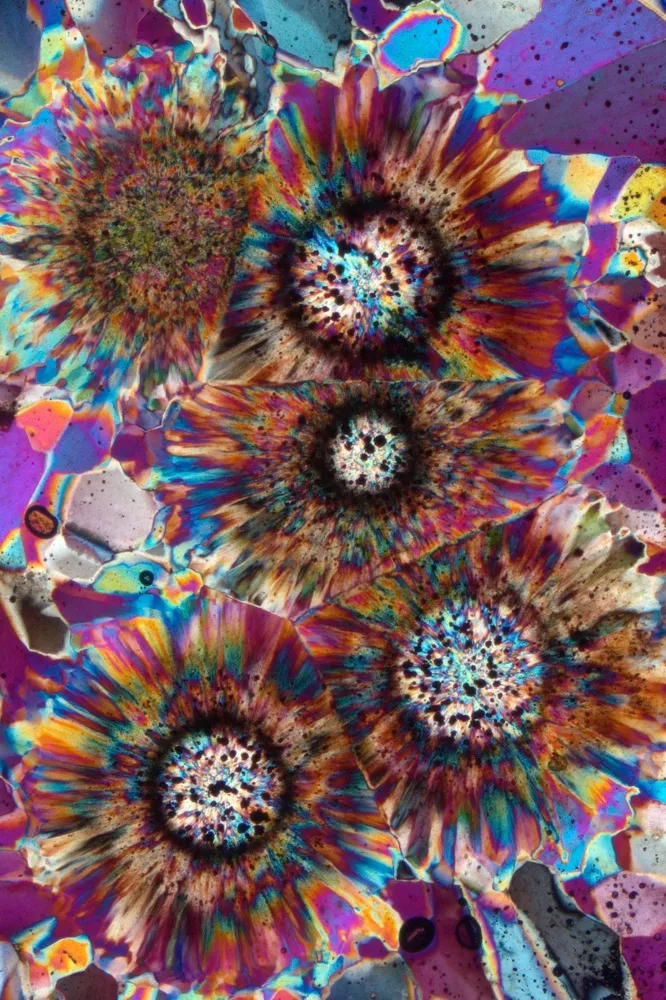
Ocean Jasper from Madagascar is on of Bernardo Cesare's favorite rock micrographs, due to its flower-like patterns.
Charoite-bearing Rock

Charoite-bearing rock from Yakutia, Russia
Get the world’s most fascinating discoveries delivered straight to your inbox.
Manitoba Color

A granulite (a type of metamorphic rock) from Manitoba, Canada, provided by Martha Growdon.
Burning Love

Crystals in a chunk of lava from Lipari, Italy, take the shape of a heart.
Crystal Forms

Crystals of the mineral plagioclase in gabbro, an igneous rock.
Ocean Jasper

Ocean Jasper from Madagascar.

Stephanie Pappas is a contributing writer for Live Science, covering topics ranging from geoscience to archaeology to the human brain and behavior. She was previously a senior writer for Live Science but is now a freelancer based in Denver, Colorado, and regularly contributes to Scientific American and The Monitor, the monthly magazine of the American Psychological Association. Stephanie received a bachelor's degree in psychology from the University of South Carolina and a graduate certificate in science communication from the University of California, Santa Cruz.