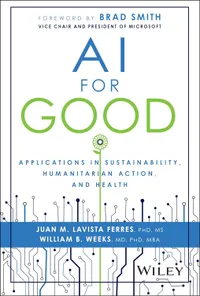
Over the last few years, artificial intelligence (AI) has been firmly in the world's spotlight, and the rapidly advancing technology can often be a source of anxiety and even fear in some cases. But the evolution of AI doesn't have to be an inherently scary thing — and there are plenty of ways that this emerging technology can be used for the benefit of humanity.
Writing in "AI for Good" (Wiley, 2024), Juan M. Lavista Ferres and William B. Weeks, both senior directors at Microsoft's AI for Good Research Lab, reveal how beneficial AI is being used in dozens of projects across the world today. They explain how AI can improve society by, for example, being used in sustainability projects like using satellites to monitor whales from space, or by mapping glacial lakes. AI can also be used in the wake of natural disasters, like the devastating 2023 earthquake in Turkey, or for social good, like curbing the proliferation of misinformation online. In addition, there are significant health benefits to reap from AI, including studying the long-term effects of COVID-19, using AI to manage pancreatic cysts or detecting leprosy in vulnerable populations.
In this excerpt, the authors detail the recent rise of large language models (LLMs) such as ChatGPT or Claude 3 and how they have grown to become prominent in today's AI landscape. They also discuss how these systems are already making a significant beneficial impact on the world.
The rise of language models
At the core of today's linguistic technologies, such as GPT, lies the concept of a language model. Imagine you begin a sentence with "This morning I woke up and saw a beautiful blue _____." What should follow? A language model predicts the continuation based on probabilities derived from vast amounts of text data. For instance, words like "sky" might be highly probable continuations. However, the model's sophistication allows it to consider a diverse range of possibilities, such as "bird" or "car," each with a specific probability, showcasing its nuanced understanding of different contexts.
Despite their limitations, the influence of LLMs has been remarkable, especially in the latter part of 2023. For instance, GPT-4 has achieved significant milestones, such as passing both the multiple-choice and written sections of the bar exam. The true strength of these models lies in their ability to learn from a vast source of information: the World Wide Web. This immense resource contains a significant portion of our collective human knowledge and is by far the most important dataset in the world. By training on this enormous dataset, LLMs can build a representation of the world that replicates the complex relationships found within human understanding.
Related: 32 times artificial intelligence got it catastrophically wrong
In summary, while these advanced LLMs don't possess real understanding or consciousness, their capacity to process and emulate human language and thought is immensely powerful. As we continue to evolve and refine these technologies, it's crucial to understand their abilities, limitations, and the ethical implications they bring.
LLMs as a language aid
When we discuss LLMs, the majority of discussions happen around the power that AI has in areas like healthcare diagnostics, but an area that's not often discussed is the power that LLMs have as a language aid in assisting non-native speakers to write fluently.
This opportunity deeply resonates with me. I am a non-native English speaker who leads a research lab with over 70% of members who hail from the Global South and are also non-native speakers. Approximately 95% of research is published in English, yet only 4.7% of the global population are native English speakers. When I give talks in Uruguay, my homeland, I always emphasize the importance of mastering both coding and English. I was fortunate, my parents ensured I learned English from a young age. However, many brilliant minds have not had that opportunity.
With GPT, the ability to write confidently in English is now within reach of everyone. LLMs, like GPT, are not a panacea, but they have the potential to bridge language gaps in remarkable ways. A good translation tool doesn't just provide a literal translation of words between two languages. It must also convey the meaning, tone, cultural connotation, and context.
LLMs work by refining text that may not be well structured, converting it into expressions akin to those of a native speaker. This is especially vital for non-native speakers who often grapple with the nuances of English grammar and syntax. The model assists not just by ensuring grammatical accuracy, but also by enhancing vocabulary to match the quality of native English publications.
LLMs for democratizing coding
I consider myself fortunate in many aspects of my life, particularly because my parents gave my brothers and me a computer when I was eight years old. This early exposure provided me with the invaluable opportunity to learn coding. The profound impact of coding on my life is undeniable. However, among my friends and classmates, I was the only one with this privilege. More than three decades later, less than 0.5% of the world's population knows how to code.
Learning to code is akin to mastering a new language, serving as our interface to programming computers. Although there has been a significant positive impact from more people learning to code, it's challenging to foresee a radical increase in the number of coders in the coming decades.
However, the advert of LLMs could bring about a substantial shift. Advanced systems like GPT-4 have the capability to translate natural language into actual programming languages. Those models empower people to write programs and automate processes in their native tongues, be it English, Spanish, Mandarin, or others. This technology has the potential to democratize programming, extending its reach to hundreds of millions worldwide and bridging the gap between those who can code and those who cannot.
LLMS in areas like medicine
In April 2023, John W. Ayers and colleagues published a study in JAMA International Medicine that compared the responses of physicians to those of GPT-4 when answering patient queries. The study found that GPT-4 not only provided more accurate answers than the doctors, but also demonstrated greater empathy.
It's noteworthy that GPT-4 has not been extensively trained on a significant portion of medical knowledge, much of which remains behind paywalls. Additionally, the model was not specifically trained for medical scenarios. Despite these limitations, its impressive performance highlights the potential impact of such models.
Currently, approximately 4 billion people — nearly half of the world's population — lack access to doctors. While medical access has improved in recent decades, particularly in the Global South, the challenges remain significant.
These AI models are not poised to replace doctors. However, if they can provide accurate responses to human inquiries, they could enable doctors to concentrate on areas where they excel. While we have yet to see those models deployed in production environments for medical consultation, the promising results suggest a path forward in addressing global healthcare disparities.
This excerpt has been edited for style and length. Reprinted with permission from "AI for Good: Applications in Sustainability, Humanitarian Action, and Health" by Juan M. Lavista Ferres and William B. Weeks, published by Wiley. © 2024 by Juan M. Lavista Ferres and William B. Weeks. All rights reserved.