Uncrackable quantum messages can now be sent through the air and will soon be beamed into space.
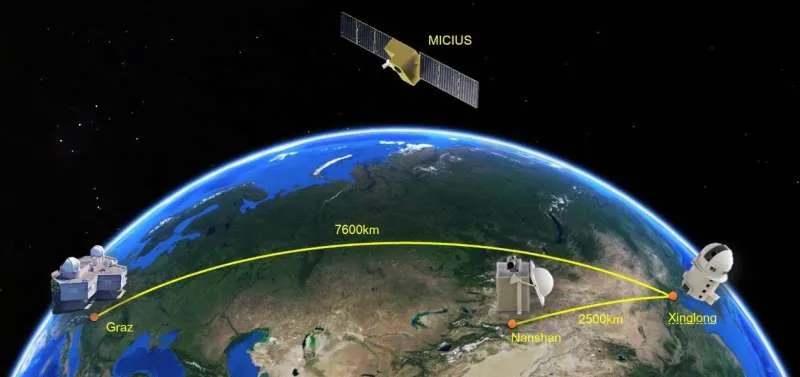
Researchers at the University of Science and Technology in China (USTC) worked out in 2018 how to secretly share "quantum keys" between orbiting satellites and ground stations, as Live Science previously reported. That made the connection between the Chinese Micius satellite and three ground sites it communicates with in Europe and Asia by far the largest secure quantum network in the world. But the quantum secrecy tool Micius originally used had a few leaks, requiring scientists to develop a more advanced form of quantum encryption known as measurement-device-independent quantum key distribution (MDI-QKD). Now, those same researchers have, for the first time, pulled off MDI-QKD wirelessly, across a city in China, without any fiber optics involved. And they're getting ready to send MDI-QKD up to Micius.
"The results by the Chinese group [are] very interesting for the quantum communication community," said Daniel Oblak, a quantum communications researcher at the University of Calgary in Ontario who did not work on the experiment.
It opens the door, he said, to practical quantum-encrypted networks relying on both satellites and fiber-optic cables working in tandem, something not possible with current technology.
Related: 12 stunning quantum physics experiments
Quantum-secure messages
Every bit of secure data you've ever sent from your phone — instructions to your bank through a mobile app, for example, or Whatsapp messages with your mom — has been broadcast across huge distances full of potential hackers. But any snoops listening in probably couldn't make any sense of that information because it was transformed into gibberish that could only be deciphered with a secure key, basically a long string of numbers. That string of numbers gets scrambled up with the information it protects, and only someone who knows the string can unscramble them.
Those systems aren't perfect though, vulnerable to attack from anyone who listened in when the key was being shared. They also don't typically use sufficiently long strings of numbers to be perfectly secure even against someone who didn't listen in on the key, according to Belgian cryptographer Gilles Van Assche's book "Quantum Cryptography and Secret-Key Distillation" (Cambridge University Press, 2006).
So in the 1980s, researchers developed a theoretical method for generating secure keys using quantum mechanics. They figured out that secure keys could be encoded into the quantum properties of individual particles, and exchanged secretly back and forth. The advantage of this "quantum key distribution" (QKD) is that quantum physics dictates that the very act of observing a particle irreparably changes it. So any spies who tried to intercept the quantum key could be immediately detected by the changes in the particles.
Securing the quantum vault
In recent years, as researchers began building prototype quantum key distribution networks using photons (light particles), an important flaw turned up in the system — "Side channel attacks" could siphon copies of a quantum key directly from the receiver, a study published in 2012 in the journal Physical Review Letters found.
So researchers developed MDI-QKD, calling it in that 2012 paper "a simple solution to remove all (existing and yet to be discovered) detector side channels."
In MDI-QKD, both the sender and receiver of a message send their quantum key photons at the same time (as well as decoys) to a third party. Each photon contains a single bit of information: a one or a zero. The third party doesn't have to be secure, and it can't read the information the photons convey.
"All it can tell is the relation between the [photons]," said Wolfgang Tittel, a quantum communications expert with QuTech, a collaboration between Delft University of Technology in the Netherlands and the Netherlands Organization for Applied Scientific Research. It can just say "whether they are the same or different."
When both the sender and the receiver send a one or a zero, they get a message from the relay saying they sent the same bit. If they send different numbers, the relay broadcasts that they sent different numbers. A hacker spying on the relay could only tell whether the photons were the same or different, but not whether they represented a one or a zero.
"But of course the people who sent the states know what they sent, so they know what the other person sent," Tittel told Live Science.
All those ones and zeros add up to a secure quantum key, and there's no way for a hacker to tell what it is.
But MDI-QKD has its own challenges, said Tittel, who was not involved with this latest experiment. It requires that both photons arrive at the relay at precisely the same time.
"We found that this is difficult because of changes in the temperature of the device," he said, which can mess up the timing.
And that's using dedicated fiber-optic cables. Sending photons through the air requires accounting for atmospheric turbulence, which makes timing even more unpredictable.
That's why the new experiment is so impressive, Tittel said. While China has been doing standard QKD with Micius since 2018, no one had until now figured out how to do the more unbreakable encryption system over long distances without fiber-optic cables to carry the photons back and forth.
In the new study, the researchers sent a MDI-QKD secure key across 11.9 miles (19.2 kilometers) of open air between two buildings in the city of Hefei. To make sure the photons arrived at the relay at exactly the same time, they developed algorithms that enabled the sender and receiver devices to account for the fluctuations in that stretch of atmosphere.
Getting MDI-QKD into space will require more problem-solving, including better algorithms that can account for the even greater distances involved.
"The second challenge we hope to overcome is associated with the motion of satellites," Qiang Zhang, one of the authors of the paper, told Phys.org.
A moving target changes the behavior of photons in ways that have to be very precisely accounted for in order to make sense of the signal.
Tittel said that the motion of the satellite makes MDI-QKD "very difficult," but that it's plausible the USTC team might pull it off.
If they do, they will have developed a quantum network uncrackable by any known method of codebreaking. It would be the most secure long-distance communication network in the world.
Originally published on Live Science.