Get the world’s most fascinating discoveries delivered straight to your inbox.
You are now subscribed
Your newsletter sign-up was successful
Want to add more newsletters?
Join the club
Get full access to premium articles, exclusive features and a growing list of member rewards.
An account already exists for this email address, please log in.
Strange radio signals detected from Earth-like planet could be a magnetic field necessary for life
Earth's magnetic field protects life on our blue planet — and astronomers just found evidence of a magnetic field on a rocky exoplanet 12 light-years away.
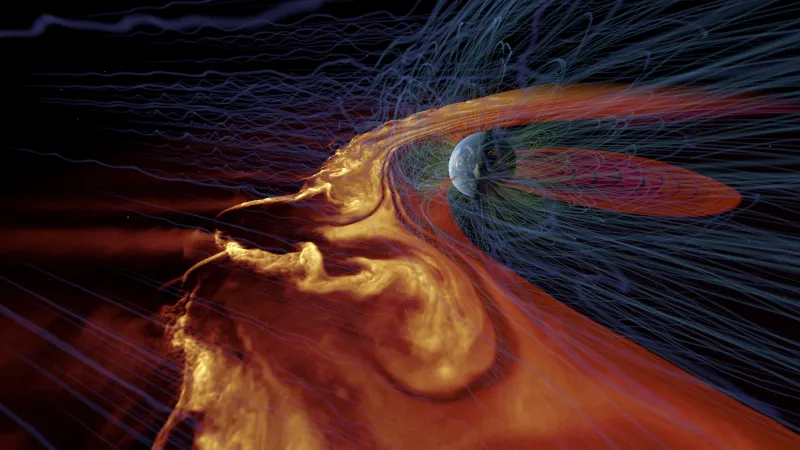
A visualization of solar wind interacting with Earth’s magnetic field during a solar storm. Strange radio signals from a distant star system could be due to similar magnetic disturbances between a star and a planet's magnetic field.
(Image credit: Advanced Visualization Lab, National Center for Supercomputing Applications, University of Illinois at Urbana-Champaign)
On Earth, we often take our planet’s magnetic field for granted. It protects living creatures from the sun’s rays, draws compass needles north and even creates beautiful auroras. Other worlds in our solar system have magnetic fields too — but what about Earth-like planets around other stars? New research may have revealed a promising lead.
Recent observations from the Very Large Array (VLA) radio telescopes in New Mexico revealed evidence of a magnetic field on the rocky exoplanet YZ Ceti b, which orbits a star about 12 light-years away from Earth. This is the first possible detection of a magnetic field on a planet beyond our solar system, according to a study published April 3 in the journal Nature Astronomy.
"This research shows not only that this particular rocky exoplanet likely has a magnetic field but provides a promising method to find more,” study author Joe Pesce, director of the National Radio Astronomy Observatory (NRAO), said in a statement.
Magnetic fields are particularly interesting to astronomers because they’re an important part of making a planet habitable. Without a magnetic field, energetic particles from a star can erode a planet’s atmosphere, stripping away the blanket of gas that can support life.
"The search for potentially habitable or life-bearing worlds in other solar systems depends in part on being able to determine if rocky, Earth-like exoplanets actually have magnetic fields," Pesce said.
New Mexico's Very Large Array hunts for signs of extraterrestrial life across the cosmos.
(Image credit: NRAO/AUI/NSF)
YZ Ceti b, however, isn’t a habitable planet. To detect the radio waves from a small, far-away exoplanet’s magnetic field, astronomers had to look towards a particularly extreme example. YZ Ceti b is quite close to its star — far too close to be a pleasant temperature for life — and it’s also orbiting at such a pace that one of its years is only two Earth days long.
This is so close in that the planet “plows” through material sloughing off of the star, according to the researchers. The planet’s magnetic field pushes electrically charged plasma back toward the star, which then interacts with the star’s own magnetic field, emitting bright flashes of energy.
Sign up for the Live Science daily newsletter now
Get the world’s most fascinating discoveries delivered straight to your inbox.
Essentially, the radio waves the team observed were an aurora on the star, likely created by the interactions with the planet, the team said.
"There should also be an aurora on the planet if it has its own atmosphere," Sebastian Pineda, University of Colorado Boulder astronomer and co-author on the new research, said in the statement.
"This is telling us new information about the environment around stars," Pineda added. "This idea is what we're calling 'extrasolar space weather.'"
The team isn’t 100% certain whether the stellar aurora is entirely caused by YZ Ceti b, though. Further observations are needed to confirm this is actually due to a rocky planet’s magnetic field, and not just a feature of the star itself. However, the team remains optimistic that these findings could lead to future breakthroughs in the search for habitable alien planets.
Study co-author Jackie Villadsen, an astronomer at Bucknell University in Lewisburg, Pennsylvania, said in the statement that this “could really plausibly be” the first detection of a magnetic field on a rocky exoplanet. "But I think it's going to be a lot of follow-up work before a really strong confirmation of radio waves caused by a planet comes out,” she added.
Briley Lewis (she/her) is a freelance science writer and Ph.D. Candidate/NSF Fellow at the University of California, Los Angeles studying Astronomy & Astrophysics. Follow her on Twitter @briles_34 or visit her website www.briley-lewis.com.