Get the world’s most fascinating discoveries delivered straight to your inbox.
You are now subscribed
Your newsletter sign-up was successful
Want to add more newsletters?
Join the club
Get full access to premium articles, exclusive features and a growing list of member rewards.
An account already exists for this email address, please log in.
Molecule responsible for robbing Venus of its water may finally have been identified
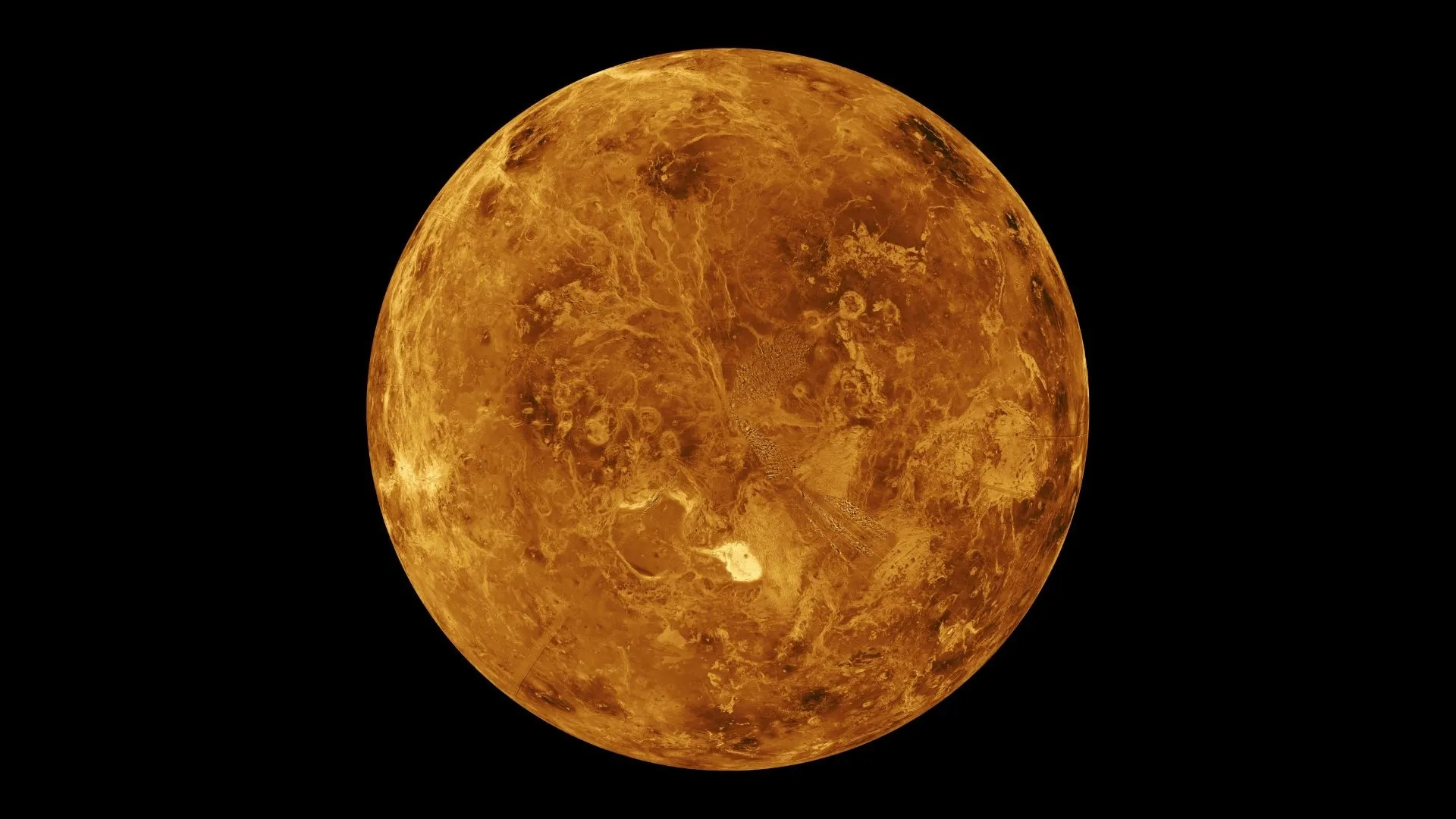
A new water loss mechanism on Venus explains how the planet lost all its water, turning the planet from a potentially habitable world into the parched hellscape we know today.
Scientists have identified a water-loss mechanism on Venus that could explain how the once water-rich world became completely parched.
In the newly identified process, linked to a previously overlooked molecule high in Venus' atmosphere, water escaped Venus at double the rate previously estimated. As faster water loss means less time is needed to boil away the planet's water reservoir, scientists say Venus may have harbored oceans — and potentially habitable conditions — for longer than previously thought before the drying process began.
"This would provide more time for possible life to arise," study co-author Eryn Cangi, a research scientist at the Laboratory for Atmospheric and Space Physics (LASP) in Colorado, wrote in The Conversation. "Our results don't mean oceans or life were definitely present, though — answering that question will require lots more science over many years."
Prior studies suggest that both Venus and Earth likely received similar amounts of water early in their history, mostly from water vapor-spewing volcanoes and icy comets that frequently bombarded the worlds. Estimates suggest Venus once had enough moisture to cover its surface in about 1.8 miles (3 kilometers) of water. However, Venus receives far more sunlight than Earth, and previous research revealed this sunlight likely boiled away the planet's water reservoir by breaking atmospheric water molecules into hydrogen and oxygen atoms. Once free, the lightweight hydrogen escaped into space via a process known as hydrodynamic escape, leaving Venus without one of the two ingredients needed to form water.
The process explains how most of Venus' water evaporated from its atmosphere, likely within the first billion years of the planet's history. However, it doesn't account for the last 330 feet (100 meters) worth of water that was likely left behind once the escape process stopped, soon after most hydrogen atoms exited Venus, the researchers of the new study said.
A new water loss mechanism on Venus doubles previous estimates. In the planet's upper atmosphere, hydrogen atoms (orange) escape into space, leaving behind carbon monoxide molecules (blue and purple).
(Image credit: Aurore Simonnet/LASP/CU Boulder)
"As an analogy, say I dumped out the water in my water bottle. There would still be a few droplets left," study lead author Michael Chaffin, a research scientist at LASP, said in a statement. The remaining water can't have escaped from Venus the same way, but it must have been removed from the atmosphere relatively quickly to explain the hot, dry world we know today.
In the new study, the researchers suggested the remnant water was removed via a new mechanism known as HCO+ dissociative recombination (nicknamed DR). In this process, positively charged hydrogen, carbon and oxygen atoms combine with negatively charged electrons to produce carbon monoxide (CO) and hydrogen as a byproduct, after which the hydrogen escapes into space. Because water is the original source of the hydrogen reservoir on Venus, this process "effectively dries out the planet," the researchers said. Computer models of reactions in Venus' upper atmosphere show this mechanism closes the gap between the expected and observed water loss, according to the study, published Monday (May 6) in the journal Nature.
Sign up for the Live Science daily newsletter now
Get the world’s most fascinating discoveries delivered straight to your inbox.
"One of the surprising conclusions of this work is that HCO+ should actually be among the most abundant ions in the Venus atmosphere," Chaffin said in the statement.
However, scientists have never observed this molecule on Venus. Previous missions to the planet weren't designed to detect it, but they did measure individual reactants that produce HCO+ in the atmosphere.
None of the three upcoming missions to Venus are designed to detect the molecule either. NASA's VERITAS and the European Envision missions, both scheduled to launch in 2031, do not have the science instruments required to study hydrogen loss from Venus' upper atmosphere where the DR process occurs. NASA's DAVINCI probe, also scheduled to launch in 2031, will collect measurements about the pressure, temperature and winds of the atmosphere, but only below 43 miles (70 kilometers).
Confirming the presence of HCO+, and nailing down this phase of Venus’ history, will therefore have to wait a long time.
Sharmila Kuthunur is an independent space journalist based in Bengaluru, India. Her work has also appeared in Scientific American, Science, Astronomy and Space.com, among other publications. She holds a master's degree in journalism from Northeastern University in Boston. Follow her on BlueSky @skuthunur.bsky.social