Get the world’s most fascinating discoveries delivered straight to your inbox.
You are now subscribed
Your newsletter sign-up was successful
Want to add more newsletters?
Join the club
Get full access to premium articles, exclusive features and a growing list of member rewards.
An account already exists for this email address, please log in.
US company to use giant spinning cannon to blast hundreds of pancake-like 'microsatellites' into space
Rocket start-up SpinLaunch wants to catapult hundreds of flattened "microsatellites" into space at once, using a cannon-like machine that accelerates objects by spinning them. The first orbital demonstration is scheduled for next year.
A California-based startup plans to launch hundreds of flattened "microsatellites" into low-Earth orbit at once, by firing rockets out of a giant centrifugal cannon. The first batch of pancake-like spacecraft could be shot into space as soon as next year — and could set a new record.
SpinLaunch is a private company that aims to fire payloads into space using giant, cannon-like machines. These "cannons" accelerate spacecraft using spinning arms inside a vacuum-sealed chamber, before shooting them upward out of a barrel faster than a speeding bullet. Using this novel technology, the company aims to establish its own satellite constellation, Meridian Space, which they claim could provide more cost-effective competition to the likes of SpaceX's Starlink network.
On April 3, SpinLaunch revealed that it had received $12 million in funding from Kongsberg Defence and Aerospace (KDA), putting its total funding close to $150 million. The announcement also revealed that KDA's NanoAvionics had been selected to build the first batch of 250 satellites in the Meridian Space constellation, which could be launched during an in-orbit demonstration test planned for some point in 2026.
On the same day, NanoAvionics also released a video explaining more about the new satellites. This revealed that each satellite will be shaped like a flat disk and placed on top of one another inside a "launch bus," like a giant stack of pancakes. Each satellite will be 7.5 feet (2.2 meters) wide and weigh approximately 154 pounds (70 kilograms), making them significantly lighter than most other communications satellites. For example, Starlink's current V2 satellites weigh around 1,760 pounds (800 kg) each.
If all the satellites are successfully delivered into low-Earth orbit (LEO) next year, it would set a new record for most spacecraft launched at once, currently held by SpaceX's Transporter-1 mission, which launched 143 satellites in 2021, according to Live Science's sister site Space.com.
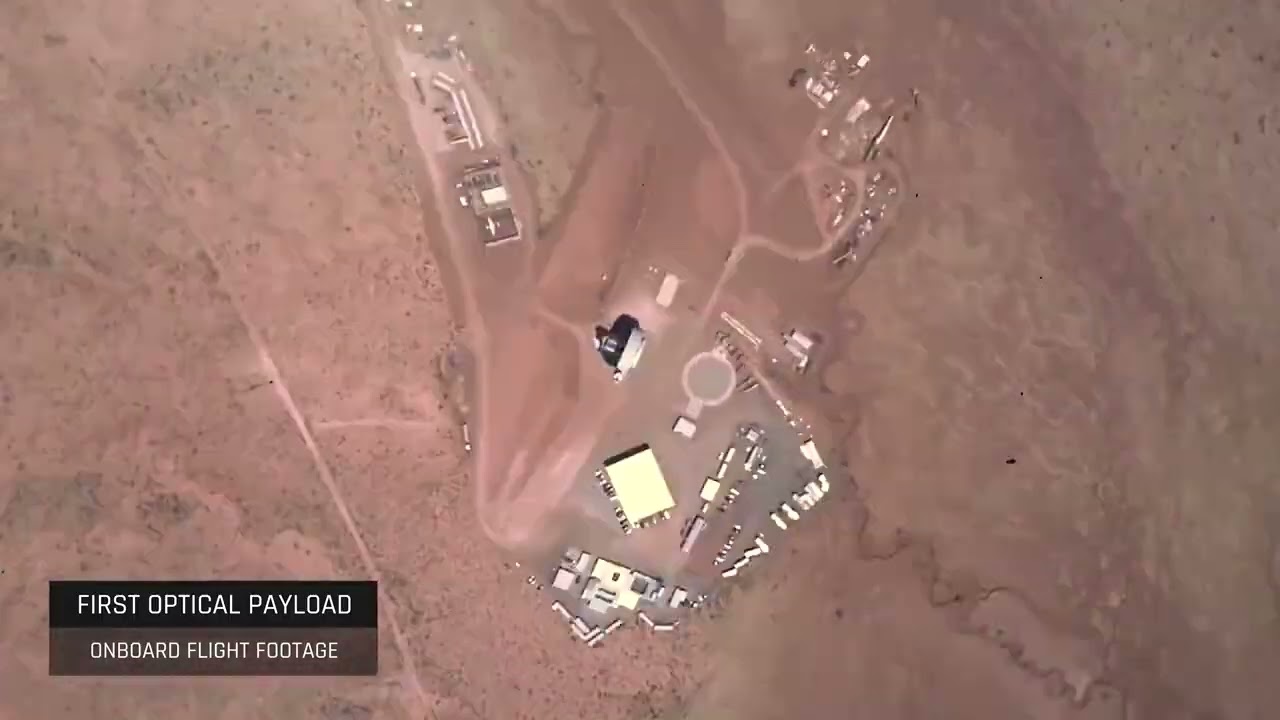
SpinLaunch's Suborbital Accelerator has already launched 10 rockets into suborbital flight from New Mexico. The launch in this photo occurred on Sept. 27, 2022.
(Image credit: SpinLaunch)
SpinLaunch has previously launched 10 rockets using its Suborbital Accelerator in New Mexico, which has a vacuum chamber around 108 feet (33 m) wide and spins objects to speeds of up to 5,000 mph (8,000 km/h). The most recent launch, in September 2022, successfully delivered multiple payloads into suborbit for the first time, Space.com previously reported.
Sign up for the Live Science daily newsletter now
Get the world’s most fascinating discoveries delivered straight to your inbox.
During these test launches, the acceleration process took up to 30 minutes, and the rockets experienced up to 10,000 Gs of force before being fired into the upper atmosphere. (One G is equivalent to the force exerted on an object by Earth's gravity.)
Details of next year's orbital demonstration are limited, but the mission will likely be carried out using the same machine as the previous tests. This means that the rocket will be catapulted into a suborbital flight before its engines kick in and deliver the final push needed to put the payload into LEO, according to Space.com.
Watch a SpinLaunch test payload soar with on-board cam - YouTube
The main draw of this type of launch system is that it is much cheaper than firing chemical rockets. SpinLaunch predicts that its future commercial launches could cost between $1,250 and $2,500 per kilogram launched into space, which is less than half the cost of SpaceX's Falcon 9 rockets, which cost around $6,000 per kilogram, according to New Space Economy.
Since the accelerated rockets don't release any greenhouse gases during launch, they are also better for the environment than chemical rockets. These spacecraft also do not need boosters that have to be discarded in space, which will mean less space junk in LEO and reduced chances of discarded equipment falling back to Earth's surface.
The Meridian Space satellites will provide superfast communications services at a much lower price point than its competitors, thanks to its cheaper launch system.
(Image credit: SpinLaunch/NanoAvionics)
SpinLaunch is only planning to launch around 1,200 of satellites in its Meridian Space constellation. However, once this is completed, the company is planning to build a larger Orbital Accelerator machine — with a 328-foot-wide (100 m) chamber — that will be capable of firing payloads for other companies directly into LEO, without the rockets having to fire at all. If this happens, SpinLaunch claims it could eventually launch up to five commercial payloads into space every single day, according to New Space Economy.
Harry is a U.K.-based senior staff writer at Live Science. He studied marine biology at the University of Exeter before training to become a journalist. He covers a wide range of topics including space exploration, planetary science, space weather, climate change, animal behavior and paleontology. His recent work on the solar maximum won "best space submission" at the 2024 Aerospace Media Awards and was shortlisted in the "top scoop" category at the NCTJ Awards for Excellence in 2023. He also writes Live Science's weekly Earth from space series.
You must confirm your public display name before commenting
Please logout and then login again, you will then be prompted to enter your display name.