Get the world’s most fascinating discoveries delivered straight to your inbox.
You are now subscribed
Your newsletter sign-up was successful
Want to add more newsletters?
Join the club
Get full access to premium articles, exclusive features and a growing list of member rewards.
An account already exists for this email address, please log in.
NASA's Parker Solar Probe will reach its closest-ever point to the sun on Christmas Eve
NASA's record-breaking Parker Solar Probe will smash its own personal bests for proximity to the sun and fastest speed by a human-made object when it whizzes past our star on Christmas Eve (Dec. 24). It is unlikely to get significantly closer to the sun before the end of its mission.
The Parker Solar Will come within 3.8 million miles of the sun on Dec. 24. It is unlikely to get much closer to our home star before the end of its mission.
On Christmas Eve, NASA's Parker Solar Probe will come closer than ever before to "touching the sun," getting more than eight times closer than Mercury does to our home star. It will also smash its own speed record, becoming the fastest human-made object when it zooms past our home star.
While the probe will make a few more final flybys in the next 12 months, it is unlikely to get much closer than it will on Tuesday.
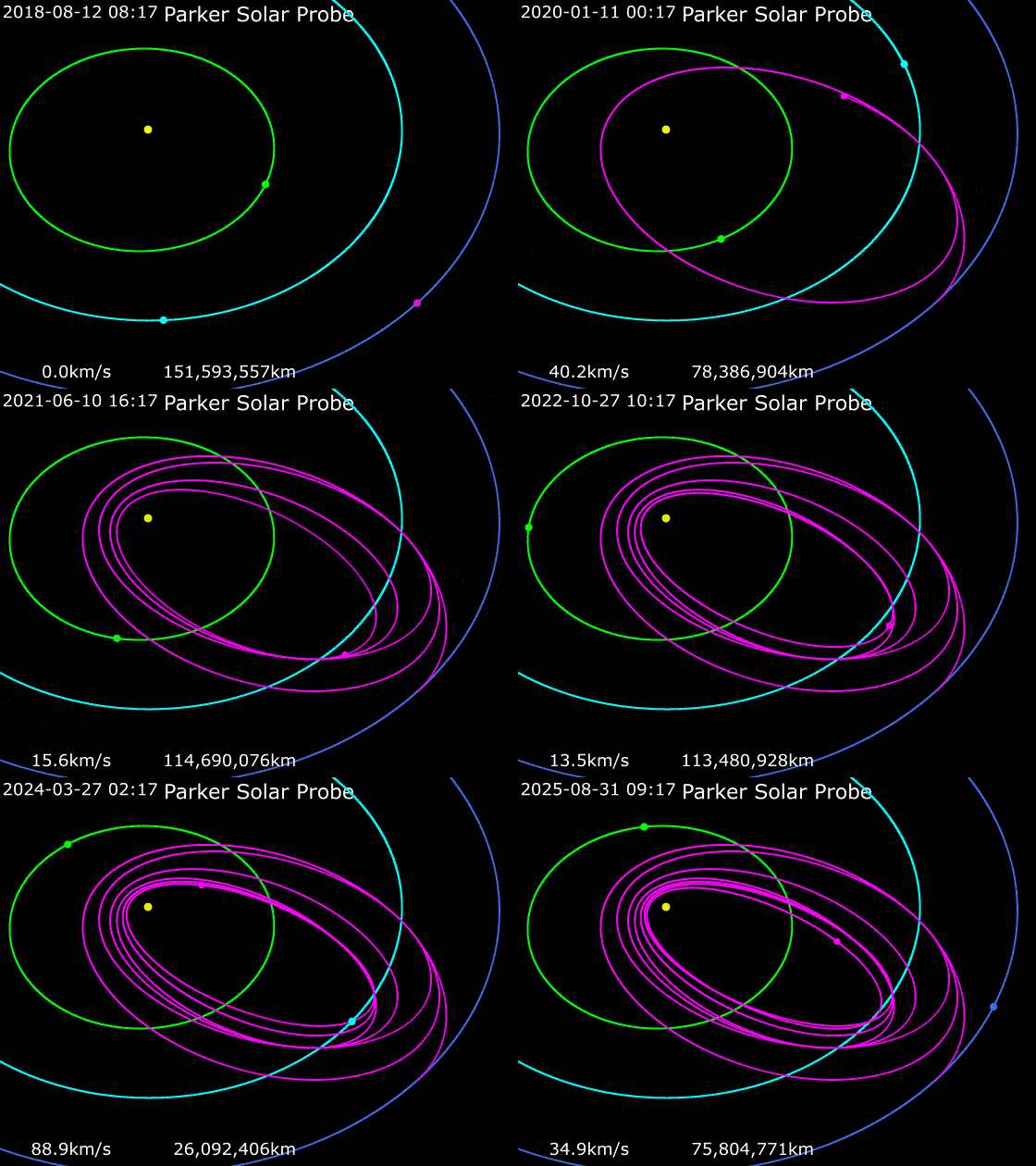
Parker was launched in 2018 with the goal of learning more about the sun's atmosphere, or corona, by flying through it, which the probe achieved for the first time in 2021. To do this, the spacecraft has repeatedly slingshotted around our home star, as well as occasionally around Venus, to build up enough speed and momentum to get progressively closer with every approach. To date, it has completed 21 solar slingshots.
The probe has already come closer to the sun than any other spacecraft in history, reaching a minimum distance of around 4.5 million miles (7.2 million kilometers) from our home star during close approaches in October 2023 and March this year. It has also previously broken the record for fastest human-made object, maxing out at roughly 395,000 mph (635,000 km/h) — or around 150 times faster than a rifle bullet.
But at 6:53 a.m. EST on Dec. 24, the probe will come within 3.8 million miles (6.1 million km) of the sun and reach a top speed of around 435,000 mph (700,000 km/h), according to NASA. To do this, the craft will have to endure temperatures in excess of 2,550 degrees Fahrenheit (1,400 degrees Celsius), which it should be able to do thanks to the near-indestructible heat shield that protects the sun-facing side of the probe.
The probe has been gradually working its way closer to the sun by slingshotting itself around Venus to pick up speed.
(Image credit: NASA/JPL/HORIZONS system)
"This will be a monumental achievement for all humanity," Nour Raouafi, an astrophysicist at the Johns Hopkins University Applied Physics Laboratory and project scientist for the Parker Solar Probe mission, previously said about the upcoming flyby. "This is equivalent to the moon landing of 1969."
Sign up for the Live Science daily newsletter now
Get the world’s most fascinating discoveries delivered straight to your inbox.
Closer than ever
Parker began its current maneuver in early November, when the probe successfully completed its seventh and final scheduled slingshot around Venus, Live Science's sister site Space.com reported. This "gravity assist" gave the spacecraft the last little push it needed to eventually break its own speed record.
The close approach also coincides with the explosive peak in the sun's roughly 11-year cycle of activity, known as solar maximum, which has been ongoing for most of this year and will likely continue well into 2025. As a result, this close approach could also help us learn more about what happens to the sun's magnetic field as it flips, and it could ultimately help scientists better predict space weather that can impact Earth.
The Parker Solar Probe is expected to make up to four more close flybys of the sun in 2025. It may get slightly closer to the sun than it will now, but not by much.
After that, the probe's thrusters will run out of fuel, and most of the dead spacecraft will eventually be pulled apart by the sun. However, the heat shield could remain in orbit around our home star for thousands of year, Space.com previously reported.
Harry is a U.K.-based senior staff writer at Live Science. He studied marine biology at the University of Exeter before training to become a journalist. He covers a wide range of topics including space exploration, planetary science, space weather, climate change, animal behavior and paleontology. His recent work on the solar maximum won "best space submission" at the 2024 Aerospace Media Awards and was shortlisted in the "top scoop" category at the NCTJ Awards for Excellence in 2023. He also writes Live Science's weekly Earth from space series.