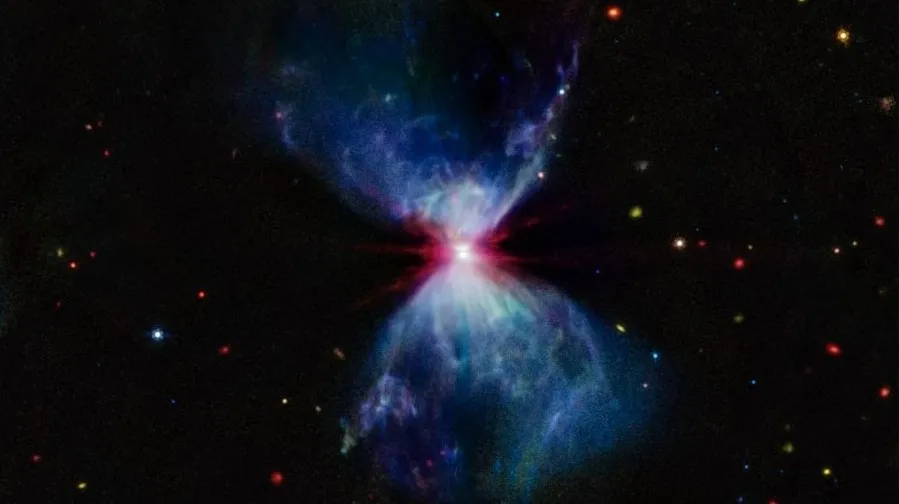
To mark Independence Day, NASA has released a James Webb Space Telescope (JWST) image showing the frenzied eruption of a young star in vibrant red, white and blue.
The cosmic pyrotechnics come from the nebula L1527, which is located 460 light-years away in the constellation Taurus.
Similar in shape to an hourglass or a butterfly's wings, the image shows a 100,000-year-old baby star roaring to life inside a gas cloud. Rotating in place, the star is consuming material around its sides while expelling it in vast jets from either pole.
"This fiery hourglass marks the scene of a very young object in the process of becoming a star," NASA wrote in a statement. "A central protostar grows in the neck of the hourglass, accumulating material from a thin protoplanetary disk, seen edge-on as a dark line."
Stars can take tens of millions of years to form — growing from billowing clouds of turbulent dust and gas to gently glowing protostars, before developing into gigantic orbs of fusion-powered plasma.
The nebula L1527 as seen by the JWST's Near-Infrared Camera (NIRCam) instrument.
As stars sputter into life, they fling out material in the form of winds and jets of ionized plasma in a process known as stellar feedback.
Sign up for the Live Science daily newsletter now
Get the world’s most fascinating discoveries delivered straight to your inbox.
The gas surrounding the infant star is usually dark, but the star's outflows produce shockwaves in the gas that cause it to glow. The blue-colored region shows carbon-based molecules called polycyclic aromatic hydrocarbons.
To capture the image, NASA used the James Webb Space Telescope's powerful Mid-Infrared Instrument (MIRI).
The JWST also imaged the protostar in the near-infrared spectrum, its outflows appearing in the orangey hues of a spectacular cosmic sunset.
Ben Turner is a U.K. based writer and editor at Live Science. He covers physics and astronomy, tech and climate change. He graduated from University College London with a degree in particle physics before training as a journalist. When he's not writing, Ben enjoys reading literature, playing the guitar and embarrassing himself with chess.