













Astronomers spot a possible 'future Earth' — 8 billion years into its future
The rocky planet, roughly twice Earth's size, has offered astronomers a glimpse of one of Earth’s possible futures — if it doesn’t get engulfed by our expanding sun.

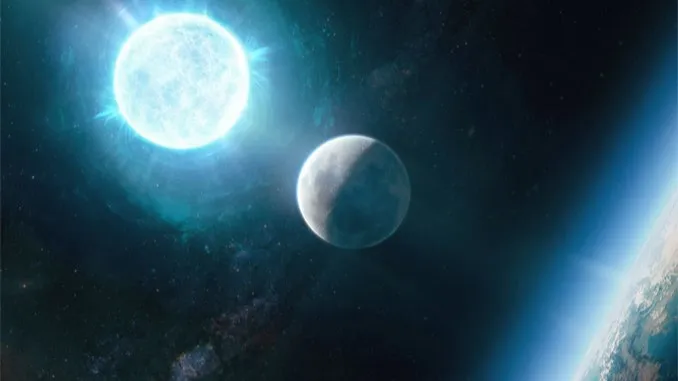
Astronomers have discovered a distant planet that has offered them a rare glimpse of what our planet may look like 8 billion years in the future.
The planet, called KMT-2020-BLG-0414 and located 4,000 light-years from Earth, is a rocky world orbiting a white dwarf — the embering husk of a star. Our sun is expected to transform into a white dwarf in 5 billion years’ time.
Before that, though, our sun will first accelerate outward into a red giant, consuming Mercury, Venus, and possibly even Earth and Mars. If our planet is spared, it could eventually resemble this one, drifting farther out from the cooling remains of the dying cosmic furnace. The researchers described the distant world Sept. 26 in the journal Nature Astronomy.
"We do not currently have a consensus whether Earth could avoid being engulfed by the red giant sun in 6 billion years," lead author Keming Zhang, an astronomer at University of California San Diego, said in a statement. "In any case, planet Earth will only be habitable for around another billion years, at which point Earth's oceans would be vaporized by runaway greenhouse effect — long before the risk of getting swallowed by the red giant."
For most of their lives, stars burn by fusing hydrogen into helium. Once they have exhausted their hydrogen fuel, however, they begin fusing helium, leading to a massive increase in energy output that causes them to swell to hundreds or even thousands of times their original size — and gobbling up any nearby planets as they transform into red giants.
Related: Scientists may finally understand why large alien planets keep turning into 'super-Earths'
The remote planetary system is located near the bulge at the center of our Milky Way galaxy, and was first noticed by astronomers in 2020 when it moved in front of the light of an even more distant star located 25,000 light years away. As gravity warps space, the system warped the far-away star’s light, acting as a ‘gravitational lens’ and making its presence detectable.
Get the world’s most fascinating discoveries delivered straight to your inbox.
RELATED STORIES
Once they peered at the star they spotted the planet, which is twice the size of Earth and orbits its white dwarf at a distance of one to two times Earth’s distance from the sun. The system also contains a brown dwarf — a star that failed to ignite — roughly 17 times the mass of Jupiter.
What becomes of humanity far into the future is a matter of wild speculation. Scientists do not know whether life can survive the red giant phase, or if humans could ever prevent the warming that will boil the oceans in the next billion years. However, Zhang speculated that humans may one day flea-hop to the currently icy moons Europa and Enceladus, which orbit Jupiter and Saturn respectively. Those ice worlds will become water worlds during the sun's later years.
"As the sun becomes a red giant, the habitable zone will move to around Jupiter and Saturn's orbit, and many of these moons will become ocean planets," Zhang said. "I think, in that case, humanity could migrate out there."

Ben Turner is a U.K. based writer and editor at Live Science. He covers physics and astronomy, tech and climate change. He graduated from University College London with a degree in particle physics before training as a journalist. When he's not writing, Ben enjoys reading literature, playing the guitar and embarrassing himself with chess.