













Key Atlantic current is weakening much faster than scientists had predicted
A current key to stabilizing climates across the Atlantic and beyond could be one-third weaker by 2040, a new study has revealed.


An essential Atlantic Ocean current that regulates the planet's climate is weakening much faster than previously thought, according to a new study.
The Atlantic Meridional Overturning Circulation (AMOC), which includes the Gulf Stream, stabilizes climates in the Northern Hemisphere and beyond.
But a new climate model that factors in freshwater melt from Greenland's ice sheet has suggested that, at the current rate of global carbon dioxide emissions, the current could weaken by as much as one-third in the next 15 years. The researchers published their findings Nov. 18 in the journal Nature Geoscience.
The AMOC acts as a planetary conveyor belt, bringing nutrients, oxygen and heat north from tropical waters while moving colder water south — a balancing act that keeps both sides of the Atlantic 9 degrees Fahrenheit (5 degrees Celsius) warmer than it would otherwise be.
But research into Earth's climate history shows that the current has switched off in the past, and a growing number of studies have hinted that climate change is causing the AMOC to slow. Worst-case scenarios suggest the current may collapse.
If the current were to stop completely, it would sow chaos across the globe, causing temperatures to plummet across Europe, storms to proliferate at the equator, and other unforeseen effects to impact tipping points in the Amazon rainforest and other regions.
Get the world’s most fascinating discoveries delivered straight to your inbox.
However, while many climate models predict a moderate slowdown in the AMOC before 2100, the Intergovernmental Panel on Climate Change (IPCC) has estimated that the probability of the system crossing a tipping point this century is less than 10%.
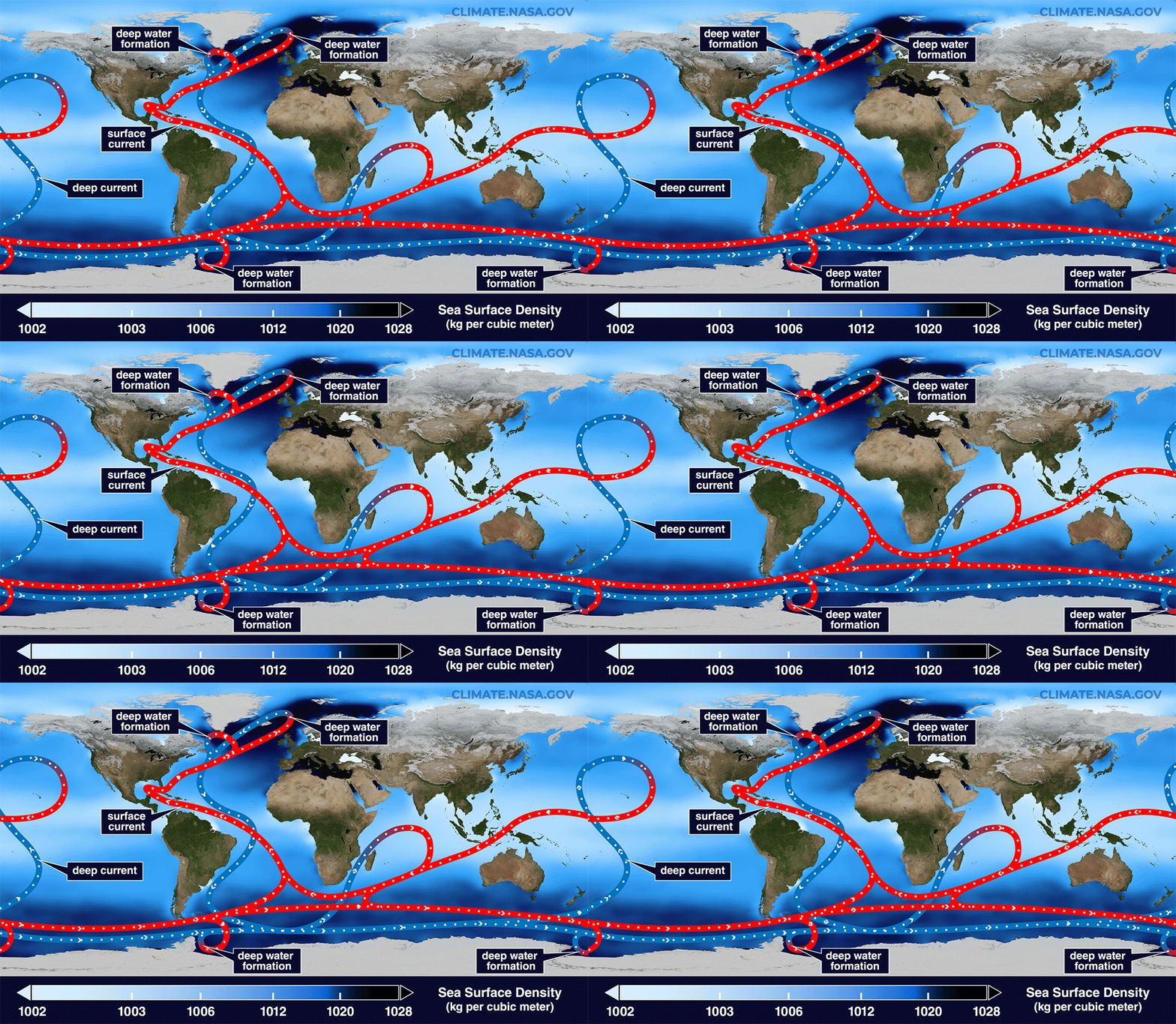
A simplified animation of the global AMOC "conveyor belt", with surface currents shown in red and deep sea ones in blue.
Yet this is only the beginning of the story. Other models have suggested that the current could collapse soon, stirring up disagreement among scientists, and some have suggested that the risks of the current weakening have been underestimated and demand urgent action.
One important piece of the puzzle is meltwater streaming into the Atlantic from Greenland and the Canadian Arctic. The AMOC works like a giant engine, taking warmer waters from the South (which are saltier and denser) northward. As it moves north, the salty water cools and becomes denser, and thus sinks. This conveyor belt of water also releases heat into the atmosphere before it returns south.
But the influx of lighter fresh water from melting glaciers is displacing some of this salty ocean water, causing it to stop sinking so deeply and slowing down the AMOC. Yet until now, this meltwater hadn't been factored into the models.
RELATED STORIES
"The scientific community is still very split on that topic," Laurie Menviel, a paleoclimatologist at the University of New South Wales (UNSW) in Sydney, told Live Science. "The first aspect is that getting precise estimates of additional meltwater and ice discharge is difficult. There was also a belief that the flux was too small to affect the system."
To investigate the possible oversight, Menviel and her colleague Gabriel Pontes, a research scientist at UNSW, created a new model that factored in the estimated meltwater outflows.
The pair's model suggests that the AMOC has been slowing at a rate of 0.46 sverdrup (a sverdrup is 1 million cubic meters of water per second) every decade since 1950, and that if humanity exceeds 3.6 degrees Fahrenheit (2 degrees Celsius) of global warming (in line with current projections), the circulation could be 33% weaker by 2040.
"This paper is important in that it confirms what many have suspected but what hasn't been shown explicitly before," Stefan Rahmstorf, an oceanographer who runs the Earth system analysis department at the Potsdam Institute for Climate Impact Research in Germany, told Live Science. "For the future, the results suggest that we must expect a faster AMOC decline than IPCC has predicted."

Ben Turner is a U.K. based writer and editor at Live Science. He covers physics and astronomy, tech and climate change. He graduated from University College London with a degree in particle physics before training as a journalist. When he's not writing, Ben enjoys reading literature, playing the guitar and embarrassing himself with chess.