













Hailin impact crater: China's newly discovered meteor pit born from a 'nuclear explosion level' event
The Hailin impact crater is a newly-discovered scar in the mountains of Northeast China left behind by a meteor impact, but geologists aren't sure exactly when this happened.

QUICK FACTS
Name: Hailin impact crater
Location: Heilongjiang Province, Northeast China
Coordinates: 45.30003016530084, 129.42274911658617
Why it's incredible: The crater has a unique oval shape and asymmetric sides.
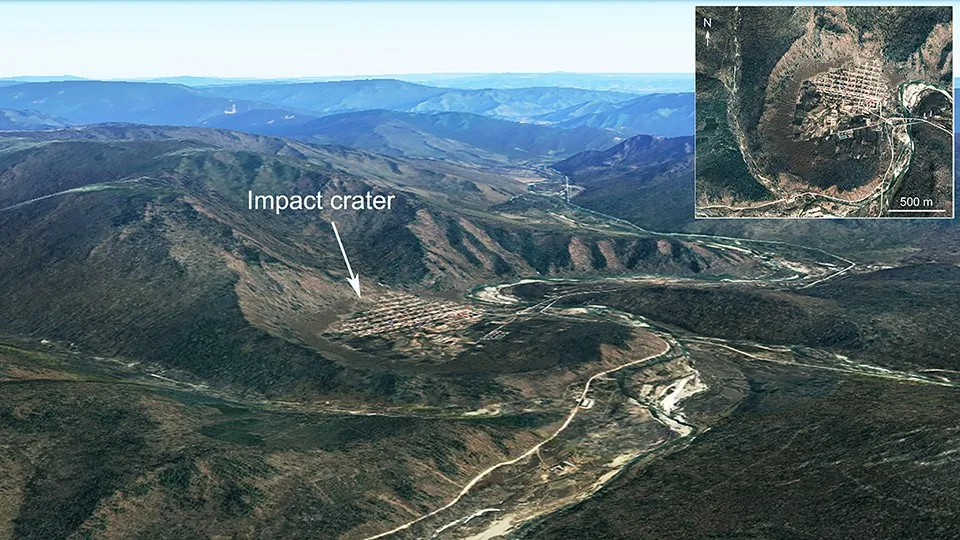
The Hailin impact crater is a giant gouge in a Chinese hillside that was left by a asteroid which smashed into Earth several million years ago. Researchers discovered the crater this year, noting its unique oval shape and uneven sides.
The meteor impact that blew out the crater was a "nuclear explosion level" event, Ming Chen, a staff scientist at the Center for High Pressure Science and Technology Advanced Research in China who was involved in the discovery, said in a statement. The pit measures up to 4,460 feet (1,360 meters) across and 600 feet (183 m) deep, but no one had detected it until recently because it is filled with sediment.
Related: The largest asteroid impact crater on Earth is lurking beneath Australia, new evidence suggests
It's unclear exactly when the meteor struck, but Chen and his colleagues say the event probably occurred sometime in the past 20 million years, after the land which the meteor hit rose to form a mountainous region known today as the Changbai Mountain Range.
The researchers published their findings Nov. 19, 2024 in the journal Matter and Radiation at Extremes.
The Hailin crater is the fourth confirmed impact crater in China and the first example in the world of an impact crater located on a mountain ridge, according to the statement. Scientists previously discovered the world's first known mountaintop impact crater, also in northeastern China, but there is a distinction between mountaintop and mountain ridge.
The Hailin crater's unusual oval shape results from the jagged terrain beneath rather than from a low angle of approach by the meteor, which is typically the reason why impact craters can be elliptical. The meteor landed smack bang on top of a ridge with sloping sides, resulting in a relatively small diameter as measured perpendicular to the ridge — about 3,770 feet (1,150 m) — and a longer diameter along the ridge line of 4,460 feet (1,360 m), according to the study.
Get the world’s most fascinating discoveries delivered straight to your inbox.
The perfectly oval crater sits 2,950 feet (900 m) above sea level. While it's missing a part of its eastern rim due to unspecified geological processes, the rest of its sides are perfectly intact.
MORE INCREDIBLE PLACES
The pit contains sediments and rock fragments, as well as evidence of an ancient lake that drained away when the eastern rim collapsed, according to the study. Chen and colleagues analyzed the rock fragments with a microscope, revealing deformations in the quartz grains that could only have been triggered by the shock of a huge impact.
"The discovery of the Hailin crater and other craters in China indicates that meteorite impacts at such scale could occur on Earth again in the future," Chen said in the statement.
Meanwhile, the researchers say they plan on drilling into the crater to explore its deep structure and evolutionary history.
Discover more incredible places, where we highlight the fantastic history and science behind some of the most dramatic landscapes on Earth.

Sascha is a U.K.-based staff writer at Live Science. She holds a bachelor’s degree in biology from the University of Southampton in England and a master’s degree in science communication from Imperial College London. Her work has appeared in The Guardian and the health website Zoe. Besides writing, she enjoys playing tennis, bread-making and browsing second-hand shops for hidden gems.