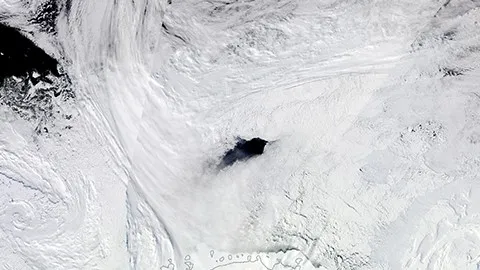
Scientists have finally discovered what's causing a Switzerland-size hole to repeatedly open up in Antarctica's sea ice.
Researchers first spotted the hole, called the Maud Rise polynya, in 1974 and 1976 in Antarctica's Weddell Sea, and since then it has reappeared fleetingly and sporadically — opening up in different sizes but in the same place, then sometimes not at all for years. This left scientists puzzled as to the exact conditions needed for the hole to form.
In 2016 and 2017, a huge 309,000 square mile (80,000 square kilometers) opened up for several weeks during both winters, enabling scientists to get a closer look at the phenomenon and finally solve the 50-year mystery. They reported their findings Wednesday (May 1) in the journal Science Advances.
"2017 was the first time that we've had such a large and long-lived polynya in the Weddell Sea since the 1970s," lead author Aditya Narayanan, a postdoctoral researcher at the University of Southampton in England, said in a statement.
Most of this sea ice grows during the weeks-long polar night on the floating ice shelf that wraps around the continent. Holes in this ice, called polynyas, form when strong winds from inland push the tiles apart.
Get the world’s most fascinating discoveries delivered straight to your inbox.
This cold wind also freezes more seawater inside the polynyas, adding extra chunks to the sheet of pack ice.
But in the open ocean and away from these coastal winds, where the Maud Rise polynya forms, holes in the sea ice are much less likely to develop. This, along with a startling reduction in the overall ice extent across the Southern Ocean, led scientists to wonder what specific conditions could be causing the Maud Rise polynya to form.
To investigate the mystery, the scientists pored over data from satellites, autonomous floats and tagged marine mammals, as well as previous observations made by other researchers. They found that in 2016 and 2017, the Weddell Sea's circular ocean current, called the Weddell Gyre, was stronger than in other years, making it easier for underwater currents to bring salt and heat nearer to the surface.
The Maud Rise polynya is located near the Maud Rise, an underwater mountain. In 2016 and 2017, due to the stronger current, salt hovered around this seamount while wind blew over the surface, which created a corkscrew effect that dragged the saltier water around the submerged mountain to the surface. This salt then lowered the freezing point of the surface water, enabling the Maud Rise polynya to form and persist.
The new finding is important for understanding Antarctica and its broader impacts on the global ocean, according to the researchers. Climate change is already making winds from the southernmost continent more powerful, likely creating more polynyas in the future. Meanwhile, 40% of the global ocean’s waters finds their origins in the Antarctic coastline, making it vital in regulating regional climates across the planet.
"The imprint of polynyas can remain in the water for multiple years after they've formed. They can change how water moves around and how currents carry heat towards the continent," study co-author Sarah Gille, a professor of climatology at the University of California San Diego, said in the statement. "The dense waters that form here can spread across the global ocean."
Ben Turner is a U.K. based writer and editor at Live Science. He covers physics and astronomy, tech and climate change. He graduated from University College London with a degree in particle physics before training as a journalist. When he's not writing, Ben enjoys reading literature, playing the guitar and embarrassing himself with chess.