













'Gravity waves' from Hurricane Helene seen rippling through the sky in new NASA images
Hurricane Helene sent gravity waves rippling through the atmosphere far above the southeastern United States, new NASA images reveal.

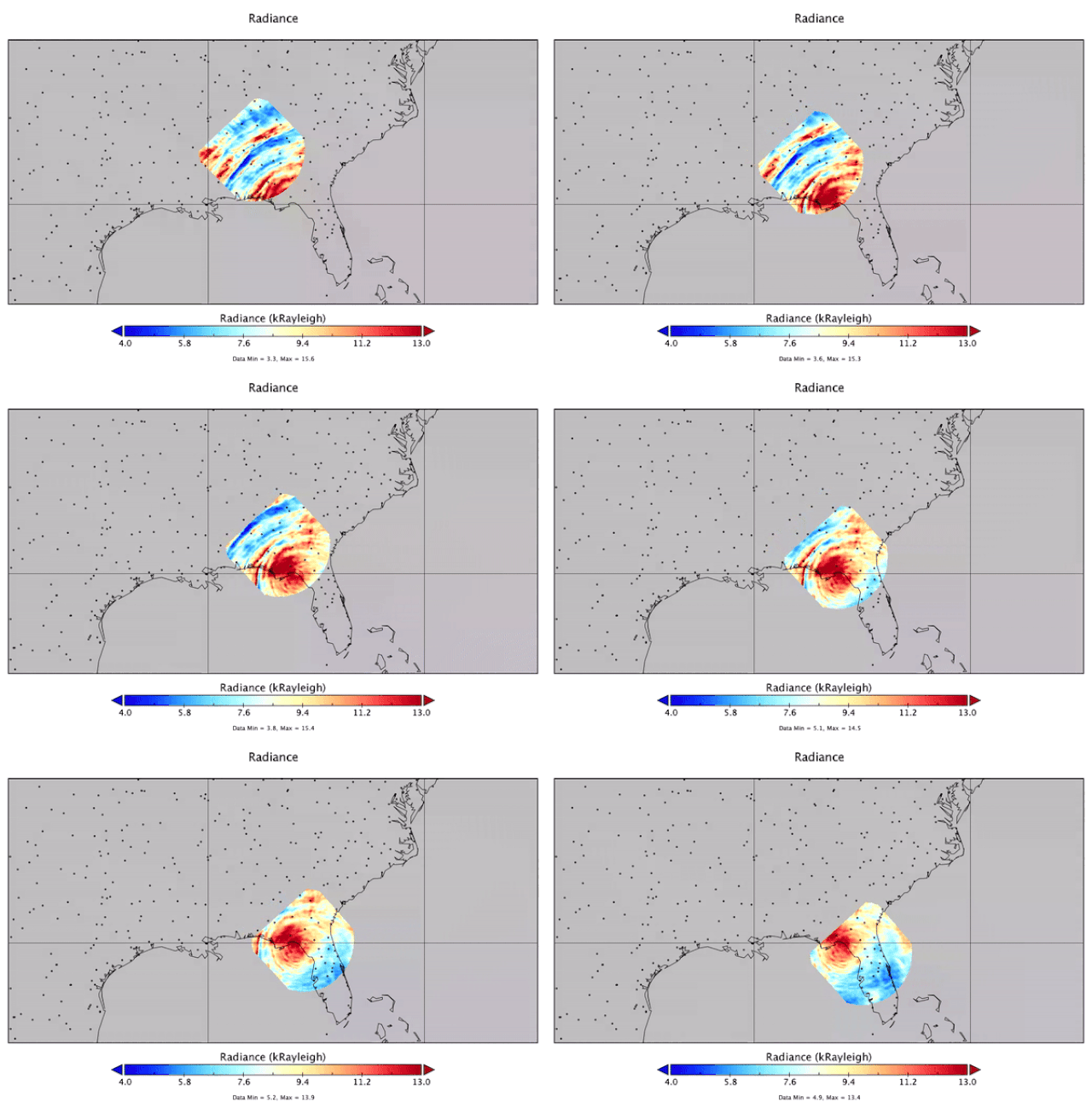
Atmospheric ripples from Hurricane Helene spread far north of Florida as the devastating storm made landfall, new NASA images show.
The agency's Atmospheric Waves Experiment (AWE) captured concentric bands of atmospheric gravity waves stretching across the Southeast as the hurricane progressed miles away.
"Like rings of water spreading from a drop in a pond, circular waves from Helene are seen billowing westward from Florida's northwest coast," AWE principal investigator Ludger Scherliess, a physicist at Utah State University, said in a statement.
Atmospheric gravity waves are vertical ripples that move through quiet areas of the atmosphere, dividing the air into peaks and troughs. According to NASA, these waves can be created by large thunderstorms, wind bursts, hurricanes, tornadoes and even tsunamis. (They are different from gravitational waves, which are ripples in the fabric of space-time that result from violent cosmic events, such as black hole collisions.)
Related: Hurricane season 2024: How long it lasts and what to expect
The AWE instrument is mounted on the International Space Station and detects these waves by measuring airglow — a faint light given off by gasses in the mesosphere, the third layer of Earth's atmosphere. The mesosphere ranges from 31 to 53 miles (50 to 85 kilometers) above Earth's surface. Most weather occurs in the first layer of Earth's atmosphere, the troposphere, though cloud tops can rise into the second layer, the stratosphere, in very strong storms. (These are called "overshooting cloud tops.")
AWE started observing in November 2023, and the Helene gravity-wave images are among the first AWE images that NASA has released publicly. One of the project's goals is to help scientists understand how weather on Earth's surface can affect space weather, the disturbances in the upper atmosphere caused by interactions with charged cosmic particles.
Get the world’s most fascinating discoveries delivered straight to your inbox.
Hurricane Helene was a Category 4 storm with winds up to 140 mph (225 km/h) when it made landfall near Perry, Florida. The storm subsequently moved inland, stalling over eastern Tennessee and western North Carolina, where it caused massive flooding. More than 230 people were killed, according to the Associated Press.

Stephanie Pappas is a contributing writer for Live Science, covering topics ranging from geoscience to archaeology to the human brain and behavior. She was previously a senior writer for Live Science but is now a freelancer based in Denver, Colorado, and regularly contributes to Scientific American and The Monitor, the monthly magazine of the American Psychological Association. Stephanie received a bachelor's degree in psychology from the University of South Carolina and a graduate certificate in science communication from the University of California, Santa Cruz.