













Over 60 million years ago, penguins abandoned flight for swimming. Here’s how.
A new genetic and fossil analysis of penguins reveals how they evolved.

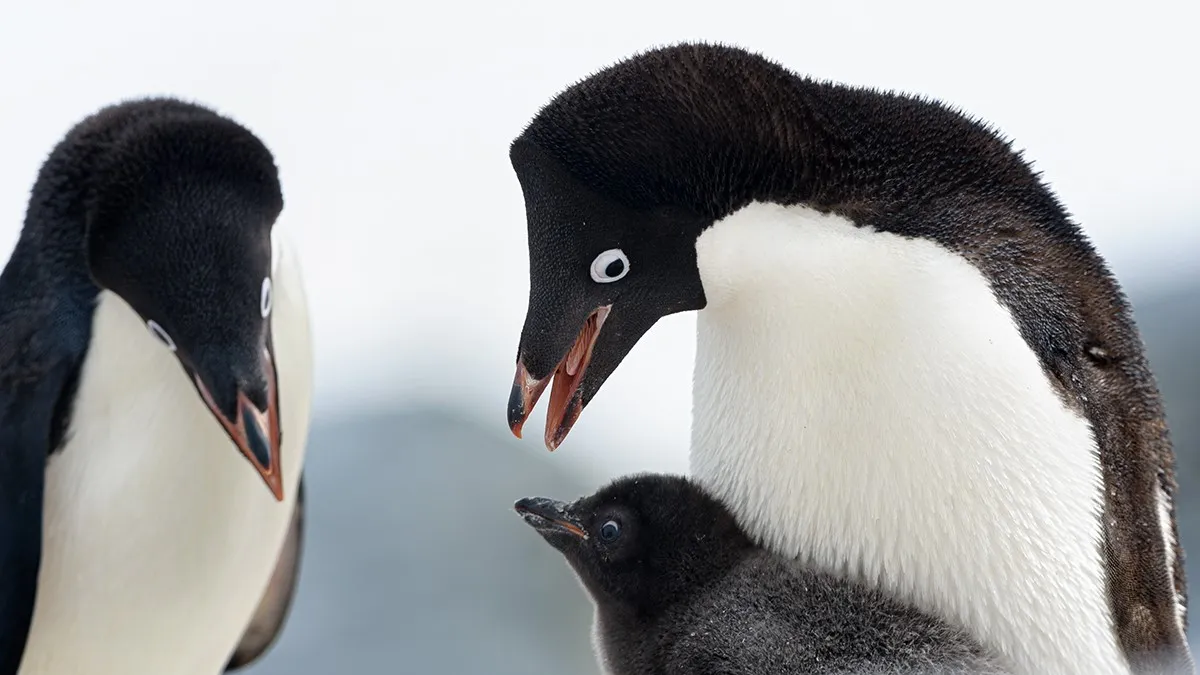
Penguins are perhaps best known for being flightless birds whose wings help them "fly" through frigid Antarctic waters. But penguins lost their ability to fly and instead became streamlined swimmers some 60 million years ago, long before the Antarctic ice sheet formed — and researchers have now revealed how that happened.
A new study of penguin fossils and the genomes of current and recently extinct penguins identified an array of genetic adaptations the birds made to live an aquatic lifestyle; from vision that is sensitive to underwater blue tones to genes related to blood oxygenation, and even to changes in bone density. Together, the findings suggest that penguins as a group adapted to survive some serious environmental changes that unfolded over millions of years.
From flight to flightless
The oldest penguin fossils date to 62 million years ago, said study co-author Daniel Ksepka, a paleontologist at the Bruce Museum in Greenwich, Connecticut. By that time, penguins were already flightless, though they looked very different from modern penguins. They had longer legs and beaks, and their wings were still more winglike than flipperlike, Ksepka told Live Science.
"These early ones are probably evolving from a puffin-like animal that could still fly through the air," Ksepka said. (This flying ancestor hasn't yet been discovered in the fossil record, so it's not known precisely when penguins lost their aerial abilities.)
Over time, evolution created a "motley crew of interesting penguin characters," Ksepka said, from penguins with long spear-like bills to penguins with red feathers to birds that stood a foot or two taller than today's largest penguin species, the emperor, which measures about 3 feet 7 inches (1.1 meters) tall.
In the study, researchers evaluated fossil evidence alongside the genomes of all still-living penguins, and partial genomes for those that went extinct within the past few hundred years. The findings suggest that penguins originated near what is today New Zealand sometime before 60 million years ago, dispersed to South America and Antarctica, and then returned to New Zealand. Most species alive today diverged from each other in the last 2 million years or so, Ksepka said. During that period, Earth has gone through cycles of glacial and interglacial periods in which the polar ice expanded and retreated. Advancing ice pushed penguins northward, probably cutting some populations off from one another and enabling them to take their own evolutionary paths for about 100,000 years . By the time the ice retreated, the separated penguins had evolved into different species.
"It doesn’t affect all species equally, but it’s almost like someone is turning a crank to make more penguin species," Ksepka said.
Get the world’s most fascinating discoveries delivered straight to your inbox.
Genetic adaptations
Despite all the changes they've been through, penguins have the slowest evolutionary rate of change of all birds, the researchers reported July 19 in the journal Nature Communications. This was surprising and remains unexplained, Ksepka said. Larger animals and animals that reproduce relatively slowly, as penguins do, tend to have slower evolutionary rates, he said. However, some birds that are bigger than penguins evolve more quickly than penguins do. Other types of birds that reproduce at a rate similar to that of penguins also evolve more quickly, so more work is needed to understand why penguins are so slow to evolve, Ksepka said
While penguin evolution may be comparatively slow, it's provided them with many adaptations for life in and near the sea. They share a suite of genes with other flightless birds that likely shortened their wings, and they also have unique genes that may have turned many of the muscles in the wings of penguin's ancestors into tendons, which stiffened penguin wings and made them more like flippers. The researchers also found mutations in genes associated with calcium storage, which may contribute to the dense bones that help penguins to dive.
Evolution has also wrought many other changes, such as genes associated with fat storage and temperature regulation. One interesting find was that penguins lost several genes early on in their evolution that were linked to digesting the exoskeletons of crustaceans. This suggests that early penguins had a diet centered around prey such as fish and squid, Ksepka said. But the expansion of the ice sheets created an Antarctic ecosystem that was rich in krill, which are small crustaceans. Luckily, the researchers found, penguins had one gene left — the CHIA gene — that enabled them to still digest crustaceans.
Related content
"If that last one had shut off, they may have had a hard time digesting [krill]," Ksepka said.
About 75% of all the penguin species that ever lived are extinct, and climate change may extinguish still more, Ksepka warned. This is especially true for species with a niche lifestyle, like emperor penguins (Aptenodytes forsteri) that breed entirely on sea ice. If sea ice melts, Ksepka said, emperor penguins may struggle to find breeding grounds. On the other end of the spectrum, tiny penguins that inhabit the rocky Galapagos Islands live so far from other land that they have nowhere to flee if their equatorial habitat gets too hot.
"We definitely think these animals are sensitive to environmental change, and in many cases they are already considered endangered," Ksepka said. "In other cases they could become much more vulnerable over the next few decades."
Originally published on Live Science.

Stephanie Pappas is a contributing writer for Live Science, covering topics ranging from geoscience to archaeology to the human brain and behavior. She was previously a senior writer for Live Science but is now a freelancer based in Denver, Colorado, and regularly contributes to Scientific American and The Monitor, the monthly magazine of the American Psychological Association. Stephanie received a bachelor's degree in psychology from the University of South Carolina and a graduate certificate in science communication from the University of California, Santa Cruz.