















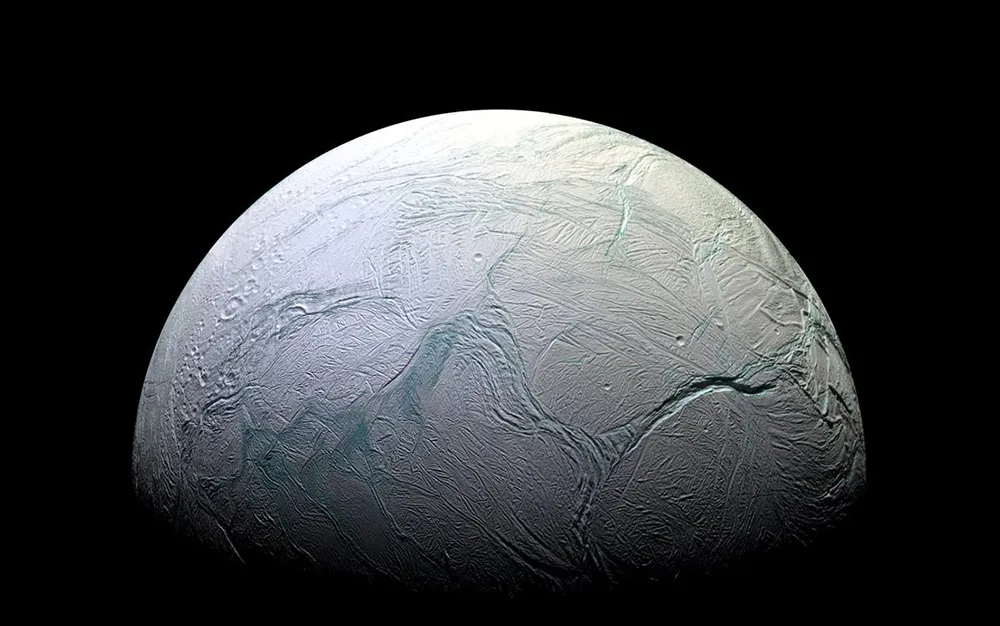
The methane wafting from Enceladus may be a sign that life teems in the Saturn moon's subsurface sea, a new study reports.
In 2005, NASA's Cassini Saturn orbiter discovered geysers blasting particles of water ice into space from "tiger stripe" fractures near Enceladus' south pole. That material, which forms a plume that feeds Saturn's E ring (the planet's second-outermost ring), is thought to come from a huge ocean of liquid water that sloshes beneath the moon's icy shell.
And there's more than just water ice in the plume. During numerous close flybys of the 313-mile-wide (504 kilometers) Enceladus, Cassini spotted many other compounds as well — for example, dihydrogen (H2) and a variety of carbon-containing organic compounds, including methane (CH4).
Photos: Enceladus, Saturn's cold, bright moon, in pictures
The dihydrogen and methane are particularly intriguing to astrobiologists. The H2 is likely being produced by the interaction of rock and hot water on Enceladus' seafloor, scientists have said, suggesting that the moon has deep-sea hydrothermal vents — the same type of environment that may have been life's cradle here on Earth.
In addition, H2 provides energy for some Earth microbes that produce methane from carbon dioxide, in a process called methanogenesis. Something similar could be happening on Enceladus, especially given that Cassini also spotted carbon dioxide, and a surprising bounty of methane, in the moon's plume.
"We wanted to know: Could Earth-like microbes that 'eat' the dihydrogen and produce methane explain the surprisingly large amount of methane detected by Cassini?" study co-lead author Régis Ferrière, an associate professor in the University of Arizona's Department of Ecology and Evolutionary Biology, said in a statement.
Get the world’s most fascinating discoveries delivered straight to your inbox.
So Ferrière and his colleagues built a series of mathematical models that assessed the probability that Enceladus' methane was generated biologically. These simulations were diverse; the team investigated whether the observed H2 production could sustain a population of Enceladus microbes, for example, and how that population would affect the rate at which H2 and methane escaped into the plume, among other things.
"In summary, not only could we evaluate whether Cassini's observations are compatible with an environment habitable for life, but we could also make quantitative predictions about observations to be expected, should methanogenesis actually occur at Enceladus' seafloor," Ferrière said.
That evaluation should cheer those of us who hope that something swims in the frigid, dark Enceladus sea. The team determined that abiotic (without the aid of life) hydrothermal-vent chemistry as we know it on Earth does not explain the methane concentrations observed by Cassini very well. Adding the contributions of methanogenic microbes, however, fills the gap nicely.
To be clear: The new study, which was published last month in the journal Nature Astronomy, does not argue that life exists on Enceladus. For instance, it's possible that the icy moon features some types of abiotic methane-producing reactions that aren't prevalent here Earth — perhaps the decay of primordial organic matter left over from the moon's birth, the researchers said. Indeed, that latter hypothesis would fit nicely if Enceladus formed from organic-rich material delivered by comets, as some scientists believe.
"It partly boils down to how probable we believe different hypotheses are to begin with," Ferrière said. "For example, if we deem the probability of life in Enceladus to be extremely low, then such alternative abiotic mechanisms become much more likely, even if they are very alien compared to what we know here on Earth."
That being said, "biological methanogenesis appears to be compatible with the data," Ferrièr added. "In other words, we can't discard the 'life hypothesis' as highly improbable. To reject the life hypothesis, we need more data from future missions."
Mike Wall is the author of "Out There" (Grand Central Publishing, 2018; illustrated by Karl Tate), a book about the search for alien life. Follow him on Twitter @michaeldwall. Follow us on Twitter @Spacedotcom or Facebook.
