













Scientists discover possible antidote for death caps, the world's deadliest mushroom
A potential antidote for death cap mushrooms has been discovered and tested in lab dish studies and in mice.
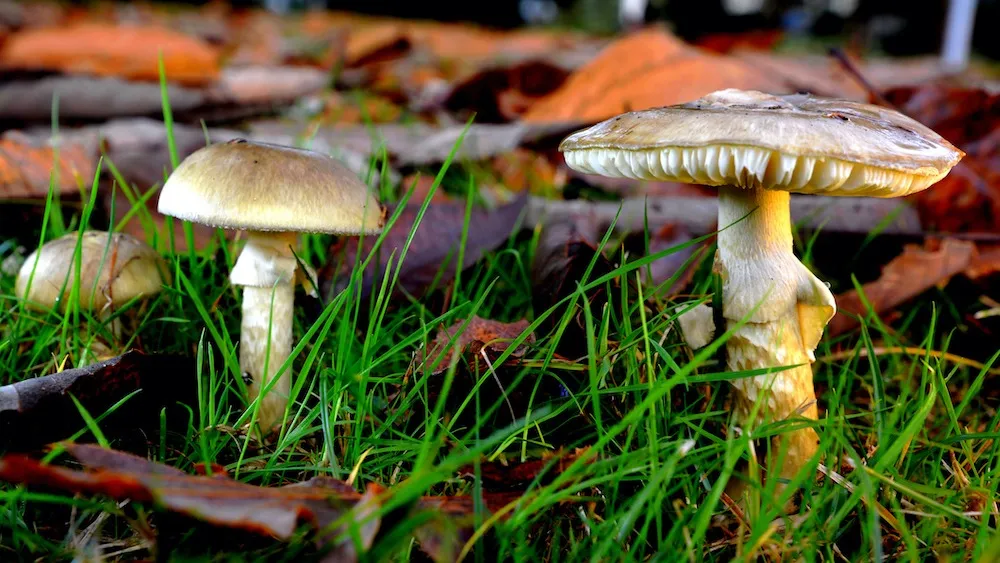
The most lethal mushroom in the world is the death cap mushroom, and now scientists have discovered a possible antidote from an unlikely source: a fluorescent dye.
Called indocyanine green (ICG), the dye is commonly used in medical imaging to help assess the functionality of the heart and liver, but an international team of scientists have found that it also stops alpha-amanitin (AMA), the death cap mushroom's primary toxin, dead in its tracks, according to a study published May 16 in the journal Nature Communications. So far, this antidote has worked in human cells, mini models of the liver and in mice, but it hasn't been tested in humans.
Greenish-yellow, umbrella-shaped death cap mushrooms (Amanita phalloides) are responsible for 90% of all poisonous mushroom fatalities in humans, according to the study. While death cap mushrooms are native to Europe, they can be found throughout North America, according to The Atlantic.
When ingested, the fungus' toxins can cause vomiting, bloody diarrhea or urine, liver and kidney damage, and even death. Treatments vary depending on when the toxins were ingested, but can include stomach pumping and surgical removal of parts of the mushroom, according to WebMD.
"So far, it remains unclear how exactly death cap mushrooms kill people," study co-author Qiao-Ping Wang, a professor and department head at the School of Pharmaceutical Sciences at Sun Yat-Sen University in Shenzhen, China, told Live Science in an email. "But it was thought to have the most toxic toxin, AMA, responsible for its cytotoxicity," or ability to kill cells.
Wang added that previous research showed that AMA "could block RNA transcription," which is when information from a strand of DNA is copied into a new molecule on its way to getting used to build new proteins. Thus, RNA transcription is "an essential biological process for cell function and survival."
Related: World's deadliest mushroom conquered California with a clone army, study reveals
To see which genes and proteins were key to death caps' toxicity, the scientists used CRISPR, a genome-editing technology, to create a pool of human cells, each with a different mutation. Next, they tested which of the mutant cells could survive being exposed to AMA. Through this process, they found that AMA likely requires an enzyme known as STT3B to exert its toxic effects.
Get the world’s most fascinating discoveries delivered straight to your inbox.
"We found the STT3B protein and its biological pathway is critical for toxin cytotoxicity," Wang said. STT3B is involved in the production of N-glycans, which are key for making sure proteins "fold" into their correct shapes; getting rid of the gene for STT3B in cells dramatically boosted cells' resistance to AMA and also hindered the toxin's ability to enter cells.
"We confirmed these findings in liver cells and liver organoids" — miniature models of the human liver — "since the liver is the target organ of mushroom toxins," Wang said.
To find a potential antidote for AMA, the team consulted the U.S. Food and Drug Administration's list of approximately 3,200 approved compounds, narrowing it down to 34 possible inhibitors of the STT3B protein.
Of the potential candidates, "we only found indocyanine green can effectively prevent cell death from amanitin toxin" in human liver cells and mice cells, Wang said. "The results demonstrated that ICG can prevent liver damage as well as kidney induced by [AMA]. Importantly, ICG could improve survival after [AMA] poisoning."
Wang said that the team is currently "investigating how STT3B may contribute to resistance against mushroom toxins, but the exact mechanism is still unknown."
RELATED STORIES
Preliminary data suggest that STT3B is required for AMA to enter cells, Wang said. "ICG has demonstrated significant potential in mitigating the toxic impact of [AMA] in liver cells and mice. However, further research is necessary to ascertain whether [ICG] possesses the same therapeutic benefits in human subjects."
"If successful, ICG could represent a groundbreaking, life-saving treatment for individuals suffering from mushroom poisoning," he said.
Wang added that the research team plans to eventually conduct human trials to assess ICG's efficacy in people who recently ingested death cap mushrooms. "These tests will yield more definitive results and provide a clearer picture of ICG's potential to revolutionize the treatment of mushroom poisoning," he said.
Jennifer Nalewicki is former Live Science staff writer and Salt Lake City-based journalist whose work has been featured in The New York Times, Smithsonian Magazine, Scientific American, Popular Mechanics and more. She covers several science topics from planet Earth to paleontology and archaeology to health and culture. Prior to freelancing, Jennifer held an Editor role at Time Inc. Jennifer has a bachelor's degree in Journalism from The University of Texas at Austin.