













Monet and Turner's atmospheric landscapes actually depicted air pollution, new study finds
Impressionist painters like Monet depicted their smog-filled surroundings in their artworks.
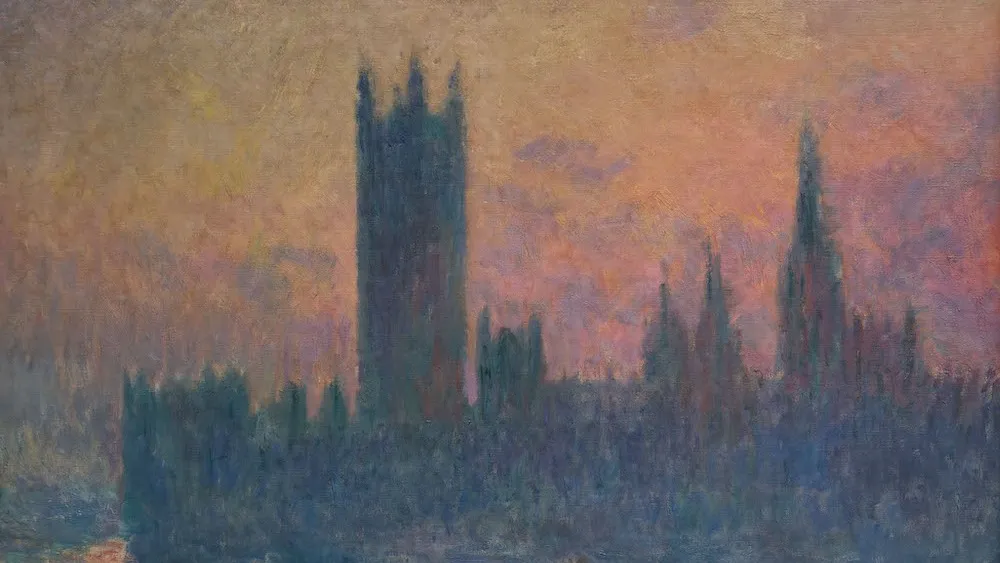
Impressionist artists like Claude Monet and Joseph Mallord William (J. M. W.) Turner are famous for their hazy, dreamlike paintings. However, a new study finds that what these European painters were really depicting in their works wasn't a figment of their imagination, but an environmental disaster: air pollution.
Scientists examined approximately 100 artworks by the two impressionist painters, who dominated the art scene between the mid-18th and early 20th centuries, during the Industrial Revolution. The team discovered that what some art enthusiasts had long believed was Monet and Turner's style of painting was actually them "capturing changes in the optical environment" that were associated with a decrease in air quality as coal-burning factories began dotting European cities and spewing pollutants into the air, according to the study, published Jan. 31 in the journal Proceedings of the National Academy of Sciences.
"It is often said that Turner was born in the age of sail and died in the age of steam and coal — his lifetime spans a time of unprecedented environmental change," first author Anna Lea Albright, an atmospheric scientist with the Laboratory of Dynamic Meteorology in France, told Live Science in an email. "During the first Industrial Revolution, these large increases in air pollution were concentrated in London, which was known as the 'Big Smoke' [where Turner was based]. Monet painted later, in the second Industrial Revolution in London and Paris."
Related: Hidden Van Gogh self-portrait discovered under 'peasant woman' painting
For the study, the scientists focused on local sulfur dioxide emission levels in London and Paris during this time period and the ways air pollution can interact with light, such as by reducing the contrast of objects viewed against a background and by increasing the intensity or "whiteness" of an image, according to the study.
They also determined that the artists' vision wasn't the cause of this trend toward hazier artworks. "Monet was not myopic; Turner did not have cataracts," a different group of researchers wrote in a 2016 study published in the journal Eye.
"Over Turner and Monet's careers, I noticed that the contours of their paintings became hazier, the palette appeared whiter and the style transformed from more figurative to more impressionistic," Albright said. "We knew Turner and Monet were painting during the Industrial Revolution with its unprecedented environmental changes. Their stylistic transformations accord with physical expectations of how air pollution influences light."
Get the world’s most fascinating discoveries delivered straight to your inbox.
Impressionist air pollution
Air pollution is caused when there's an increase in toxic microscopic particles in the atmosphere. The scientists likened air pollution in Paris and London during the Industrial Revolution to levels seen in modern megacities such as Beijing, New Delhi and Mexico City.
"Air pollution absorbs and scatters light, making objects at a distance look hazier," Albright explained. "By scattering background light of all wavelengths into the line of vision, the presence of air pollution gives images a whiter tint."
Those hazy, polluted scenes were then translated into some of Monet's and Turner's most renowned paintings, including Monet's "The Houses of Parliament, Sunset" (1903) and Turner's "Rain, Steam, and Speed - The Great Western Railway" (1844).
RELATED STORIES
"Impressionism is often contrasted with realism, but our results highlight that Turner and Monet's impressionistic works also capture a certain reality," study co-author Peter Huybers, a professor of Earth and planetary sciences at Harvard University, told Live Science in an email. "Specifically, Turner and Monet seem to have realistically shown how sunlight filters through pollution and clouds.
"The idea that Impressionism contains certain elements of polluted realism highlights how connected we are to our environment," he added. "Our surroundings influence what we see, how we feel [and] what we focus on. Maybe a modern Turner or Monet would help us see other novel phenomena in our environment, like climate change."
Jennifer Nalewicki is former Live Science staff writer and Salt Lake City-based journalist whose work has been featured in The New York Times, Smithsonian Magazine, Scientific American, Popular Mechanics and more. She covers several science topics from planet Earth to paleontology and archaeology to health and culture. Prior to freelancing, Jennifer held an Editor role at Time Inc. Jennifer has a bachelor's degree in Journalism from The University of Texas at Austin.