Get the world’s most fascinating discoveries delivered straight to your inbox.
You are now subscribed
Your newsletter sign-up was successful
Want to add more newsletters?
Join the club
Get full access to premium articles, exclusive features and a growing list of member rewards.
An account already exists for this email address, please log in.
Gold tongues found in 2,000-year-old mummies in Egypt
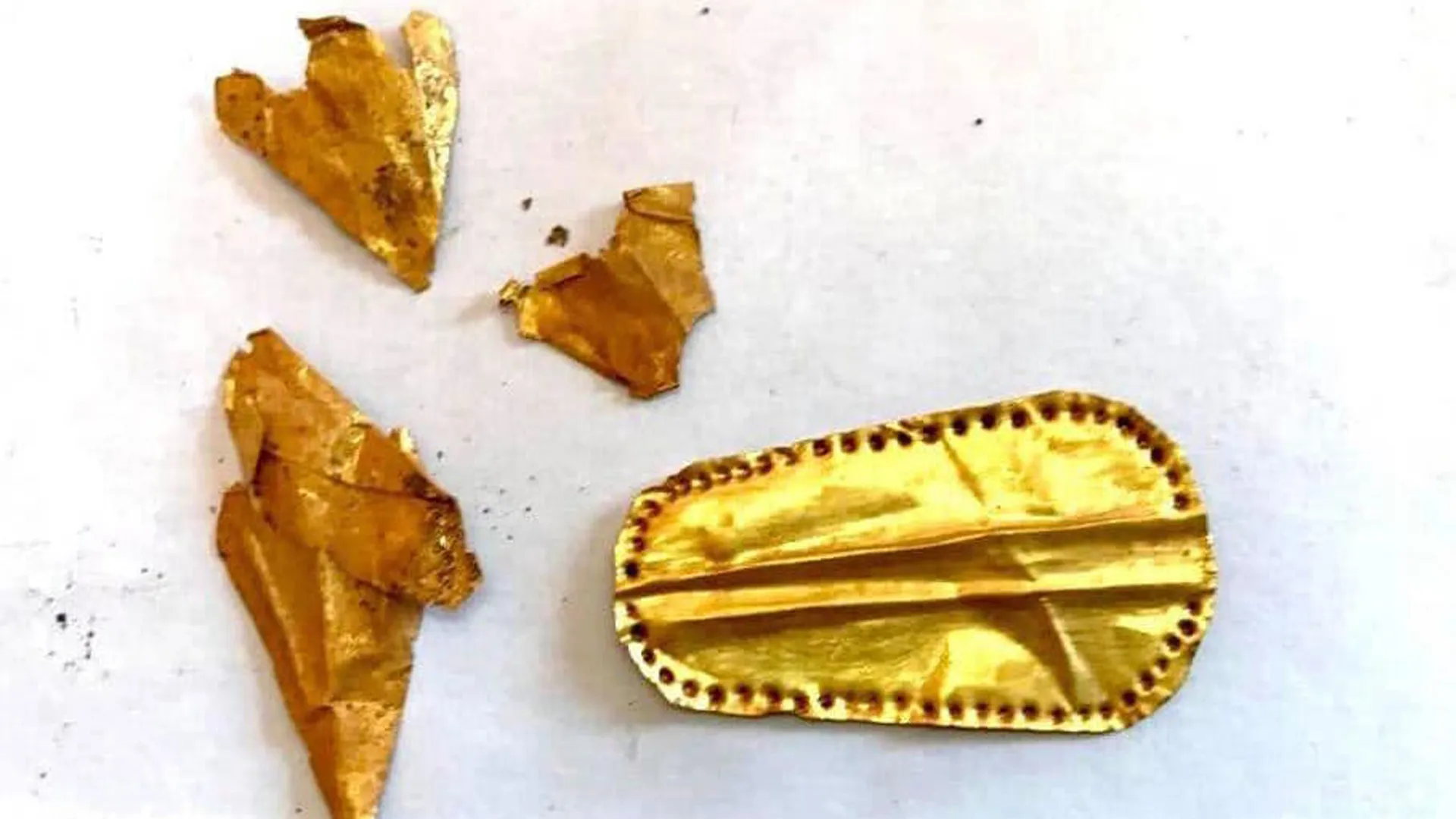
Archaeologists in Egypt have discovered several ancient mummies with gold tongues, which were thought to help transform the deceased into divine beings.
Archaeologists in Egypt have uncovered the remains of several mummies with tongues made of gold in an ancient cemetery near Quesna, a city located about 35 miles (56 kilometers) north of Cairo, according to Egypt's Ministry of Tourism and Antiquities.
Some of the mummies were buried in wooden coffins with grave goods that included necklaces, pottery, and gold artifacts in the shape of lotus flowers and beetles known as scarabs, the ministry reported in a statement posted to Facebook on Nov. 24.
Mummies with gold tongues were popular during the Greco-Roman period, Salima Ikram, a distinguished professor of Egyptology at The American University in Cairo, told Live Science in an email. The Greco-Roman period lasted from roughly 332 B.C., when Alexander the Great took over Egypt, to A.D. 395, when the Roman Empire split in two for the final time. The ministry statement noted that the mummies likely date to different times within the Greco-Roman period.
The gold tongues are a "hallmark of the later Graeco-Roman period funerary preparations, when golden tongues, and sometimes even 'eyes,' were placed on embalmed bodies," said Ikram, who was not involved in the new discovery.
Image 1 of 2
The remains of one of the mummies found in the necropolis near Quesna, Egypt.
(Image credit: Courtesy of the Egyptian Ministry of Tourism and Antiquities)
The mummies with gold tongues date back around 2,000 years and were unearthed in a necropolis near Quesna, Egypt.
(Image credit: Courtesy of the Egyptian Ministry of Tourism and Antiquities)
Gold tongues and gold eyes are "manifestations of the transformation of the deceased into divine beings," Ikram said, noting that the ancient Egyptians believed that the flesh of the gods was made of gold.
During the Greco-Roman period, ancient Egyptians also believed that gold tongues and gold eyes would "allow the deceased to speak, see, and taste in the afterlife," Ikram said.
Sign up for the Live Science daily newsletter now
Get the world’s most fascinating discoveries delivered straight to your inbox.
Mummies with gold tongues have been found elsewhere in Egypt, including at Taposiris Magna, an archaeological site on the Mediterranean coast, and Oxyrhynchus, an archaeological site located about 108 miles (174 km) south of Cairo. "It is delightful to have more golden tongued mummies," Ikram said.
Excavation and analysis of the remains at Quesna are ongoing. It is not yet clear how many mummies with gold tongues were found and whether the deceased's identities are known.
Owen Jarus is a regular contributor to Live Science who writes about archaeology and humans' past. He has also written for The Independent (UK), The Canadian Press (CP) and The Associated Press (AP), among others. Owen has a bachelor of arts degree from the University of Toronto and a journalism degree from Ryerson University.