Scientists have generated an exotic form of matter in the unique microgravity environment aboard the International Space Station and are using it to explore the quantum world, a new study finds.
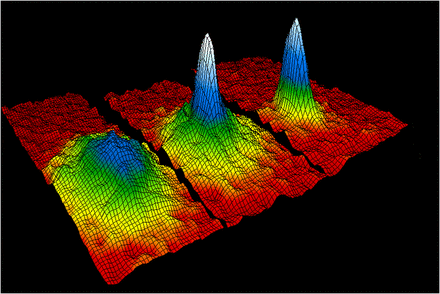
There are four states of matter common in everyday life — gases, liquids, solids, and plasmas. However, there is also a fifth state of matter — Bose-Einstein condensates (BECs), which scientists first created in the lab 25 years ago. When a group of atoms is cooled to near absolute zero, the atoms begin to clump together, behaving as if they were one big "super-atom."
Bose-Einstein condensates straddle the boundary between the everyday world, governed by classical physics, and the microscopic world, which follows the rules of quantum mechanics. In the world of quantum mechanics, a particle can behave as if it were spinning in two opposite directions at the same time, or as if it existed in two or more locations simultaneously. Because they follow some of these quantum behaviors, Bose-Einstein condensates may offer scientists key clues into the workings of quantum mechanics, potentially helping to solve mysteries such as how to create a "theory of everything" that could explain the workings of the cosmos from the smallest to largest scales.
Related: Ultracold atoms provide Insight into early universe
Scientists now routinely create Bose-Einstein condensates in hundreds of labs across the world. However, one limitation that stands in the way of this research is gravity. These "super-atoms" are extraordinarily fragile and the setups used to create them are incredibly delicate, so the pull of gravity felt on Earth can disrupt both, making it challenging to learn much about them.
As such, researchers developed the Cold Atom Lab, which can generate Bose-Einstein condensates in the microgravity found in orbit aboard the space station. Launched in 2018, the Cold Atom Lab is small and requires only a relatively small amount of energy so it meets the specific constraints aboard the space station. While the equipment originally needed to create Bose-Einstein condensates on Earth can take up an entire lab, the Cold Atom Lab takes up only about 14 cubic feet (0.4 cubic meters) and altogether requires an average of 510 watts of power.
Using the Cold Atom Lab, researchers in a new study found that they could increase the amount of time they can analyze these condensates after the traps confining the material is switched off to more than one second. In comparison, on Earth, scientists would only have hundredths of a single second for the same task.
In addition, in microgravity, the scientists found that they needed weaker forces to trap the condensates. This, in turn, means that they could create the condensates at lower temperatures. And, at these temperatures, exotic quantum effects would become increasingly pronounced.
So far with this study, the researchers have created Bose-Einstein condensates using rubidium atoms. Eventually, they also aim to add potassium atoms to investigate what happens when two condensates mix, the study's senior author Robert Thompson, a physicist at the California Institute of Technology in Pasadena, told Space.com. Additionally, scientists now seek to use the Cold Atom Lab to create spherical Bose-Einstein condensates, which can only be created in space, Thompson added.
"In the past, our major insights into the inner workings of nature have come from particle accelerators and astronomical observatories; in the future, I believe precision measurements using cold atoms will play an increasingly important role," Thompson said.
The scientists detailed their findings in the June 11 issue of the journal Nature.
Follow Charles Q. Choi on Twitter @cqchoi. Follow us on Twitter @Spacedotcom and on Facebook.