















Why extraterrestrial intelligence is more likely to be artificial than biological

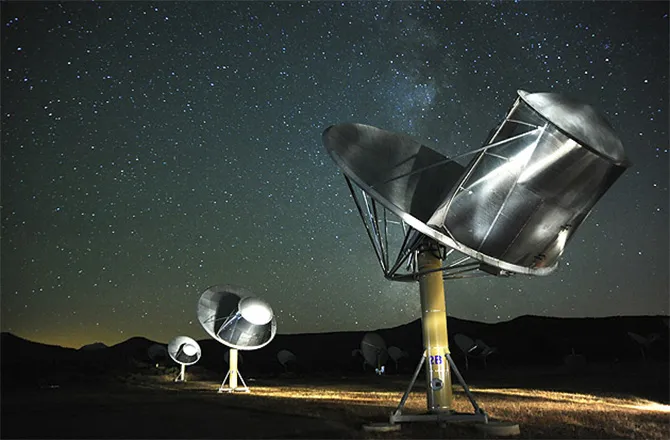
Is there intelligent life elsewhere in the universe? It’s a question that has been debated for centuries, if not millennia. But it is only recently that we’ve had an actual chance of finding out, with initiatives such as (Search for Extraterrestrial Intelligence) using radio telescopes to actively listen for radio messages from alien civilizations.
What should we expect to detect if these searches succeed? My suspicion is that it is very unlikely to be little green men – something I speculated about at a talk at a Breakthrough Listen (a SETI project) conference.
Suppose there are other planets where life began and that it followed something like a Darwinian evolution (which needn't be the case). Even then, it’s highly unlikely that the progression of intelligence and technology would happen at exactly the same pace as on Earth. If it lagged significantly behind, then that planet would plainly reveal no evidence of extraterrestrial life to our radio telescopes. But around a star older than the sun, life could have had a head start of a billion years or more.
Related: 9 strange, scientific excuses for why humans haven't found aliens yet
Human technological civilization only dates back millennia (at most) – and it may be only one or two more centuries before humans, made up of organic materials such as carbon, are overtaken or transcended by inorganic intelligence, such as AI. Computer processing power is already increasing exponentially, meaning AI in the future may be able to use vastly more data than it does today. It seems to follow that it could then get exponentially smarter, surpassing human general intelligence.
Perhaps a starting point would be to enhance ourselves with genetic modification in combination with technology – creating cyborgs with partly organic and partly inorganic parts. This could be a transition to fully artificial intelligence.
AI may even be able to evolve, creating better and better versions of itself on a faster-than-Darwinian timescale for billions of years. Organic human-level intelligence would then be just a brief interlude in our “human history” before the machines take over. So if alien intelligence had evolved similarly, we’d be most unlikely to “catch” it in the brief sliver of time when it was still embodied in biological form. If we were to detect extraterrestrial life, it would be far more likely to be electronic than flesh and blood – and it may not even reside on planets.
Get the world’s most fascinating discoveries delivered straight to your inbox.
We must therefore reinterpret the Drake equation, which was established in 1960 to estimate the number of civilizations in the Milky Way with which we could potentially communicate. The equation includes various assumptions, such as how many planets there are, but also how long a civilization is able to release signals into space, estimated to be between 1,000 and 100 million years.
But the lifetime of an organic civilization may be millennia at most, while its electronic diaspora could continue for billions of years. If we include this in the equation, it seems there may be more civilizations out there than we thought, but that the majority of them would be artificial.
We may even want to rethink the term "alien civilizations." A "civilization" connotes a society of individuals. In contrast, extraterrestrials might be a single integrated intelligence.
Decoding messages
If SETI succeeded, it would therefore be unlikely to record decodable messages. Instead, it may spot a byproduct (or even a malfunction) of some super complex machine far beyond our comprehension.
SETI focuses on the radio part of the electromagnetic spectrum. But as we have no idea of what’s out there, we should clearly explore all wavebands, including the optical and X-ray parts. Rather than just listening for radio transmission, we should also be alert to other evidence of non-natural phenomena or activity. These include artificial structures built around stars to absorb their energy (Dyson spheres) or artificially created molecules, such as chlorofluorocarbons – nontoxic, nonflammable chemicals containing carbon, chlorine, and fluorine – in planet atmospheres. These chemicals are greenhouse gasses that can’t be created by natural processes, meaning they could be a sign of "terraforming" (changing a planet to make it more habitable) or industrial pollution.

Advanced extraterrestrials could build Dyson spheres.
I’d argue it would even be worth looking for traces of aliens in our own solar system. While we can probably rule out visits by human-like species, there are other possibilities. An extraterrestrial civilization that had mastered nanotechnology may have transferred its intelligence to tiny machines, for example. It could then invade other worlds, or even asteroid belts, with swarms of microscopic probes.
And even if we did receive a decodable radio message, how could we know what the intention of the super-intelligent sender would be? We have absolutely zero idea – think of the variety of bizarre motives (ideological, financial and religious) that have driven human endeavors in the past. They may be peaceful and inquisitive. Even less obtrusively, they may realize that it’s easier to think at low temperatures – getting far away from any star, or even hibernating for billions of years until it’s cooler. But they could be expansionist – and this seems the expectation of most who’ve thought about the future trajectory of civilisations.
The future of intelligence
As the universe evolves, intelligent species may get unfathomably clever. Just take our own future. Eventually, stellar births and deaths in our galaxy will proceed gradually more slowly, until it gets jolted as the Milky Way crashes with the Andromeda galaxy in about a billion years. The debris of our galaxy, Andromeda and their smaller companions within our local group of galaxies will thereafter clump together into one amorphous galaxy, while distant ones move away from us and eventually disappear.
But our remnant will continue for far longer – time enough, perhaps, for a civilization to emerge that could be in possession of huge amounts of energy, even harnessing the entire mass of a galaxy.
This may be the culmination of the long-term trend for living systems to gain complexity. At this stage, all the atoms that were once in stars and gas could be transformed into a giant organism of galactic scale. Some science fiction authors envisage stellar-scale engineering to create black holes and wormholes – bridges connecting different points in spacetime, in theory providing shortcuts for space travelers. These concepts are far beyond any technological capability that we can envisage, but not in violation of basic physical laws.
Are we artificial?
Post-human intelligences may also be able to build computers with enormous processing power. Humans are already able to model some quite complex phenomenon, such as the climate. More intelligent civilizations, however, may be able to simulate living things – with actual consciousnesses – or even entire worlds or universes.

Are we just characters in an alien computer game?
How do we know that we aren’t living in such a simulation created by technologically superior aliens? Maybe we are no more than a bit of entertainment for some supreme being who is running such a model? Indeed, if life is destined to be able to create technologically advanced civilizations that can make computer programs, there may be more simulated universes our there than real ones out there – making it conceivable that we are in one of them.
This conjecture may sound outlandish, but it is all based on our current understanding of physics and cosmology. We should, however, surely be open-minded about the possibility that there’s much we don’t understand. Perhaps the laws we see and the constants we measure are only "local" and differ in other parts of the universe? That would lead to even more jaw-dropping possibilities.
Ultimately, physical reality could encompass complexities that neither our intellect nor our senses can grasp. Some electronic "brains" may simply have a quite different perception of reality. Nor can we predict or understand their motives. That’s why we can’t assess whether the current radio silence that SETI are experiencing signifies the absence of advanced alien civilizations, or simply their preference.
*This article is partly adapted from a speech given by the author at a Breakthrough Listen conference in 2018
This article is republished from The Conversation under a Creative Commons license. Read the original article.
Follow all of the Expert Voices issues and debates — and become part of the discussion — on Facebook and Twitter. The views expressed are those of the author and do not necessarily reflect the views of the publisher.
This article was originally published at The Conversation.

Lord Martin Rees is Emeritus Professor of Cosmology and Astrophysics at the University of Cambridge. He holds the honorary title of Astronomer Royal. Lord Rees is co-founder of the Centre for the Study of the Existential Risk, an early stage initiative which brings together a scientist, philosopher and software entrepreneur.