













Asteroid That's Nearly the Height of the World's Tallest Building Is Flying by Earth Soon
This monster asteroid is cruising by Earth in September.

Editor's Note: This story was updated on Tuesday, Sept. 3 at 11:45 a.m. EDT
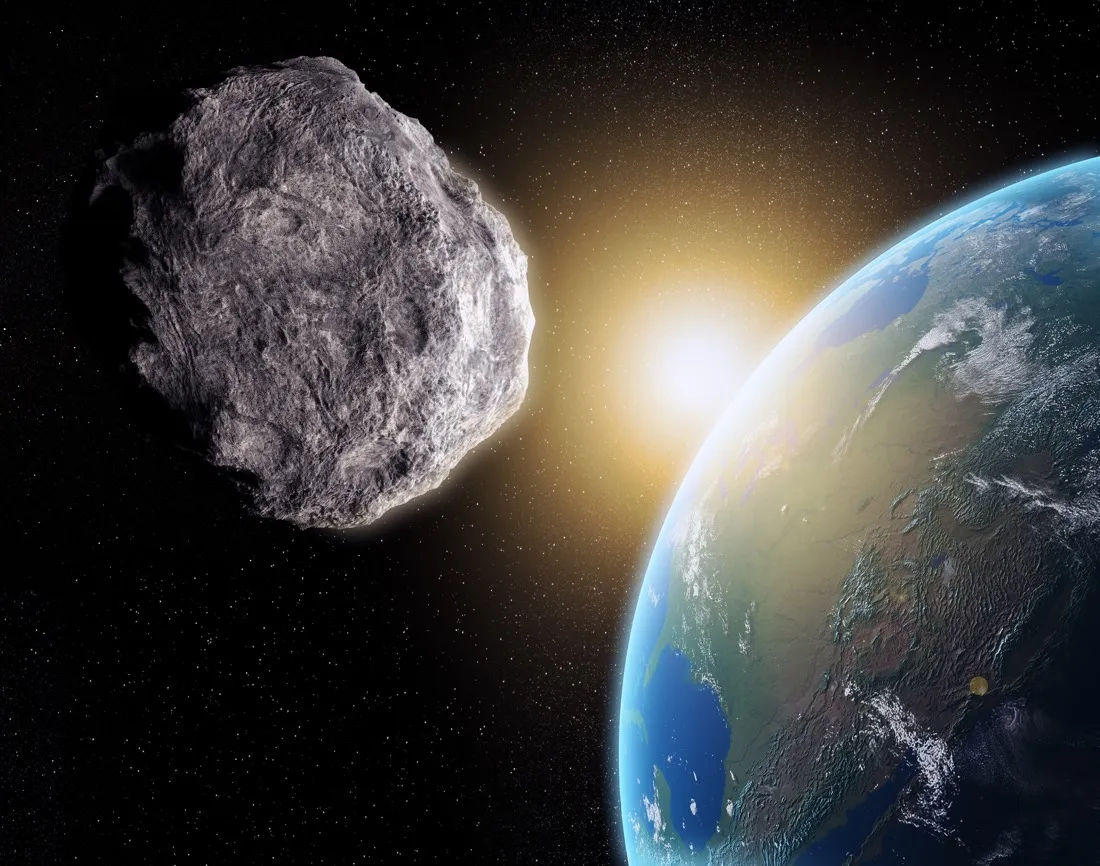
A monster of an asteroid that nearly rivals the height of the Burj Khalifa — the world's tallest building, located in Dubai — is cruising by Earth in less than a month, according to NASA.
The asteroid 2000 QW7 is incredibly bulky, measuring anywhere between 951 and 2,132 feet (290 and 650 meters) in diameter, and just a tad shorter than the 2,716-foot-tall (828 m) Burj Khalifa.
This asteroid is so immense, it's nearly twice the height of the 1,250-foot-tall (381 m) Empire State building. It's expected to whiz by our blue planet on Sept. 14, according to the Center for Near Earth Object Studies (CNEOS), a part of the Jet Propulsion Laboratory in Pasadena, California.
Related: Doomsday: 9 Real Ways Earth Could End
However, asteroid 2000 QW7 isn't exactly in a position to drop in for tea. First off, it will be going incredibly fast — 14,361 mph (23,100 km/h) — as it zooms by Earth, CNEOS reported. Second, even though it's considered a near-Earth object, it will still be quite far away. Asteroids and other space materials are considered near-Earth objects if they pass within 1.3 astronomical units of our planet (an astronomical unit is the distance from Earth to the sun, or 92.9 million miles (149.6 million kilometers)).
As CNEOS notes, 2000 QW7 will pass within 0.03564 astronomical units of Earth, which is equivalent to about 3.3 million miles (5.3 million km). Put another way, that's 13.87 times the distance between Earth and the moon.
Get the world’s most fascinating discoveries delivered straight to your inbox.
Just like Earth, asteroid 2000 QW7 orbits the sun. However, it only sporadically crosses paths with Earth. The last time it approached our planet was Sept. 1, 2000. After Sept. 14, the next time it's expected to pass by is Oct. 19, 2038, according to the Jet Propulsion Laboratory.
Editor's Note: This story was corrected to note that the Burj Khalifa is in Dubai, not Abu Dhabi.
Originally published on Live Science.

Laura is the managing editor at Live Science. She also runs the archaeology section and the Life's Little Mysteries series. Her work has appeared in The New York Times, Scholastic, Popular Science and Spectrum, a site on autism research. She has won multiple awards from the Society of Professional Journalists and the Washington Newspaper Publishers Association for her reporting at a weekly newspaper near Seattle. Laura holds a bachelor's degree in English literature and psychology from Washington University in St. Louis and a master's degree in science writing from NYU.