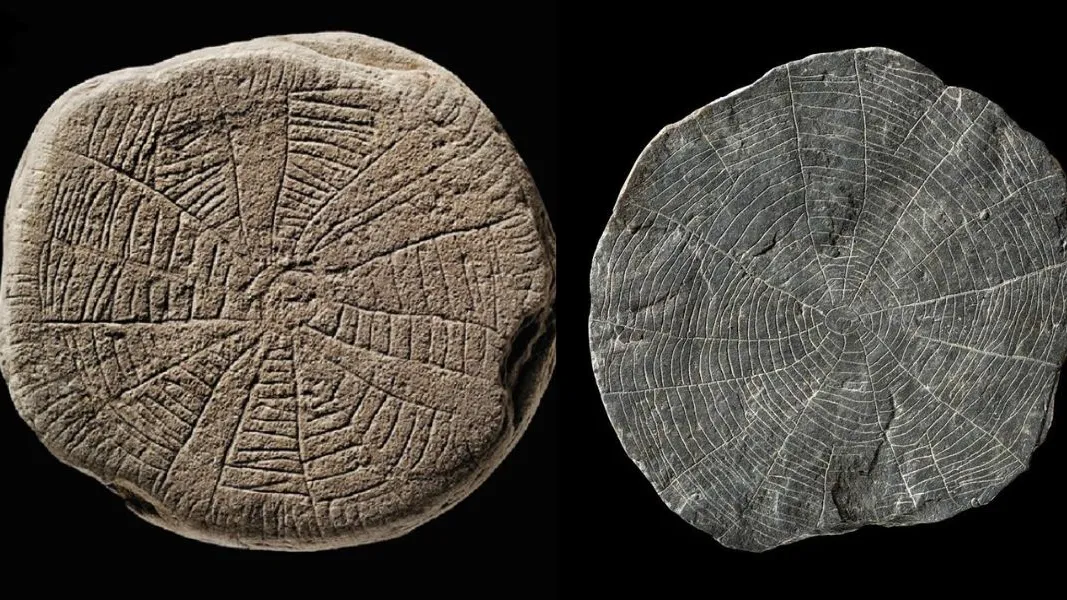
A volcanic eruption in 2910 B.C. may be the reason Neolithic people on a small island in the Baltic Sea buried hundreds of stones decorated with plant and sun imagery, archaeologists suggest in a new study.
"We have known for a long time that the sun was the focal point for the early agricultural cultures we know of in Northern Europe," Rune Iversen, an archaeologist at the University of Copenhagen, said in a statement. These stones "were probably sacrificed to ensure sun and growth."
In a study published Thursday (Jan. 16) in the journal Antiquity, Iversen and colleagues detailed the discovery of 614 stone plaques and plaque fragments on the Danish island of Bornholm, located south of Sweden in the Baltic Sea. The objects were found scattered throughout a palisade ditch. Based on the pottery style and the radiocarbon dates from charcoal found nearby, the researchers concluded that the decorated stones were deliberately placed there around 2900 B.C.
The vast majority of the stone plaques were made from black shale — a dark, flaky sedimentary rock found on the island — while others were made from quartz and flint. Most of the plaques were also decorated with incised designs, including sun and plant motifs.
Although a handful of these "sun stones" have been found on Bornholm previously, the large number of them found in one place spurred the researchers to seek a potential reason for the unique deposit.
Neolithic people appear to have buried the stones at a critical juncture, as the researchers discovered that the area was transformed into a more solid, fortified site just after the stones were deposited. Perhaps a natural disaster or climatic event that caused crops to fail triggered the stone "sacrifice," the researchers suggested in their study.
Sign up for the Live Science daily newsletter now
Get the world’s most fascinating discoveries delivered straight to your inbox.
Based on extensive evidence of prehistoric climate events, the researchers made a connection between the burial of the stones and a volcanic eruption in 2910 B.C. that almost certainly negatively affected weather and harvests across the Northern Hemisphere.
"These depositions could have been made during a time of stress with the purpose of bringing back the sun and re-establishing agricultural production," the researchers wrote in their study. "They could also have been made when the climate crisis was over, as an act of celebration for the return of the sun."
After the stone deposit, a new kind of culture began on Bornholm, the researchers explained in the study. People stopped building massive tombs, began creating more fortified settlements, and formed new social networks with people in Scandinavia. But the importance of the sun may not have diminished, as Neolithic societies across Europe relied on the sun for their harvest.
"It is quite simply an incredible discovery, which demonstrates that depositions honouring the sun is an ancient phenomenon, which we encounter again in South Scandinavia during the climate disaster caused by a volcanic eruption in the year 536 AD," study co-author Lasse Vilien Sørensen, an archaeologist at the National Museum of Denmark, said in the statement.
Kristina Killgrove is a staff writer at Live Science with a focus on archaeology and paleoanthropology news. Her articles have also appeared in venues such as Forbes, Smithsonian, and Mental Floss. Kristina holds a Ph.D. in biological anthropology and an M.A. in classical archaeology from the University of North Carolina, as well as a B.A. in Latin from the University of Virginia, and she was formerly a university professor and researcher. She has received awards from the Society for American Archaeology and the American Anthropological Association for her science writing.