















Doban-kun: A 'cute' human-shaped counting tool from prehistoric Japan
This anthropomorphic clay tablet was likely used in an ancient ritual by the Jōmon culture in Japan.

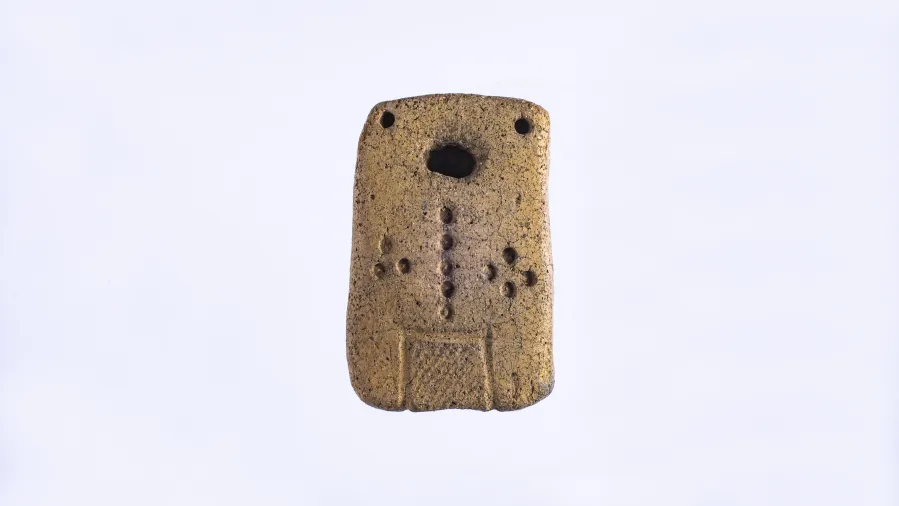
Name: Doban-kun
What it is: A clay tablet
Where it is from: Northern Honshu, Japan
When it was made: Around 1500 B.C.
Related: Dancing dwarf: A 2,300-year-old ancient Egyptian statue of a godlike man with a muscular 6-pack
What it tells us about the past:
This small, clay tablet was likely a tool used to perform rituals at two prehistoric stone rings in northern Japan over three millennia ago. The holes were used for counting and were arranged in the shape of a person.
Get the world’s most fascinating discoveries delivered straight to your inbox.
Doban-kun, which means "flat clay man" in Japanese, is 2.3 inches (5.8 centimeters) tall and 1.5 inches (3.7 cm) wide and weighs about 1.7 ounces (48.4 grams). It was found near the Ōyu Stone Circles, which were built by the Jōmon culture.
The Jōmon period spanned roughly 14000 to 300 B.C. Although there was no large-scale agriculture in this period, the Jōmon culture was largely sedentary and very complex, creating pottery, jewelry, statues and tools from a variety of natural materials, such as stones, bones and antlers.
According to the Ōyu Stone Circle Center, the site was created from dozens of river rocks around 2000 B.C., in the late Jōmon period. The two larger circles were likely used in rituals that helped strengthen social ties among the surrounding settlements, while the smaller circles were made to mark graves. The sundial-like arrangement of the stones suggests that the Jōmon people understood the movement of the sun.
MORE ASTONISHING ARTIFACTS
Numerous small clay tablets were found during excavations at the stone circles over the past several decades, but Doban-kun is unique. Researchers think it was created as a tool for counting. The largest hole, representing the person's mouth, is 1; the eyes are 2; the right side of the chest is 3; the left side is 4; and the vertical line of circles in the center of the chest is 5. Circles on the back of the head represent 6.
There is also a hole in the bottom center that connects to the mouth hole via a channel through the clay body. This could mean that Doban-kun is a female figure, Doban-chan ("flat clay woman").
Either way, the tablet has a cute appearance, according to the Ōyu Stone Circle Center, which may have been a popular style at the time. But whether Doban-kun represents a 3,500-year-old example of kawaii, or "cute culture," is still up for debate.

Kristina Killgrove is a staff writer at Live Science with a focus on archaeology and paleoanthropology news. Her articles have also appeared in venues such as Forbes, Smithsonian, and Mental Floss. Kristina holds a Ph.D. in biological anthropology and an M.A. in classical archaeology from the University of North Carolina, as well as a B.A. in Latin from the University of Virginia, and she was formerly a university professor and researcher. She has received awards from the Society for American Archaeology and the American Anthropological Association for her science writing.