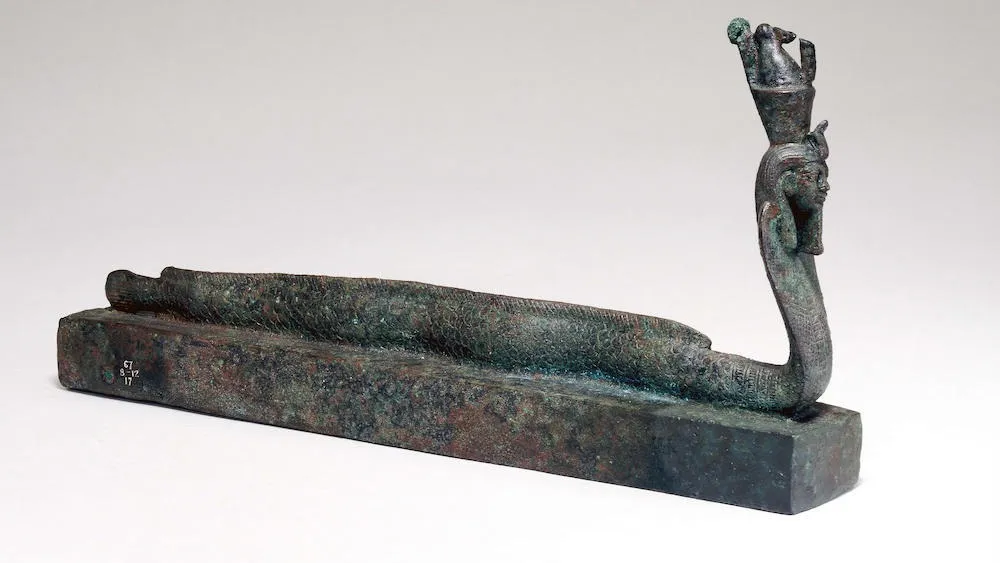
For thousands of years, six ancient Egyptian coffins have been sealed to the outside world, their contents unknown. Now, scientists have used technology to peer inside the coffins, which are now housed at the British Museum in London, for the first time since their burial, revealing the mummified remains of several animals, including a complete lizard skull.
The coffins, which range in length from approximately 2 inches (50 millimeters) to 12 inches (300 mm) and date to between 664 B.C. and 250 B.C, were unearthed in the ancient cities of Naukratis (also spelled Naucratis) and Tell el-Yehudiyeh (or Tell el-Yehudiya) in 1885. They were constructed using copper compounds and feature figures of lizards, eels and cobras on their exteriors. (The provenance of two of the coffins is unknown.)
One of the boxes is topped with a human-headed part-eel, part-cobra creature wearing a crown that may be associated with Atum, an ancient Egyptian primordial god. The ornate imagery hints at the boxes' contents, which were revealed in a study published Thursday (April 20) in the journal Scientific Reports.
Because the coffins were constructed of metal, scientists used a method called neutron tomography — a noninvasive technology that, unlike X-rays, isn't affected by metal — to look inside the coffins for the first time since their burial.
Inside one coffin, the scans revealed the complete intact skull of a lizard "similar to a group of wall lizards" whose species are found in North Africa to this day. Two other coffins contained fragments of animal bones wrapped in cloth, possibly linen, according to a statement.
"While animal burials were commonplace in ancient Egypt, it's quite rare to have coffins that are still sealed," lead author Daniel O'Flynn, an X-ray imaging scientist at the British Museum, told Live Science. "Because these boxes are made out of metal, it's very difficult to look through them with X-rays, so what we were able to do with this study was to look inside a small group of coffins using neutrons. This is the first time that we've been able to confirm for these objects at the British Museum that there are actually animal remains inside of them."
Sign up for the Live Science daily newsletter now
Get the world’s most fascinating discoveries delivered straight to your inbox.
An animal coffin topped with two lizard figures (top and side view). Neutron imaging shows textile wrappings and a bone (arrow).
(Image credit: tk)
In addition to the bones, scientists discovered lead in three of the coffins; the metal may have been used to distribute weight during the burial process or to fix a hole in the side of one of the coffins. The exteriors of several of the boxes were also affixed with loops, which could've been used to suspend them from shrine or temple walls or to carry them during religious processions, according to the statement.
"The lead was an interesting finding," O'Flynn said. "We found quite a lot of lead in three of the boxes. We're not entirely sure of its purposes. It could've been something purely practical. But another interpretation is that it could've been included due to its status in ancient Egypt as a magical material, and we know from previous research that lead was used in the protection of mummified remains as well as in love charms and curses."
The study was inconclusive about whether the animals were sacrificed.
"It's possible that they were sacrificed, but they could also represent offerings to the gods," O'Flynn said.
Jennifer Nalewicki is former Live Science staff writer and Salt Lake City-based journalist whose work has been featured in The New York Times, Smithsonian Magazine, Scientific American, Popular Mechanics and more. She covers several science topics from planet Earth to paleontology and archaeology to health and culture. Prior to freelancing, Jennifer held an Editor role at Time Inc. Jennifer has a bachelor's degree in Journalism from The University of Texas at Austin.