













Ancient Egyptian 'office workers' had terrible posture just like us, disfigured skeletons reveal
The development of osteoarthritis was more common among scribes than their ancient Egyptian peers, a study finds.
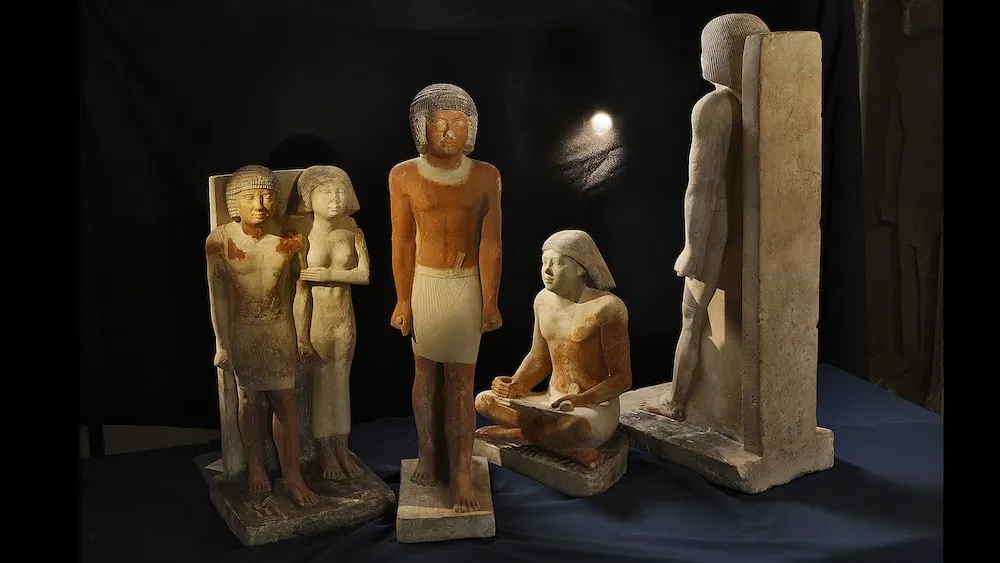
Ancient Egyptian scribes worked in cramped and hunched over positions that were so extreme, it may have led to them developing osteoarthritis in their joints and other skeletal issues, a new analysis reveals.
Archaeologists examined the skeletons of 69 adult males — 30 of whom were scribes — who were buried between 2700 and 2180 B.C. in a necropolis in Abusir, a pyramid burial complex in Egypt. A new analysis of their bones was published Thursday (June 27) in the journal Scientific Reports.
Being a scribe in ancient Egypt was considered a high-status career, especially since these men could read and write — a skill held by only 1% to 5% of the ancient Egyptian population, according to the University College London.
"Officials with scribal skills belonged to the elite of the time and formed the backbone of the state administration," study co-author Veronika Dulíková, an Egyptologist at the Czech Institute of Egyptology of the Faculty of Arts at Charles University, in the Czech Republic, told Live Science in an email. "They were therefore important for the functioning and management of the whole country."
But scribes experienced downsides to their jobs, too, since they often performed repetitive administrative tasks that involved sitting in certain positions for prolonged periods of time, according to a statement.
Researchers noticed that the scribes' skeletons showed more obvious degenerative changes in their joints, compared to the adult males who held other occupations. The areas most affected included the right collarbone, the right upper arm bone where it connects with the shoulder socket, the bottom of the right thigh bone where it meets the knee and the vertebra at the top of the spine.
Related: When did the ancient Egyptians start using hieroglyphs?
Get the world’s most fascinating discoveries delivered straight to your inbox.
The researchers also noticed unique indentations in both kneecaps of each scribe, and a "flattened surface on a bone in the lower part of the right ankle," according to the statement.
The cause of these skeletal changes was likely due to scribes sitting for long periods in a cross-legged position or while kneeling on their left legs with their right legs bent upwards with the papyrus in their laps. And — much like today's office workers — the scribes hunched over as they wrote.
"In a typical scribe's working position, the head had to be bent forward and the spine flexed, which changed the center of gravity of the head and put stress on the spine," lead author Petra Brukner Havelková, an anthropologist in the Department of Anthropology at the National Museum in Prague, told Live Science in an email. "And the correlation between [jaw disorders] and cervical spine dysfunction or neck/shoulder symptoms is well documented or supported by clinical studies."
She added, "We may realize that although they were high-ranking dignitaries who belonged to the ancient Egyptian elite, they suffered the same worries as we do today and were exposed to similar occupational risk factors in their profession as most civil servants today."
There have also been numerous statues and wall art found in tombs showing scribes sitting in these exact positions performing their tasks.
RELATED STORIES
"The relief decoration in tombs and scribal statues give us an idea of the postures of the scribes of the time," Dulíková said. "They were in different sitting and standing positions. These are therefore very important for studying the physical changes involved."
The scribes' jaws and first bones in their right thumbs also appeared to be affected, bearing wear-and-tear not seen in the other skeletons. This was likely the result of the scribes chewing the ends of rush stems to create writing utensils, which they then pinched with their thumbs as they wrote.
"Our research reveals that remaining in a cross-legged sitting or kneeling position for extended periods, and the repetitive tasks related to writing and the adjusting of the rush pens during scribal activity, caused the extreme overloading of the jaw, neck and shoulder regions," the authors wrote in the study.
Jennifer Nalewicki is former Live Science staff writer and Salt Lake City-based journalist whose work has been featured in The New York Times, Smithsonian Magazine, Scientific American, Popular Mechanics and more. She covers several science topics from planet Earth to paleontology and archaeology to health and culture. Prior to freelancing, Jennifer held an Editor role at Time Inc. Jennifer has a bachelor's degree in Journalism from The University of Texas at Austin.