













3,600-year-old jewelry and weapon hoard found under field in Czech Republic
Archaeologists used metal detectors to find the hoard, which includes several pieces of jewelry and weapons.
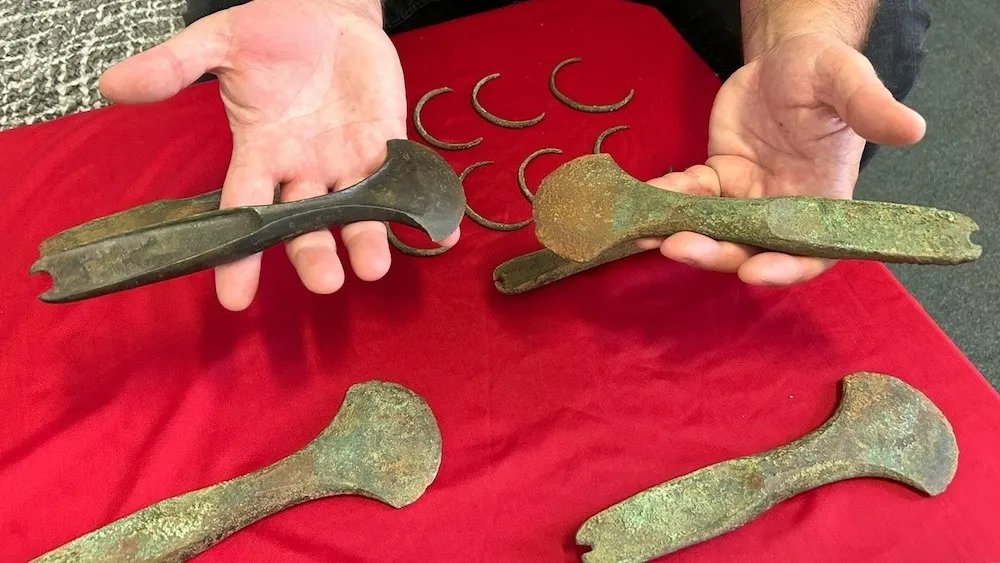
Archaeologists discovered a hoard of Bronze Age artifacts while doing routine survey work in a field in the Czech Republic.
The bronze objects — which include eight arm rings, two pins, eight axes and one spearhead — were found near Budyně nad Ohří, a town about 35 miles (56 kilometers) northwest of Prague, Radio Prague International reported.
Researchers estimate that most of the items, which they found using metal detectors, date to around 1600 B.C.
"Most items are characteristic of the Middle Bronze Age, with only one ax belonging to the earlier period," Martin Trefný, an associate professor at the Museum of the Říp Region and the University of Jan Evangelista Purkyně and the curator of the hoard, told Live Science in an email. One ax is even older and dates to the Early Bronze Age.
"Axes could have been used as tools or weapons. The latter function also applies to the spearhead," Trefný said. "Bracelets were forearm ornaments, and pins served either to fasten clothing or, for example, to style women's hair."
Related: 'Jackpot' of 2,000 early-medieval coins discovered by hiker in Czech Republic
Archaeologists remain unclear about why the hoard was buried, but they have proposed three possibilities.
Get the world’s most fascinating discoveries delivered straight to your inbox.
"In the first case, the hoards are presumed to have a votive function, meaning they served as offerings to deities," Trefný said. "In the second case, we speak of an economic function, where hoards are interpreted as, for example, storage for manufacturers of the given items."
Alternatively, the buried items could reflect "a crisis situation, where it was necessary to hide the items, for example, from enemies," he said.
RELATED STORIES
The treasure could be worth "millions of crowns," Trefný told Radio Prague International. (One million Czech crowns, or koruna, is about $42,500.)
"All the items testify to the technological advancement of bronze casters and processors in Central Europe 3,500 years ago," Trefný told Live Science. "The composition of the hoard also contributes to understanding the warfare, craft techniques and contemporary fashion of the time. Considering that hoards might have a ritual significance, they can also reveal a bit about the contemporary religion."
In the "near future," these found items will be on display at the Podřipské Museum, located about 30 miles (50 km) north of Prague, Radio Prague International reported.
Jennifer Nalewicki is former Live Science staff writer and Salt Lake City-based journalist whose work has been featured in The New York Times, Smithsonian Magazine, Scientific American, Popular Mechanics and more. She covers several science topics from planet Earth to paleontology and archaeology to health and culture. Prior to freelancing, Jennifer held an Editor role at Time Inc. Jennifer has a bachelor's degree in Journalism from The University of Texas at Austin.