













2,600-year-old stone busts of 'lost' ancient Tartessos people discovered in sealed pit in Spain
Archaeologists in Spain recently discovered five life-size busts of human figures depicting the lost Tartessos civilization.
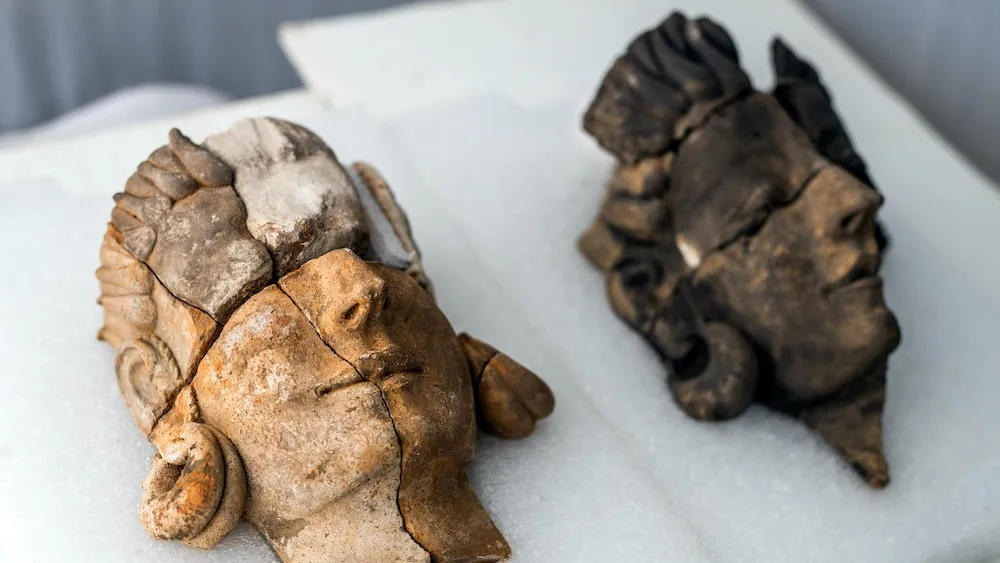
Archaeologists in Spain have unearthed five life-size busts of human figures that could be the first-known human depictions of the Tartessos, a people who formed an ancient civilization that disappeared more than 2,500 years ago.
The carved stone faces, which archaeologists date to the fifth century B.C., were found hidden inside a sealed pit in an adobe temple at Casas del Turuñuelo, an ancient Tartessian site in southern Spain. The pieces were scattered amongst animal bones, mostly from horses, that likely came from a mass sacrifice, according to a translated statement published April 18.
"The unusual thing about the new finding is that the representations correspond to human faces," Erika López, a spokesperson for the Spanish National Research Council (CSIC), said in the statement.
Archaeologists from the CSIC called this discovery "a profound paradigm shift in the interpretation of [Tartessos]," since this ancient civilization, which existed from about the eighth to the fourth centuries B.C., was long considered an aniconic culture in which divinity was represented through animal or plant motifs, rather than idolized humans, according to the statement.
Related: King Solomon's mines in Spain? Not likely, experts say.
Of the figurative reliefs, two are nearly complete and likely portray female divinities wearing earrings, which could be a nod to the Bronze Aged peoples' adept goldsmithing skills. Archaeologists found only fragments of the other three reliefs, but identified one as a warrior wearing a helmet, according to the statement.
Although the Tartessos didn't leave much of an archeological record, archaeologists do know that they were skilled at goldsmithing; for instance, gold pieces similar to the reliefs' earrings have been unearthed at two nearby Tartessian sites, Cancho Roano and La Mata. These locations were torched to the ground in a similar manner to the newly discovered pit site, but why and how these conflagrations occurred remains a mystery, according to an April 21 Vice article.
RELATED STORIES
Some historians, including the Greek philosopher Aristotle, once linked the Tartessos people to the mythical lost city of Atlantis. However this idea "has been widely dismissed in the scientific community," according to a 2022 BBC article.
"The finding only further influences both the importance of the site and the importance of the Tartessian culture in the Guadiana valley during its last moments," López said in the translated statement.
Get the world’s most fascinating discoveries delivered straight to your inbox.
Jennifer Nalewicki is former Live Science staff writer and Salt Lake City-based journalist whose work has been featured in The New York Times, Smithsonian Magazine, Scientific American, Popular Mechanics and more. She covers several science topics from planet Earth to paleontology and archaeology to health and culture. Prior to freelancing, Jennifer held an Editor role at Time Inc. Jennifer has a bachelor's degree in Journalism from The University of Texas at Austin.