













Google Doodle Celebrates Physicist Who Escaped Nazi Germany

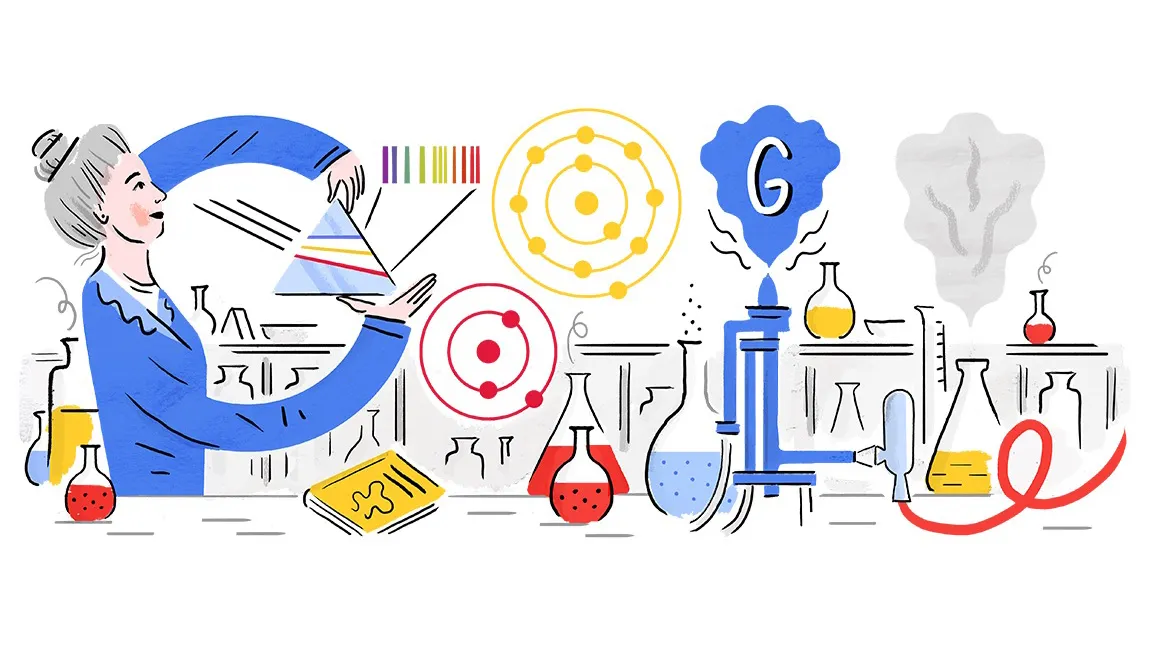
Today's Google Doodle celebrates the 132nd birthday of physicist Hedwig Kohn, who escaped Nazi Germany and is known for, among other things, her work on flame spectroscopy, a technique that allows scientists to chemically analyze elements by burning them.
The Doodle, drawn by Hamburg-based guest artist Carolin Löbbert, shows us Kohn in her lab, where she took samples of elements, set them on fire, and determined the type, characteristics and quantity of the elements, based on the wavelength and intensity of the flame.
Kohn's many other claims to fame include being one of three women certified to teach physics at a German university before World War II; contributing more than 200 pages to a leading textbook that became the standard introduction to radiometry (the science of measuring electromagnetic radiation, including visible light); and filing one patent. [Top 10 Inventions That Changed the World]
Kohn was born in Breslau (today Wrocław), Poland, in 1887. The young woman's thirst for education was so strong, that she entered the local university to audit classes in 1907 — a full year before women were allowed to enroll, according to the Jewish Women's Archive. In 1913, she earned her doctorate in physics.
At the start of World War I, her advisor, Otto Lummer — famous for his work on precision radiation measurements, which contributed to the creation of Planck's radiation law — recognized her intelligence and drive; he promoted her to assistant. Kohn soon took on a large share of teaching and advising. In 1918, when Kohn was just 31 years old, she received a medal for her service, according to the Jewish Women's Archive.
When the Nazis came into power in 1933, however, Kohn was barred from teaching because she was Jewish. She managed to stay afloat by taking on research contracts, but after the 1938 Kristallnacht event — when German Nazis attacked Jewish people and property — it became clear that she had to leave the country.
The scientist's colleagues stepped up to the plate and found ways for her to get job offers abroad. Kohn managed to flee to the United States in 1940. A year later, her only brother, Kurt, was deported to Kovno (a Lithuanian city first occupied by the Soviets and then by the Germans) and murdered.
Get the world’s most fascinating discoveries delivered straight to your inbox.
In the United States, Kohn taught at the Woman's College of the University of North Carolina, and at Wellesley College in Massachusetts until 1952. By the end of her career, Kohn had published more than 20 papers and hundreds of textbook pages on radiometry. Germany didn't forget her, either. In 1952, the Federal Republic of Germany awarded her a pension and the title of professor emerita. She died in 1964.
- Warped Physics: 10 Effects of Faster-Than-Light Travel
- 7 Quantum Particles Act Like Billions in Weird Physics Experiment
- The 10 Noblest Nobel Prize Winners of All Time
Originally published on Live Science.

Laura is the managing editor at Live Science. She also runs the archaeology section and the Life's Little Mysteries series. Her work has appeared in The New York Times, Scholastic, Popular Science and Spectrum, a site on autism research. She has won multiple awards from the Society of Professional Journalists and the Washington Newspaper Publishers Association for her reporting at a weekly newspaper near Seattle. Laura holds a bachelor's degree in English literature and psychology from Washington University in St. Louis and a master's degree in science writing from NYU.