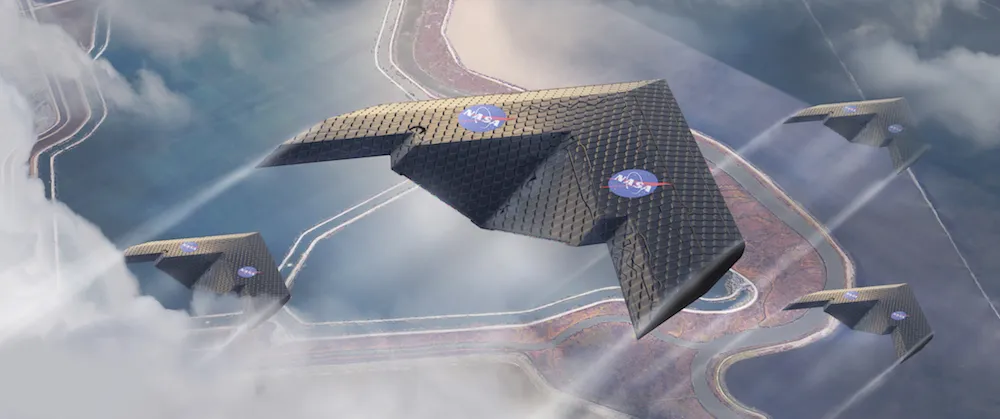
A new type of airplane wing assembled like a jigsaw puzzle could make for lighter, more efficient aircraft.
NASA and Massachusetts Institute of Technology researchers tested the wing design in a NASA wind tunnel, where the technology performed better than expected, Benjamin Jenett, one of the wing's developers and a graduate student at MIT, said in a statement. The new wing is light and flexible, able to adjust its shape midflight depending on the needs of the pilot.
Conventional airplane wings are made of metal and composite materials, so they're fairly heavy. They also involve moving parts, like the flaps and ailerons you might watch tilting up and down if you get an overwing seat on a cross-country flight.
The morphing wing is made of thousands of tiny triangular struts that have different levels of stiffness. By strategically placing these stiff and flexible struts, researchers made a wing that changes shape in response to stress.
(Image credit: Kenny Cheung, NASA Ames Research Center)
The lattice-like wing is covered with a thin sheet of polymer and has a density of just 3.8 lbs. per cubic foot (5.6 kilograms per cubic meter).
But lightness isn't the only advantage of the new wing design. It's also flexible. By strategically placing stiff and flexible components in the lattice pattern, the researchers can build a wing that changes shape in response to the stresses around it. Instead of having to lift a flap or move an aileron, a pilot could simply maneuver the plane, and the wing would change shape automatically.
"We're able to gain efficiency by matching the shape to the loads at different angles of attack," study leader Nicholas Cramer, a research computer scientist at NASA Ames Research Center in Mountain View, California, said in the statement. "We're able to produce the exact same behavior you would do actively, but we did it passively."
Sign up for the Live Science daily newsletter now
Get the world’s most fascinating discoveries delivered straight to your inbox.
Stephanie Pappas is a contributing writer for Live Science, covering topics ranging from geoscience to archaeology to the human brain and behavior. She was previously a senior writer for Live Science but is now a freelancer based in Denver, Colorado, and regularly contributes to Scientific American and The Monitor, the monthly magazine of the American Psychological Association. Stephanie received a bachelor's degree in psychology from the University of South Carolina and a graduate certificate in science communication from the University of California, Santa Cruz.