













Floating Robots Spotted a Huge Plume of Magma Under the Galápagos

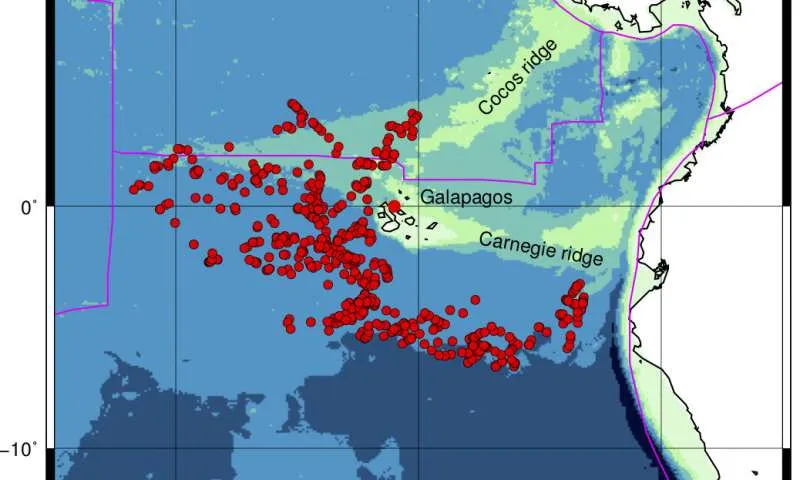
A fleet of floating robots has figured out why the Galápagos Islands exist. And, according to the robots' creators, the discovery could help explain why the Earth isn't a floating ball of ice.
The Galápagos Islands are a volcanic archipelago in the Pacific Ocean, about 600 miles (1,000 kilometers) off the coast of Ecuador. The islands are most famous as hosts to a large number of species not found anywhere else in the world, which helped the biologist Charles Darwin develop the theory of evolution. Now, according to an international team of researchers, we know that the islands were formed by a thin tunnel bringing magma up from a "mantle plume" 1,200 miles (1,900 km) below the surface. Scientists had suspected such a plume might exist before, but this is the most direct evidence yet that it’s down there.
The researchers published their description of the mantle plume, and the floating robots that helped discover it, today (Feb. 4) in the journal Nature Scientific Reports. [The 10 Most Pristine Places on Earth]
"Mantle plumes" are giant bubbles of very hot magma that sit much closer to the Earth's crust than usual. For decades, scientists have proposed that plumes like this could explain why certain regions of the planet are very volcanically active, even though they're far from the edges of tectonic plates where volcanism is more expected. (Hawaii is a famous example.) Not every volcanologist accepts this explanation, but those who do think it explains why the Earth hasn't run out of heat.
While the planet has had temperature swings in its history significant enough to radically transform the climate (we're in the middle of an unnaturally sudden one right now), its temperature has remained fairly constant from a geological perspective. The planet hasn't cooled over time from its internal heat running out. And, according to the study authors, this requires some explanation.
Earth could have only maintained its temperature, lead author Guust Nolet, a geoscientist at the University of Nice/Sophia Antipolis in France, said in a statement, "if some of the original heat from its accretion, and that created since by radioactive minerals, could stay locked inside the lower mantle. But most models of the Earth predict that the mantle should be [pushing heat up to the surface] and releasing this heat much more quickly. These results of the Galápagos experiment point to an alternative explanation: The lower mantle may well resist [transferring heat up through the body of the planet], and instead only bring heat to the surface in the form of mantle plumes such as the ones creating Galápagos and Hawaii."
The result would be a kind of trickle effect, where the hot innards of the planet would release enough geothermal heat to keep the crust warm, but not so much that it burned itself out.
Get the world’s most fascinating discoveries delivered straight to your inbox.
To detect this possible mantle plume feeding the Galápagos, the researchers deployed nine robots called "MERMAIDS," which would float freely about a mile (1.6 km) under the ocean surface, listening for underwater earthquakes.
Scientists figure out what's going on inside the planet by carefully studying how earthquakes move through it. It's a technology that's a bit like an ultrasound, but on a massive scale. The problem is, most earthquake data comes from land, which covers just a third of the planet's surface. The MERMAIDS are designed to fill in the gaps. [Channel Islands: Photos of North America's Galapagos]
Whenever they hear an earthquake, according to the statement, the MERMAIDS rise to the ocean surface and use GPS data to figure out their location on Earth. Then they transmit home their GPS and seismic data. This is the sort of data the researchers used to reconstruct the plume under the Galápagos, which is the first published result from the MERMAIDs project.
It's worth noting that not every seismologist accepts that mantle plumes really exist. As Sara Pratt reported in 2015 for Earth Magazine, some seismologists doubt that there's enough information in seismic waves to offer clear pictures of what's going on that far below the crust. Opponents of the theory point out that the various definitions of "mantle plume" are often so broad as to contradict one another, and that while many mantle plumes have been "discovered," no one's been able to produce a confirmed list of ones that really exist. These doubters offer alternative, modified theories of plate tectonics that explain volcanic hotspots like Hawaii and the Galápagos.
Still, mantle plumes remain the dominant explanation in seismology for places on this planet like the Galápagos. And this plume discovered under those islands would be the first major discovery accomplished using free-floating seismometers. Scientists now have an exciting new method for peering deep into the planet.
- The World's 5 Most Active Volcanoes
- Best National Parks to Visit During Winter
- Gallery: The Incredible Eruption of Mount St. Helen's
Originally published on Live Science.
