













Invasive Tick Is 'Here to Stay,' and Here's Where It Could Spread Next

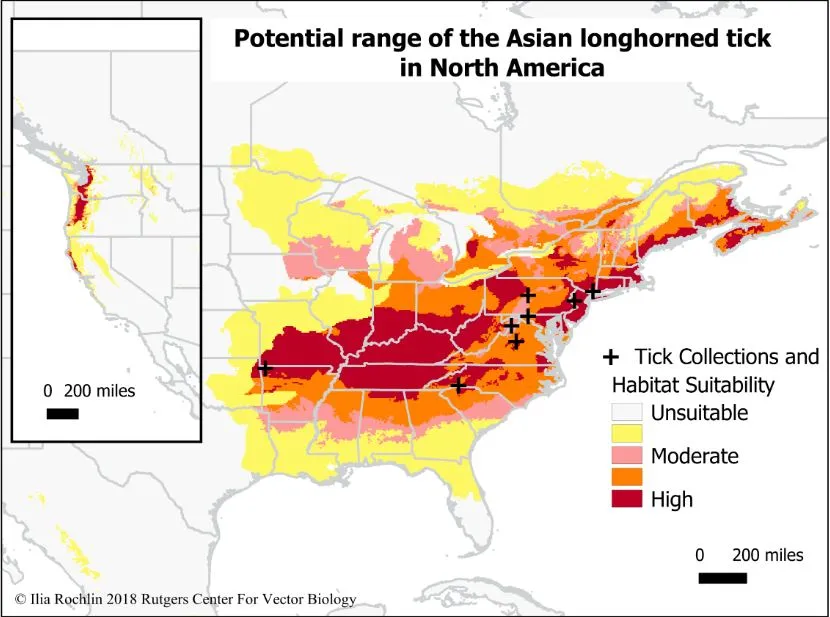
An invasive tick species, new to the U.S., has already popped up in nine states, and a new study suggests that the species could spread much further.
This tick, called the Asian longhorned tick (Haemaphysalis longicornis), is native to Asia and was first identified in the U.S. in 2017, when it was found on a sheep in New Jersey. Since then, the tick has been detected in eight other states: New York, Virginia, West Virginia, Arkansas, North Carolina, Pennsylvania, Connecticut and Maryland, according to the Centers for Disease Control and Prevention (CDC).
But the new study, published today (Dec. 13) in the Journal of Medical Entomology, suggests that the tick could spread to much of the eastern U.S. and parts of the Midwest, as well as a small section of the Pacific Northwest.
Researchers used climate data from the tick's native habitat, which includes parts of China, Japan and Korea, to predict where the tick could spread in North America. Then, they created a statistical model to determine habitats that were likely suitable for the tick.[5 Things to Know About the New Tick Species in the US]
The study found that much of the eastern U.S. coast was suitable for the longhorned tick, with areas as far north as Maine and as far south as northern Florida predicted to be at least moderately suitable. The tick could also appear in Gulf Coast states as far west as Louisiana, as well as in Midwest and southeastern states, including Missouri, Illinois, Indiana, Ohio, Kentucky and Tennessee. A small section of the Washington, Oregon and Northern California coast was also found to be highly suitable for H. longicornis, the study found.
"The Asian longhorned tick is a very adaptable species," study author Ilia Rochlin, an entomologist and researcher affiliated with Rutgers University's Center for Vector Biology in New Jersey, said in a statement. "The optimal tick habitat appears to be defined by temperate conditions — moderate temperature, humidity and precipitation."
Indeed, the suitability of other areas outside the predicted regions was limited due to warmer temperatures in parts of the south, cold temperatures in the north and a dry climate in the west, the study said.
Get the world’s most fascinating discoveries delivered straight to your inbox.
Last month, the CDC announced that it is working with experts in veterinary medicine, agricultural science and public health to better understand the potential impact of the longhorned tick in the U.S.
One concern is that this tick poses a threat to livestock. Unlike most tick species, longhorned ticks can reproduce asexually and lay massive numbers of eggs. A single female longhorn tick can lay up to 2,000 eggs at a time, the CDC said. Due to these large numbers, longhorned ticks can cause severe infestations in livestock, leading to weakness, anemia or even death in the animals.
There is also concern that the tick could spread diseases, as it does in other parts of the world. But so far, no cases of disease tied to these ticks have been reported in the U.S., according to the CDC.
Unfortunately, now that the tick has arrived in the U.S., it's probably here to stay, Rochlin said. The longhorned tick "will be difficult to impossible to eradicate" given it's ecological adaptability and ability to reproduce asexually, Rochlin wrote in his paper.
But studies like these can alert public health officials and veterinary experts as to whether they are in a moderate- or high-risk area for the tick to inhabit.
"Hopefully, this awareness will lead to increased surveillance and expanded public outreach and education," Rochlin said.
He noted that the model was intended to determine the potential tick habitat on a large scale but not where the ticks could be at the local level, such as the specific counties at risk. To determine that, "we need to learn more about this tick species' biology, ecology and local distribution," Rochlin said.
- Microscopic Monsters: Gallery of Ugly Bugs
- Photos: Amazing Insects of the North American Deserts
- Tiny & Nasty: Images of Things That Make Us Sick
Originally published on Live Science.

Rachael is a Live Science contributor, and was a former channel editor and senior writer for Live Science between 2010 and 2022. She has a master's degree in journalism from New York University's Science, Health and Environmental Reporting Program. She also holds a B.S. in molecular biology and an M.S. in biology from the University of California, San Diego. Her work has appeared in Scienceline, The Washington Post and Scientific American.