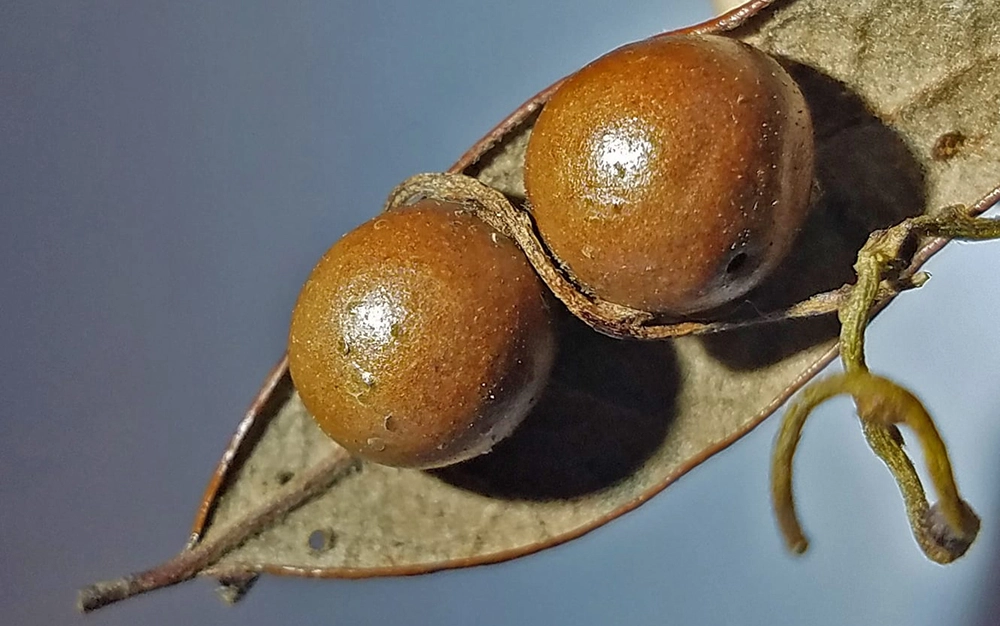
Smooth, shiny balls that cling to the undersides of oak leaves often hold a grim secret inside, or, depending on how you look at it, a crunchy surprise: the dried-up corpse of a wasp, killed by a parasitic plant known as the love vine.
These tiny spheres are leaf deformities called galls — swollen tumors of leaf tissue — and their growth is caused by a type of insect called the gall wasp. These parasitic wasps house their eggs and protect their young inside the galls. There, the growing wasps are safe from harm — that is, until the parasitic love vine (Cassytha filiformis) comes calling and breaks into the wasps' homes, researchers recently wrote in a new study.
When the scientists opened galls that were in the grip of the delicate orange vines, they found wasp mummies inside; the vines had penetrated the galls and drained the insects to husks for their nutrients. [The 10 Most Diabolical and Disgusting Parasites]
Though experts have investigated gall wasps and love vines separately for over a century, this is the first study to look at the fascinating — and fatal — relationship between the two, the researchers reported.
Love vines aren't the only plants that target insects as food. Venus flytraps' leafy "jaws" trap and digest hapless insect prey, and pitcher plants lure and catch bugs with sticky slime. But while insects have to visit those plants to be caught by them, the love vine seeks out the wasps, and then attacks them as they go about their business inside their galls, the study authors reported.
Bigger is better
In the study, the scientists examined 2,000 galls produced by the wasp species Belonocnema treatae, found in oak groves that spanned 1,000 miles (1,609 kilometers) across Florida.Of those galls, 58 percent had been attacked by the vine, which seemed to prefer larger galls — spheres smaller than 0.1 inches (3.5 millimeters) in diameter were rarely parasitized, the scientists reported.
After a love vine wraps around a gall, it penetrates the outer wall with structures called haustoria.
(Image credit: Scott Egan/Rice University)
"We found the vines attached to galls that were slightly larger than average. That means the vine is either only attacking larger galls, or the vine is inducing the galls that it attacks to grow bigger, perhaps to draw more energy from them," study lead author Scott Egan, an assistant professor of biosciences at Rice University in Houston, said in a statement.
Sign up for the Live Science daily newsletter now
Get the world’s most fascinating discoveries delivered straight to your inbox.
Love vines penetrated the galls' outer walls using stubby structures called haustoria, which siphoned nutrients from inside, and the vine "was observed to wrap tightly, multiple times, directly below the gall and initiate haustoria into the stem tissue," the researchers wrote in the study.
When parasitic plants attack
Dissections of 51 parasitized wasp galls revealed 23 with a dead, mummified wasp inside. But if you were hoping to catch a glimpse of one of those dried-up wasps (Live Science certainly was), you're out of luck — cutting into the galls also cut into the wasps at their center, "so we never got that perfect picture," Egan told Live Science in an email.
Five other gall-producing insects were fair game for the love vines: The scientists found evidence of parasitized galls in four additional wasp species, and in one type of gall-forming fly.
While this is the first documented evidence of a parasitic plant attacking an insect-made structure in a way that is harmful to the insect, it's likely not the only example of such a relationship in the natural world, Egan said in the statement.
"This could be unique, but biologists have catalogued more than 1,300 species of gall-forming wasps and more than 4,000 species of parasitic plants, so this could just be the tip of the iceberg," he said.
The findings were published online Aug. 20 in the journal Current Biology.
Mindy Weisberger is a science journalist and author of "Rise of the Zombie Bugs: The Surprising Science of Parasitic Mind-Control" (Hopkins Press). She formerly edited for Scholastic and was a channel editor and senior writer for Live Science. She has reported on general science, covering climate change, paleontology, biology and space. Mindy studied film at Columbia University; prior to LS, she produced, wrote and directed media for the American Museum of Natural History in NYC. Her videos about dinosaurs, astrophysics, biodiversity and evolution appear in museums and science centers worldwide, earning awards such as the CINE Golden Eagle and the Communicator Award of Excellence. Her writing has also appeared in Scientific American, The Washington Post, How It Works Magazine and CNN.