













Chinese Space Station Comes Tumbling to Earth Over Pacific Ocean

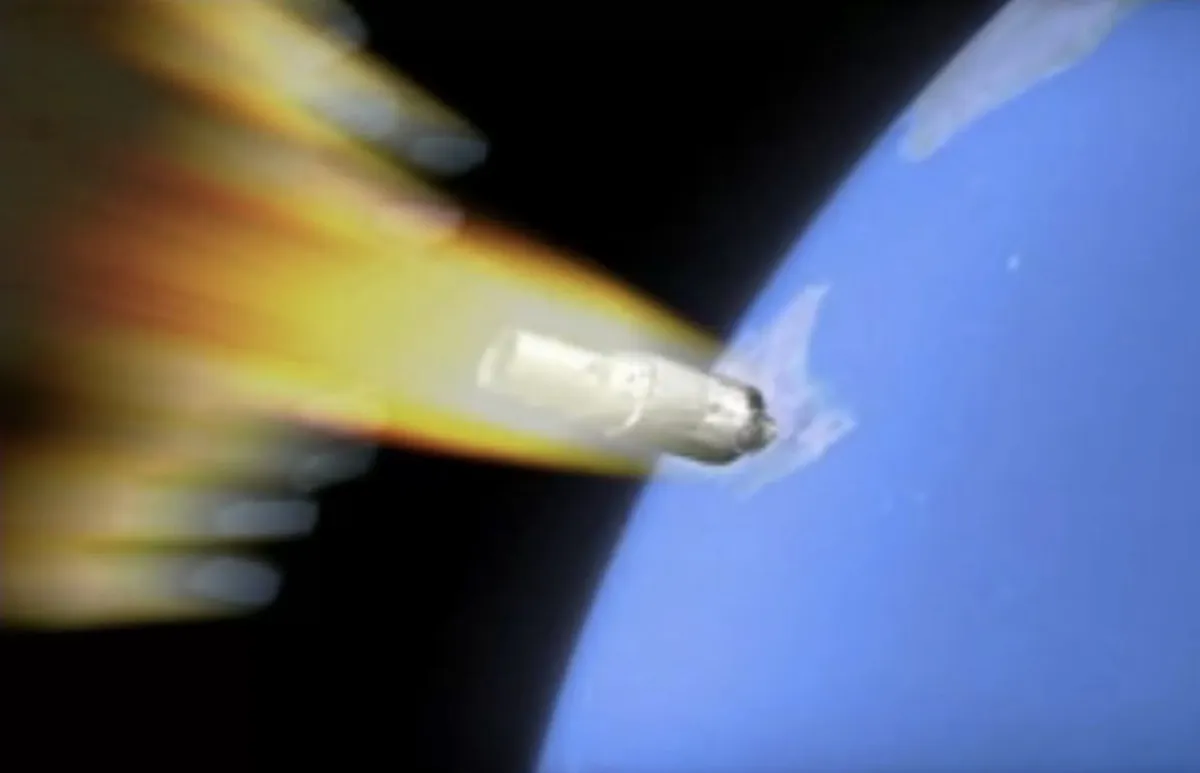
After weeks of uncertainty about when and where it would crash, the Chinese space station Tiangong-1 has tumbled to Earth in the southern Pacific Ocean at about 8:16 p.m. EDT (0016 GMT on April 2), the U.S. Strategic Command's Joint Force Space Component Command (JFSCC) reported.
Despite the uncontrolled nature of the re-entry, the European Space Agency (ESA) had previously estimated that the chances of being hit by debris from Tiangong-1 were 10 million times smaller than the chance of being hit by lightning in any given year (about 1 in 1.4 million). [In Photos: A Look at China's Space Station That's Crashing to Earth]
Space junk
Tiangong-1 weighed about 18,739 pounds (8.5 metric tons), minus some burned fuel, when it fell out of orbit. The space station first launched in 2011, but ended its active life as an experimental space station after the second of two crews left it in 2013. It orbited about 217 miles (350 kilometers) above Earth for most of its time in space, but Chinese officials announced in March 2016 that the space station was no longer communicating with Earth. Thfat meant that controllers on Earth could not fire the space station's engines as its orbit began to decay, leaving no way to control where Tiangong-1 would enter the atmosphere or land on Earth.
Larger objects than Tiangong-1 have crashed to Earth, most notably NASA's Skylab in 1979, which weighed 81 tons (73 metric tons). During a partially controlled re-entry, Skylab missed its target in the Indian Ocean, scattering some unburned pieces in western Australia. [The Weirdest Things That Fell From The Sky]
The Russian space station Mir weighed a whopping 132.3 tons (120 metric tons), but its 2001 re-entry over the South Pacific was controlled. Prior to Tiangong-1, the largest object to fall back to Earth without any control was Salyut-2, a Soviet space station that fell out of orbit after an accident in 1973. It weighed in at 20.2 tons (18.3 metric tons).
Re-entry predictions
The fall of Tiangong-1 was monitored by the Inter-Agency Space Debris Coordination Committee, an international group that included NASA, the ESA as well as the space agencies of 11 other nations. According to the ESA, the members of the committee pooled their predictions of Tiangong's re-entry time and will be using the results to better understand how to predict the behavior of space debris.
Even in the days leading to the crash, these agencies couldn’t predict anything more specific than that Tiangong-1 would impact somewhere between 42.8 degrees North and 42.8 degrees South latitudes sometime between March 21 to April 2. It was only in the last day that the ESA narrowed the final plunge to within 24 hours and then as it got closer, to within a couple of hours.
Get the world’s most fascinating discoveries delivered straight to your inbox.
Original article on Live Science.

Stephanie Pappas is a contributing writer for Live Science, covering topics ranging from geoscience to archaeology to the human brain and behavior. She was previously a senior writer for Live Science but is now a freelancer based in Denver, Colorado, and regularly contributes to Scientific American and The Monitor, the monthly magazine of the American Psychological Association. Stephanie received a bachelor's degree in psychology from the University of South Carolina and a graduate certificate in science communication from the University of California, Santa Cruz.