













Roman Military Commander's Sprawling Home Found Beneath Subway System

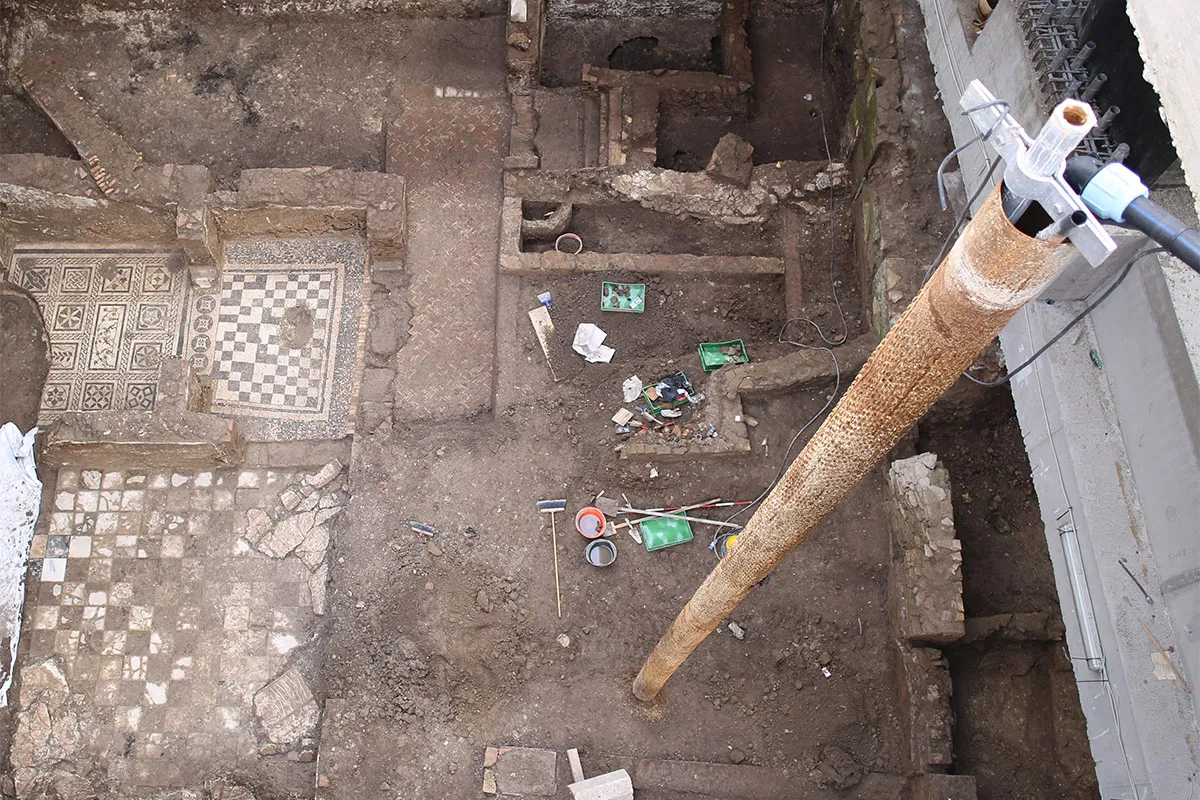
Archaeologists in Rome have discovered the remains of a sprawling residence of a Roman military commander dating back 1,900 years and holding several rooms covered in ornate mosaic floors with geometric patterns, along with pools and fountains.
They discovered the "domus" about 40 feet (12 meters) underground during construction work to expand the Metro C line of Rome's subway system, a team of archaeologists from Rome's Superintendency for Archaeology announced recently.
The commander's residence was uncovered alongside the remains of a military barracks used by Roman soldiers that was discovered in 2016 during this same subway construction. [See Photos of the Excavation and Newly Discovered Domus]
The barracks and commander's house appear to have been constructed during the reign of Emperor Hadrian (reign: A.D. 117-138), who was concerned with consolidating the Roman Empire and improving its defenses.
The house is located beside the barracks. Excavations are ongoing, but work so far within the barracks has revealed the remains of a lengthy building that appears to have served as housing for the ordinary soldiers. There are also water channels and buildings that would have housed supplies.
The military commander's house is about 3,230 square feet (300 square meters) and contains 14 rooms, as well as the remains of a courtyard, fountains and pools. The rooms are decorated with mosaic floors made of white marble and gray slate, most of which are decorated in a variety of geometric patterns.
The remains of plaster paintings were still hanging on the walls. Their designs are hard to make out in released photos, but they seem to incorporate rectangular geometric shapes. The house likely had a heating system, as a cavity was found beneath the floor that would have allowed for the passage of hot air, archaeologists said. Exactly how this heating system worked is not yet clear.
Get the world’s most fascinating discoveries delivered straight to your inbox.
The military barracks and commander's house are not the only major archaeological discoveries made during the construction of the subway line. In 2017, archaeologists announced the discovery of a 2,300-year-old aqueduct located near the Roman Colosseum. It would have transported fresh water into the center of the city, and it may be the oldest aqueduct discovered in Rome so far, the archaeologists said at the time.
One of the new subway stations being constructed on the Metro C line, called San Giovanni, will display artifacts discovered during excavations that took place as the subway line was built.
Originally published on Live Science.

Owen Jarus is a regular contributor to Live Science who writes about archaeology and humans' past. He has also written for The Independent (UK), The Canadian Press (CP) and The Associated Press (AP), among others. Owen has a bachelor of arts degree from the University of Toronto and a journalism degree from Ryerson University.