













World's Biggest Plane Taxis Closer to Takeoff

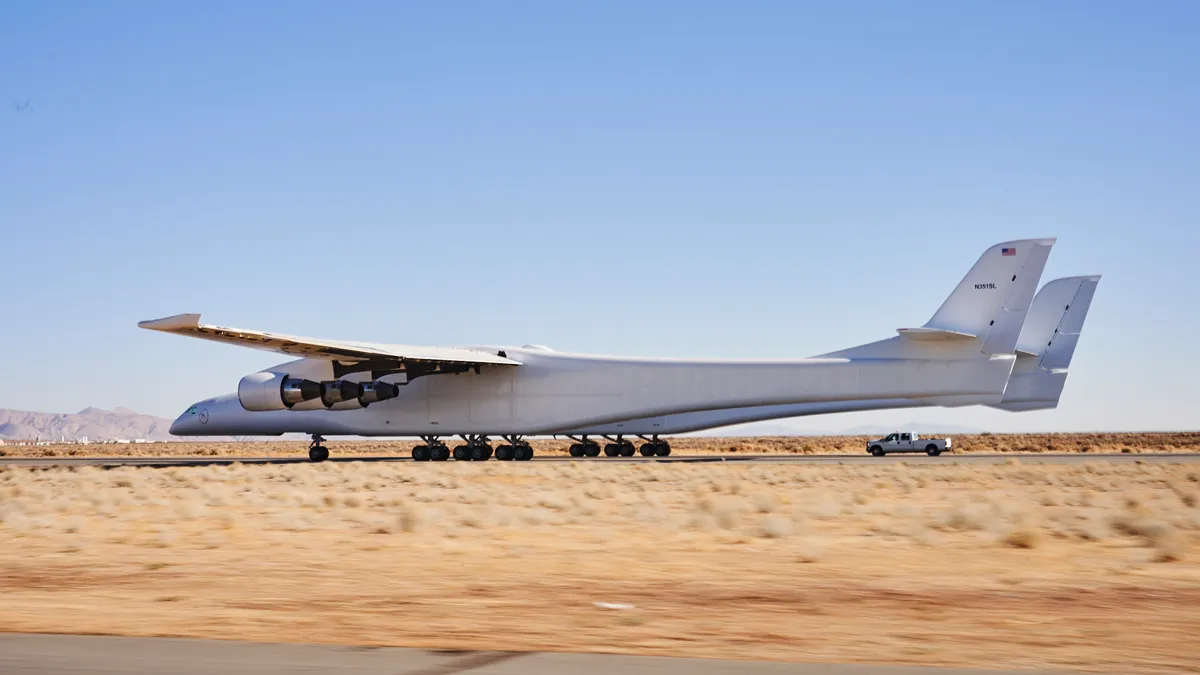
The hefty, double-bodied Stratolaunch airplane — its wingspan of 385 feet (117 meters) is the widest in the world — recently reached a new milestone that brings it one step closer to leaving the ground.
In runway tests conducted on Sunday (Feb. 25) at the Mojave Air and Space Port in Mojave, California, Stratolaunch achieved a taxi speed of 46 mph (74 km/h), according to a tweet posted on Feb. 26 by Paul Allen, founder of Stratolaunch Systems Corp. and co-founder of Microsoft.
Stratolaunch, which weighs about 500,000 lbs. (227,000 kilograms), can carry a payload of up to 550,000 lbs. (250,000 kg). The massive aircraft will transport rocket launchers and satellites bound for low Earth orbit, according to the company's website. [Stratolaunch Test Photos: The World's Largest Plane in Action]
Rocket launches from fixed locations can be delayed or halted by inclement weather and may face hazards from airborne traffic. But deploying rockets and satellites from a moving aircraft such as Stratolaunch — which would take off from a runway and release its payloads from a cruising altitude of about 36,000 feet (11,000 meters) — could reduce the risk of launch cancellations or delays from bad weather, making access to space "more convenient, reliable and routine," Stratolaunch representatives said on the company website.
Stratolaunch resembles two conjoined airplanes connected by a central wing. It utilizes six Boeing 747 engines and has two fuselages, or aircraft bodies; the one on the right is occupied by the flight crew, and the one on the left houses flight data systems. The center wing that joins the fuselages helps to stabilize the aircraft and serves as the attachment point for rocket payloads, according to the Stratolaunch website.
Allen shared video of Stratolaunch on Feb. 26 as it trundled down the runway "with all flight surfaces in place," he wrote on Twitter.
Stratolaunch first left its hangar in May 2017, and in September, the aircraft's engines were tested for the first time. The plane first rolled down the runway in December 2017, reaching a runway taxi speed of 40 mph (64 km/h) as technicians put the plane through its paces for steering and braking. The latest tests build on its prior runway performance, and the plane is expected to be operational by the end of the decade, according to company representatives.
Get the world’s most fascinating discoveries delivered straight to your inbox.
Original article on Live Science.

Mindy Weisberger is a science journalist and author of "Rise of the Zombie Bugs: The Surprising Science of Parasitic Mind-Control" (Hopkins Press). She formerly edited for Scholastic and was a channel editor and senior writer for Live Science. She has reported on general science, covering climate change, paleontology, biology and space. Mindy studied film at Columbia University; prior to LS, she produced, wrote and directed media for the American Museum of Natural History in NYC. Her videos about dinosaurs, astrophysics, biodiversity and evolution appear in museums and science centers worldwide, earning awards such as the CINE Golden Eagle and the Communicator Award of Excellence. Her writing has also appeared in Scientific American, The Washington Post, How It Works Magazine and CNN.