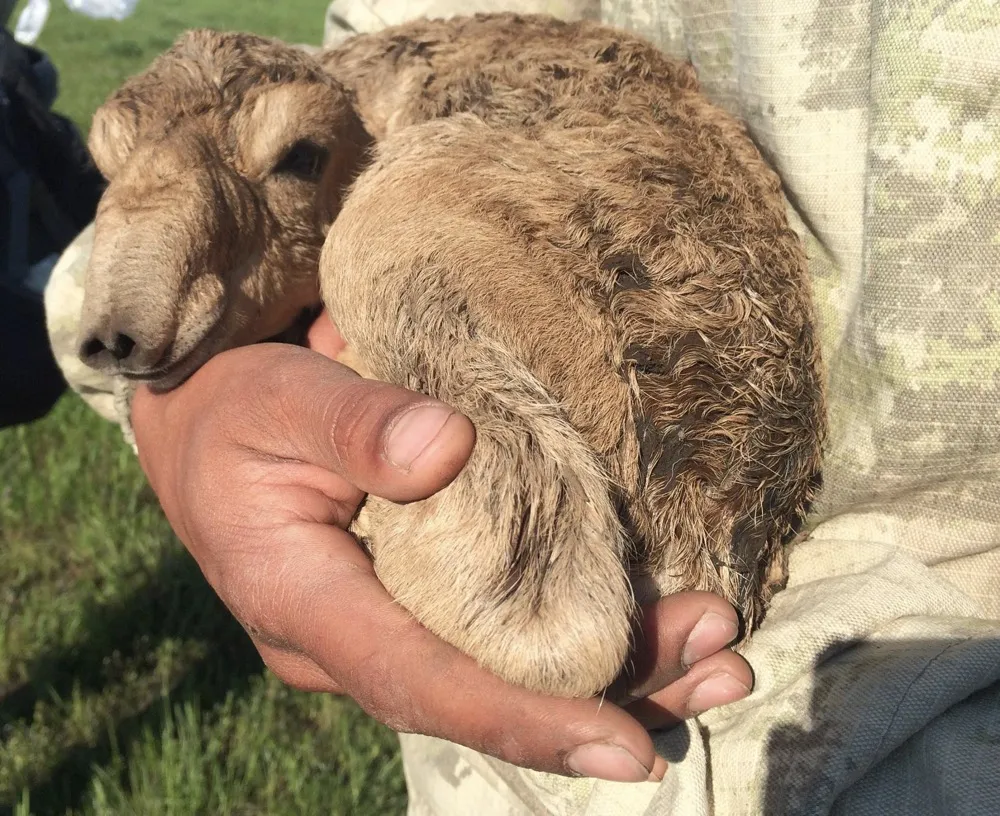
New born saiga calf nestling in the arms of a scientist.
(Image credit: Courtesy of the Joint saiga health monitoring team in Kazakhstan (Association for the Conservation of Biodiversity, Kazakhstan, Biosafety Institute, Gvardeskiy RK, Royal Veterinary College, London, UK))
One day in May of 2015, a handful of critically endangered saiga antelope dropped over, dead. This wasn't necessarily alarming to the scientists in the area who were busy monitoring the herd; the saiga antelope (Saiga tatarica tatarica) of the Central Asian steppe are stressed in springtime, which is calving season, and deaths happen every day. But the next day, more antelope died. On day three, they were dropping by the hundreds.
Within three weeks, 200,000 saiga antelope — 62 percent of the world's population — were dead. And now, scientists have learned that the killer was lurking inside the animals all along.
A new study reveals that the ruminants were killed by a bacterium that normally lives in the antelopes' tonsils without causing any problems. But unusually warm, moist weather apparently triggered the overgrowth of the bacteria, Pasteurella multocida, which subsequently found its way into the antelopes' bloodstream and killed them. [Photos: Mass Death of the Saiga Antelope]
Unfortunately for the antelope (and the steppe ecosystem), climate change seems to be promoting warmer, moister weather in the region, said study leader Richard Kock, a wildlife veterinarian at the Royal Veterinary College of the University of London.
In May 2015, there was a mass die-off of saiga antelope Torgai Betpak Dala, Kazakhstan.
(Image credit: Courtesy of the Joint saiga health monitoring team in Kazakhstan (Association for the Conservation of Biodiversity, Kazakhstan, Biosafety Institute, Gvardeskiy RK, Royal Veterinary College, London, UK))
Blood poisoning
Kock and his team were out in the field, studying the saiga antelope herds, when the die-off began. Within days, it was obvious the antelope were in crisis, he told Live Science. Most alarming, he said, was that every antelope that fell sick died. Diseases that kill every victim are rare in nature, he said, simply because bacteria that kill their hosts too efficiently also end up dying before they can spread.
In this case, almost the entire saiga antelope population of Central Kazakhstan was wiped out within three weeks, felled by hemorrhagic septicemia, or blood poisoning. The only survivors were about 30,000 antelope that were far to the north or otherwise outside the main population area. [Images: Ancient Beasts of the Arctic]
"Literally, the animals start bleeding into all the organs and you get a shutdown and the immune system just cannot respond quickly enough," Kock said.On the steppe, healthy antelope began to show signs of lethargy and weakness and then died within hours.
Sign up for the Live Science daily newsletter now
Get the world’s most fascinating discoveries delivered straight to your inbox.
Kock and his colleagues found P. multocida throughout the tissues, milk and blood of dead antelope. No other pathogen was widespread enough to explain the die-off, he said. The bacterium was also already known to cause hemorrhagic septicemia.
"If that organism gets into your bloodstream, it's curtains for you," Kock said.
Climate opportunists
But why had P. multocida suddenly started wreaking havoc? The disease clearly hadn't spread herd to herd, Kock said, because individual herds that were more than 100 miles apart were stricken in short succession.
Steffen Zuther of ACBK and Frankfurt Zoological Society works with students in the Irghiz region of Kazakhstan in 2016, taking biological measurements of a young saiga antelope.
(Image credit: Courtesy of the Joint saiga health monitoring team in Kazakhstan (Association for the Conservation of Biodiversity, Kazakhstan, Biosafety Institute, Gvardeskiy RK, Royal Veterinary College, London, UK))
"It was not infection from animal to animal," he said. "It was just an emergence of a pathogen in each animal."
The researchers started looking at environmental factors that might have triggered the mass death. They dug into historical records of previous die-offs, discovering that a large numbers of saiga antelope had also died off in 1981 and 1988. They then used satellite data and other records to reconstruct the weather conditions leading up to the die-offs.
They found that high humidity — over 80 percent — was the common thread tying the mass death events together. Humidity was significantly higher in the 10 days before deaths started at die-off sites than it was at sites where antelope didn't die en masse. The bacteria living in the antelopes' tonsils may be sensitive to the warm, moist air that the animals breathe in, Kock said. It appears that they grow rapidly in response, spilling into the bloodstream.
Over the past decades, conditions on the steppe have been trending warmer and wetter, Kock said, meaning saiga antelopes could be at even greater risk in the future. Median temperatures in May have risen 18 degrees Fahrenheit (10 degrees Celsius) over the past decade, he said. The trend doesn't prove that climate change is driving the unusual humid stretches or the mass deaths, Kock said, but the die-offs would be consistent with climate change and its effects. The researchers plan to do more environmental monitoring, perhaps even fitting individual antelope with weather-recording collars, to find out more about the risks. P. multocida is found the world over, so it's an open question whether changing conditions could trigger similar outbreaks in other regions.
There are a few subpopulations of saiga antelope, in Mongolia and elsewhere, Kock said, but those are under threat by hunting and the diseases of domestic animals. If die-offs become more common, this rare ruminant could vanish rapidly.
"A species like this is very resilient and it can reproduce very quickly and it's tough as hell," he said. "But it's been put under extraordinary pressures."
Stephanie Pappas is a contributing writer for Live Science, covering topics ranging from geoscience to archaeology to the human brain and behavior. She was previously a senior writer for Live Science but is now a freelancer based in Denver, Colorado, and regularly contributes to Scientific American and The Monitor, the monthly magazine of the American Psychological Association. Stephanie received a bachelor's degree in psychology from the University of South Carolina and a graduate certificate in science communication from the University of California, Santa Cruz.