














Spectacular Geminid Meteor Shower Peaks Tonight! How to Watch Online

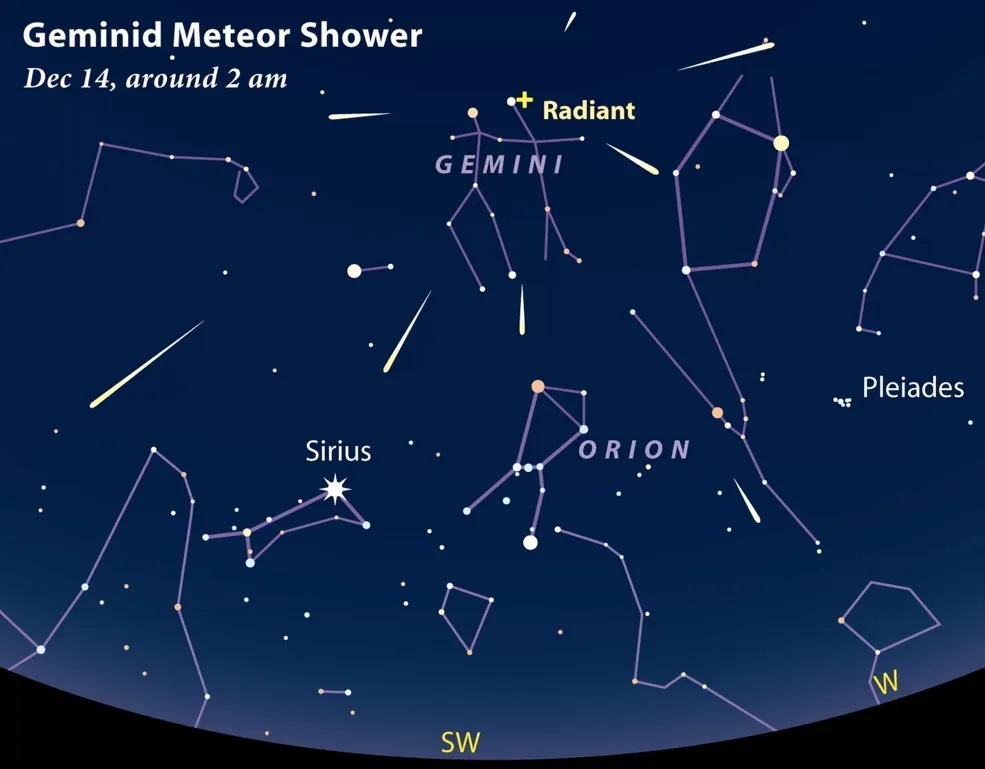
If it's clear outside on Wednesday night (Dec. 13) and Thursday morning (Dec. 14) before dawn, be sure to go outdoors. One of the year's top meteor showers, the Geminids, will peak, with rates as high as one or two meteors per minute at around 10 p.m. local time. However, the show will start around 7 p.m. local time, according to the magazine Sky & Telescope.
But if you can't make it out, or if skies are gloomy, you can also watch a Geminids webcast here from NASA's Marshall Space Flight Center in Alabama starting at sunset, about 4:40 p.m. CST (5:40 p.m. EST, or 2230 GMT) on Dec. 13. The Virtual Telescope Project will also host a webcast here showing live views from Italy, starting at 5 p.m. EDT (2200 GMT) on Dec. 13, and Arizona, starting at 5 a.m. (1000 GMT) on Dec. 14.
"The Geminids are usually one of the two best meteor showers of the year," Alan MacRobert, senior editor at Sky & Telescope, said in a statement. "Sometimes, they're more impressive than the better-known Perseids of August." [Geminid Meteor Shower 2017: When, Where & How to See It Next]
The meteors will appear to radiate from the constellation Gemini, which is in between the constellations Taurus and Cancer. To find Gemini, look for the bright constellation Orion (easily visible due to the "belt" of three stars in a row). Gemini is just over Orion's right shoulder. But there's no need to look directly at Gemini to see the meteors.
"Don't fixate on looking toward Gemini," Kelly Beatty, a senior editor at Sky & Telescope, said in the statement. "Geminids can appear anywhere in the sky, so the best direction to watch is wherever your sky is darkest, which is probably straight up."
You just need some warm clothing and your eyes to see a meteor shower in person. But if you have a small telescope and are watching in the Northern Hemisphere, you will get an extra treat. The source for the Geminids, the asteroid 3200 Phaethon, is coincidentally making its closest approach to Earth this week and so has 11th-magnitude visibility. (Lower magnitudes are brighter. By comparison, the faintest stars you can see with the naked eye are around magnitude 6, and the planet Venus is minus 5.) To find Phaethon, you can use this sky chart on Space.com.
You can also spot the object virtually in the next few days: The Virtual Telescope will host a webcast with live views from Arizona starting at 3 a.m. EST (0800 GMT) on Dec. 15 and Italy starting Dec. 16 at 3 p.m. EST (2000 GMT).
Get the world’s most fascinating discoveries delivered straight to your inbox.
The Geminids have been known as an annual meteor shower since 1862, but Phaethon wasn't discovered until 1983. It's about 3 miles (4.8 kilometers) across and orbits the sun every 1.4 years. Phaethon sheds material when it gets close to the sun, and its surface is heated to about 1,300 degrees Fahrenheit (700 Celsius.)
Meteor showers like the Geminids occur when the Earth plows into a stream of debris in space left behind by a comet or asteroid. The debris stream's location in space can alter from year to year depending on the influence of Jupiter's gravity, among other factors, which contributes to the intensity of the shower.
The light of the moon can wash out fainter meteors. However, this year, the moon is just a waning crescent and will not rise until early in the morning, after 3 a.m. To best see the meteors, find an area as far away as possible from artificial lights and give your eyes about 20 minutes to adjust to the darkness. Also make sure to dress warmly.
"Go out late in the evening, lie back in a reclining lawn chair, and gaze up into the stars," MacRobert said. "Be patient."
Editor's note: If you capture a great shot of a Geminid meteor or any other night-sky view that you would like to share with Space.com for a possible story or gallery, send images and comments in to: spacephotos@space.com.
Follow us @Spacedotcom, Facebook and Google+. Original article on Space.com.

Elizabeth Howell was staff reporter at Space.com between 2022 and 2024 and a regular contributor to Live Science and Space.com between 2012 and 2022. Elizabeth's reporting includes multiple exclusives with the White House, speaking several times with the International Space Station, witnessing five human spaceflight launches on two continents, flying parabolic, working inside a spacesuit, and participating in a simulated Mars mission. Her latest book, "Why Am I Taller?" (ECW Press, 2022) is co-written with astronaut Dave Williams.