













Satan's Enigma: 'Possessed' Nun's 17th-Century Letter Deciphered
The message — indeed devilish — describes God, Jesus and the Holy Spirit as "dead weights," the researcher said.
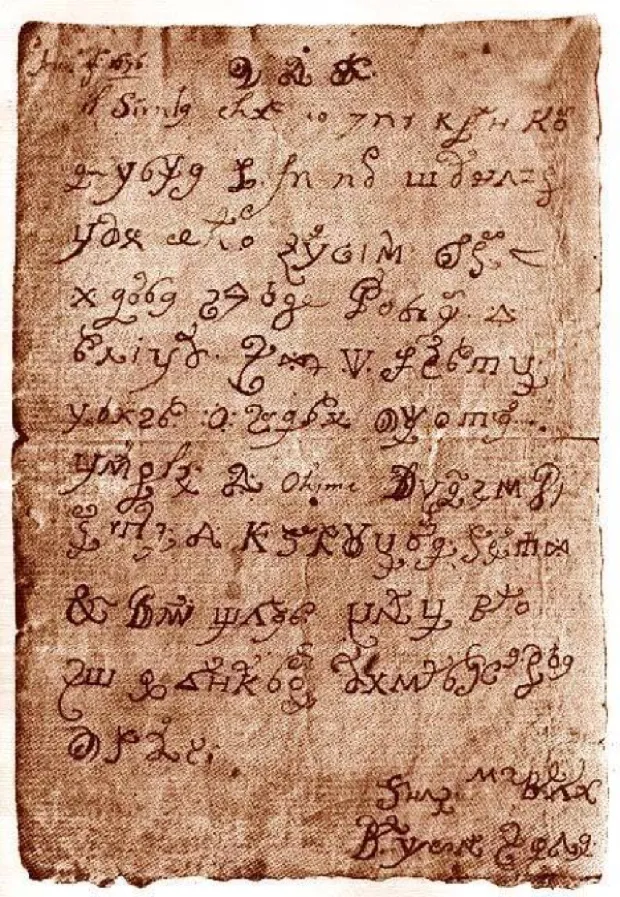
It was penned by Sister Maria Crocifissa della Concezione, a 31-year-old nun living at the convent of Palma di Montechiaro in Sicily. On Aug. 11, 1676, she was found on the floor of her cell, her face covered in ink, holding a note written in an incomprehensible mix of symbols and letters, according to historical records. Sister Maria apparently said the letter was written by the devil in an attempt to get her to turn away from God and toward evil, historical accounts suggest. [In Photos: 'Demon Burials' Discovered in Poland Cemetery]
The message, just 14 lines of jumbled, archaic letters, has for centuries defied every attempt at understanding its meaning.
"When working on historical decryption, you cannot ignore the psychological profile of the writer. We needed to know as much as possible about this nun," Ludum Director Daniele Abate told Live Science.
Sister Maria Crocifissa della Concezione, born Isabella Tomasi (she was an ancestor of Italian writer Giuseppe Tomasi di Lampedusa), entered the Benedictine convent when she was only 15 years old, according to historical records.
"The letter appeared as if it was written in shorthand. We speculated that Sister Maria created a new vocabulary using ancient alphabets that she may have known," Abate said.
To find out for sure, the researches first tested the software they used with some standard shorthand symbols from different languages. They found that the nun's letter contained a mix of words from ancient alphabets such as Greek, Latin, Runic and Arabic.
Get the world’s most fascinating discoveries delivered straight to your inbox.
"We analyzed how the syllables and graphisms [or thoughts depicted as symbols] repeated in the letter in order to locate vowels, and we ended up with a refined decryption algorithm," Abate said.
He said the team did not have great expectations for the outcome.
"We thought we could just come out with a few words making sense. But the nun had a good command of languages," he said, adding "the message was more complete than expected."
Rambling in nature and not entirely understandable, the letter, in addition to calling the Holy Trinity "dead weights," goes on to say that "God thinks he can free mortals ... The system works for no one ... Perhaps now, Styx is certain."
In Greek and Roman mythology, Styx is the river separating the netherworld from the world of the living.
Abete said the letter suggests that Sister Maria suffered from schizophrenia or bipolar disorder. "The image of the devil is often present in these disorders. We learned from historical records that every night she screamed and fought against the devil," Abate said.
For the church of that time, the letter was instead considered the outcome of her struggle against "innumerable evil spirits," according to a written account about the occurrence by Abbess Maria Serafica.
According to Serafica's account of the nun's behavior written shortly after the incident, the devil would have forced Sister Maria (who was later blessed) to sign the letter. She heroically opposed the demand by writing, "Ohimé" (oh me), which is the only comprehensible word in the letter, Serafica wrote.
The research has not been published in a peer-reviewed scientific journal.
Original article on Live Science.