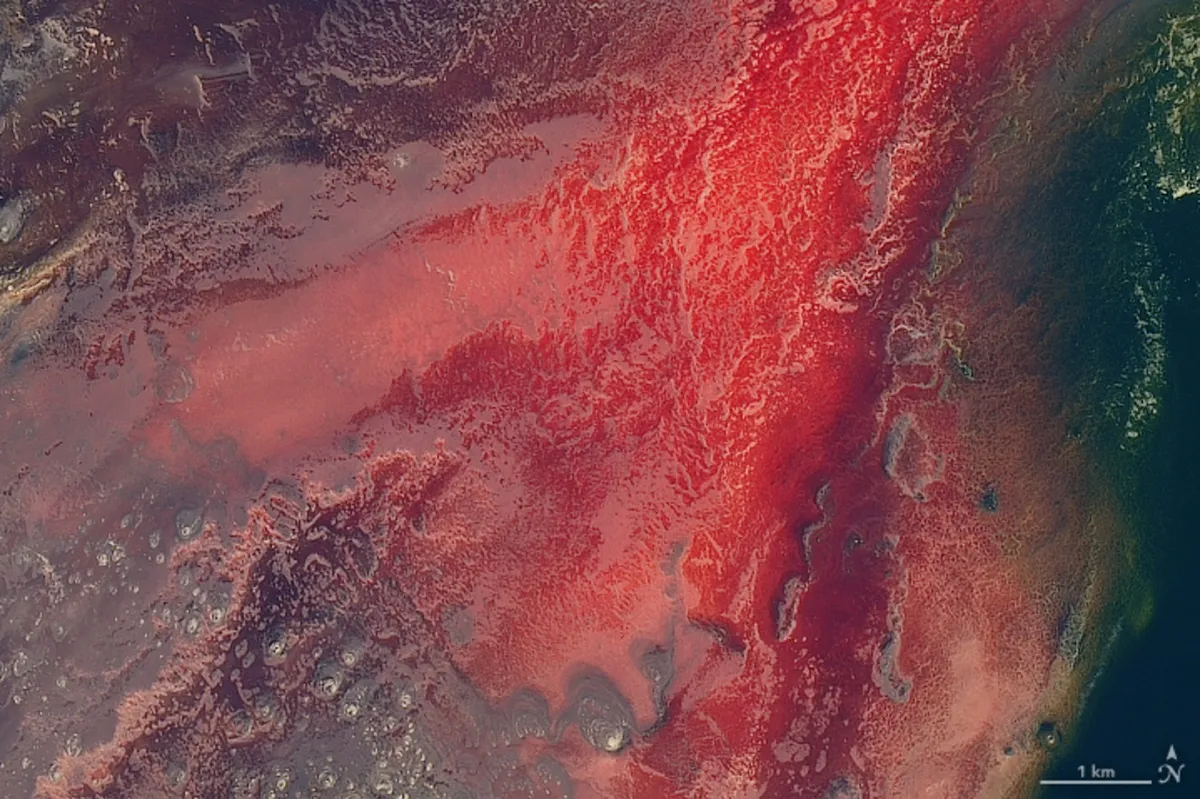
The crimson glow in Tanzania's Lake Natron, shown here in an image captured from the Landsat 8 satellite on Marck 6, 2017, is caused by salt-loving microbes called haloarchaea.
One of the world's weirdest lakes stands out in scarlet in new NASA images.
Lake Natron in northern Tanzania is an incredibly alkaline body of water. Its pH is as high as 10.5 — not quite as caustic as ammonia, but similar to the laxative Milk of Magnesia. The reason for this bizarre chemistry is the volcanic geology surrounding Lake Natron. The minerals and salts produced by volcanic processes — particularly sodium carbonate — push Lake Natron's water far above water's typical pH of around 7, which is neutral on the 0 to 14 pH scale.
Many animals can't survive in water that alkaline, but the lake is home to flocks of flamingos and other birds as well as tilapia fish. When the lake's animals die, their bodies are sometimes preserved by the sodium carbonate minerals that are responsible for the water's strange chemistry. Ancient Egyptians used sodium carbonate and other naturally occurring salts, known as natron, in their mummification practices. [Photos: Lake Natron Gives Up Its Dead]
On March 6, 2017, NASA's Landsat 8 satellite swooped over Lake Natron and snapped shots of the water's vermillion beauty. The red color is due to haloarchaea, microorganisms that thrive in the lake's salty waters, according to NASA's Earth Observatory. At the end of the dry season, when this image was taken, the lake level is particularly low and the concentrated salt ponds are especially colorful.
Lake Natron, located in the Rift Valley of Tanzania, spans an area of about 480 square miles (1,250 square kilometers), according to the World Wildlife Fund.
(Image credit: NASA Earth Observatory)
Near Lake Natron sits Ol Doinyo Lengai, an active volcano that rises abruptly out of the surrounding arid grasslands. According to the Smithsonian Institution's Global Volcanism Program, Ol Doinyo Lengai is the only volcano that has erupted carbonatite lava in human history. Unlike most volcanos, which spit out glassy, silica-rich lava, carbonatite lava contains very little silica. It's made, instead, of carbonate minerals (like natron) that are more commonly seen in sedimentary rocks.
Ol Doinyo Lengai's carbonatite lava is especially bizarre, erupting at temperatures of around 930 degrees Fahrenheit to 1,100 degrees Fahrenheit (500 to 600 degrees Celsius), according to the Hawaiian Volcano Observatory. Silica-rich Kilauea lava clocks in at 2,120 degrees F (1,160 degrees C), for comparison, while Mount St. Helens spews lava reaching 1,472 degrees F (800 degrees C).
Stephanie Pappas is a contributing writer for Live Science, covering topics ranging from geoscience to archaeology to the human brain and behavior. She was previously a senior writer for Live Science but is now a freelancer based in Denver, Colorado, and regularly contributes to Scientific American and The Monitor, the monthly magazine of the American Psychological Association. Stephanie received a bachelor's degree in psychology from the University of South Carolina and a graduate certificate in science communication from the University of California, Santa Cruz.