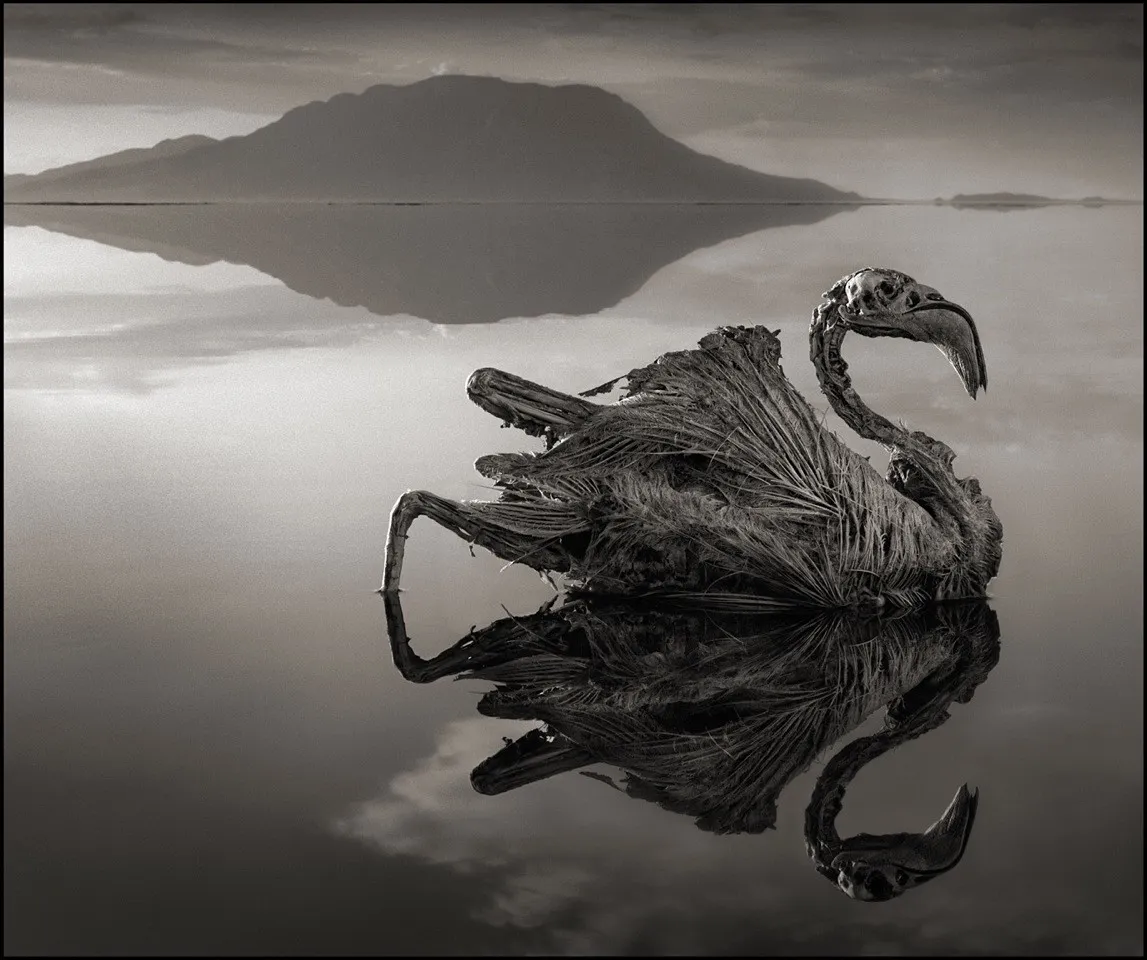
The alkaline water in Africa's Lake Natron has a pH as high as 10.5 and is so strongly caustic it can irritate or burn the skin and eyes of animals that aren't adapted to it. The alkalinity in Lake Natron is due to the sodium carbonate and other minerals that flow into the lake from the surrounding hills.
Sodium carbonate — which was once used in Egyptian mummification — also acts as a fantastic type of preservative for those animals unlucky enough to die in the waters of Lake Natron. Now, photographer Nick Brandt has captured haunting images of the lake and its dead in a book titled "Across the Ravaged Land" (Abrams Books, 2013).
Brandt discovered the remains of flamingos and other animals with mineral deposits outlining their bodies in sharp relief. "I unexpectedly found the creatures — all manner of birds and bats — washed up along the shoreline of Lake Natron," Brandt wrote in his book.
Despite some media reports, the animals didn't die simply because they came into contact with the lake's water. In fact, Lake Natron supports a thriving ecosystem of salt marshes, freshwater wetlands, flamingos and other wetland birds, tilapia and the Spirulina algae on which flamingos feed.
Lake Natron in Tanzania is one of the most serene lakes in Africa — except when enormous flocks of flamingos descend upon the lake during breeding season. More than 2 million lesser flamingos (Phoenicopterus minor) use the shallow lake as their primary breeding ground in Africa.
"I took these creatures as I found them on the shoreline, and then placed them in 'living' positions, bringing them back to 'life,' as it were," Brandt wrote, referring to the way he repositioned the animals. "Reanimated, alive again in death."
Sign up for the Live Science daily newsletter now
Get the world’s most fascinating discoveries delivered straight to your inbox.
Marc Lallanilla has been a science writer and health editor at About.com and a producer with ABCNews.com. His freelance writing has appeared in the Los Angeles Times and TheWeek.com. Marc has a Master's degree in environmental planning from the University of California, Berkeley, and an undergraduate degree from the University of Texas at Austin.