













In Photos: The History of the Hindenburg Disaster

The end of airships
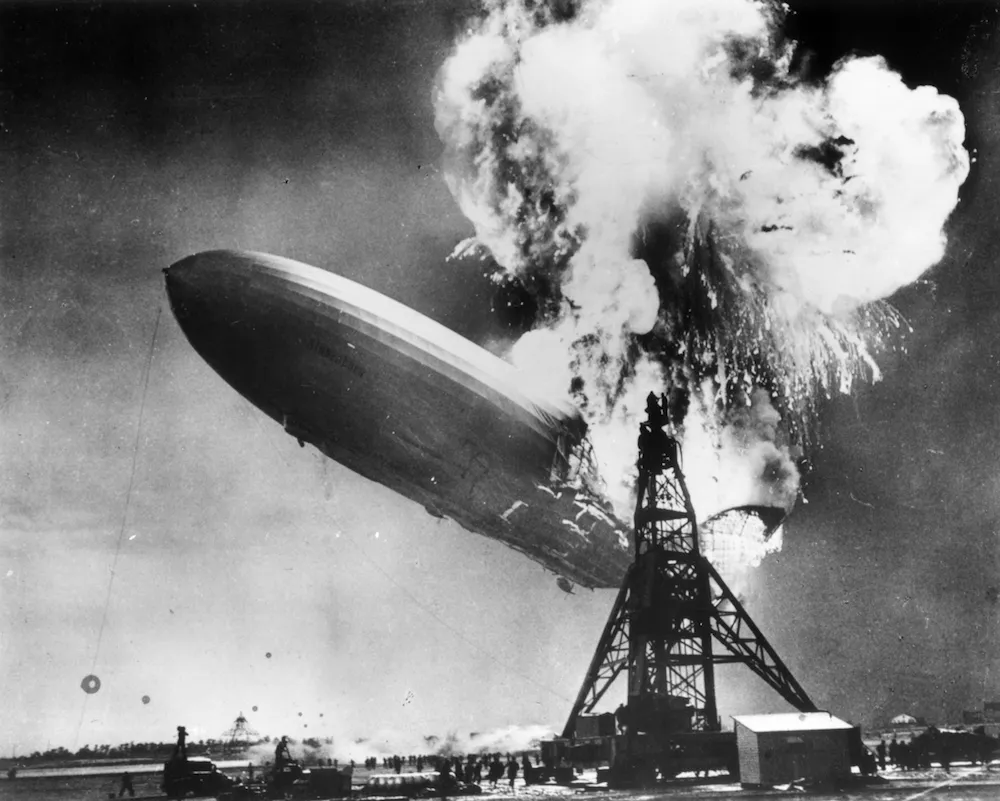
The LZ 129 "Hindenburg" was a giant passenger airship built by the German Zeppelin Company in the 1930s. The airship made its debut flight on March 4, 1936, but just a little more than a year later, the Hindenburg would become seared in people's minds after an ill-fated flight across the Atlantic Ocean.
The Hindenburg flew its first North American transatlantic flight in May 1937, but during its landing on May 6, 1937, the airship burst into flames and crashed to the ground in Lakehurst, New Jersey. Check out these photos to explore the history of the Hindenburg, including its fiery demise.
Building a behemoth

The frame of the Hindenburg takes shape at the Zeppelin Works in Friedrichshafen.
Intricate framework

The vast and intricate framework of the Zeppelin LZ 129, or the Hindenburg, under construction at Friedrichshafen, Germany, in October 1934.With a gas capacity of 7,070,000 cubic feet, the Hindenburg became the largest airship in the world.
In the hangar

In this photo, the Hindenburg is maneuvered into a hangar. Two swastikas, symbols of the German National Socialist Party, are displayed on its tail.
Fiery demise

As it prepared to land on May 6, 1937, the Hindenburg burst into flames and crashed to the ground in New Jersey.
Crash landing

The Hindenburg erupted into flames over Lakehurst, New Jersey, on May 6, 1937.
Ill-fated journey

The Hindenburg in flames after crashing as it approached its moorings.
Get the world’s most fascinating discoveries delivered straight to your inbox.
Learning from the disaster

The Hindenburg disaster came to be a symbol of the end of airship travel. An investigation found that a spark ignited the highly flammable hydrogen that filled the airship, causing it to burst into flames.
Trial run

The giant hydrogen-filled Hindenburg is pictured here on a trial flight at Friedrichshafen on March 7, 1936.
Over the Big Apple

The German-built airship Hindenburg flying over New York City.
Preparing to fly

The airship Hindenburg in its hangar during preparations for a voyage on Aug. 9, 1936.

Denise Chow was the assistant managing editor at Live Science before moving to NBC News as a science reporter, where she focuses on general science and climate change. Before joining the Live Science team in 2013, she spent two years as a staff writer for Space.com, writing about rocket launches and covering NASA's final three space shuttle missions. A Canadian transplant, Denise has a bachelor's degree from the University of Toronto, and a master's degree in journalism from New York University.