















Robotic Craft Mimics Falling Maple Seeds
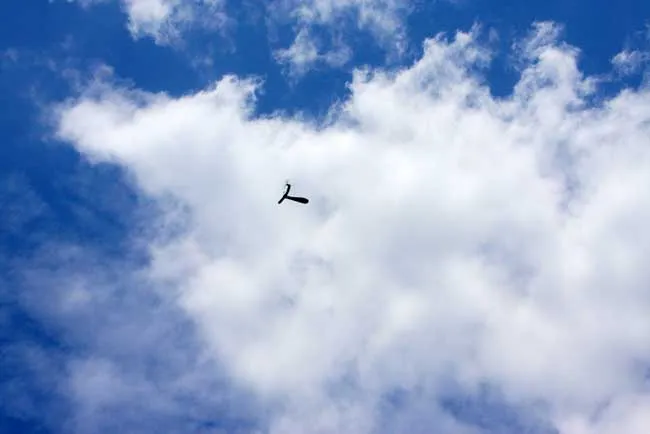
Aerospace engineers have designed a hovering craft that mimics the spiraling pattern made by maple tree seeds.
Called RoboSeed NAV (nano air vehicle), the craft has a maximum dimension of less than 4 inches (9.5 cm), making it the world's smallest controllable single-winged rotating aircraft. Other flying craft may be smaller, but they have more than one wing and are symmetrical, according to the engineers who built RoboSeed.
The team also built scaled-up versions of their one-winged crafts, which have more maneuverability.
The crafts' petite size and weight, along with their hovering ability and quietness make them optimal for several applications, the researchers say, ranging from radio-controlled toys to low- and high-altitude satellites and communications transponders.
Winged seeds, or samaras, such as that of the maple tree are considered some of the most efficient passive flyers, and hence have been ogled by many engineers looking to build tiny flying devices.
Researchers have only recently figured out though just how nature's helicopters spin. Essentially, a swirling maple seed generates a tornado-like vortex above the front leading edge of the "helicopter," which effectively sucks the wing upward to oppose gravity.
Craft design
Get the world’s most fascinating discoveries delivered straight to your inbox.
Since the 1950s, researchers have been trying to create a stable, unmanned aerial vehicle that could mimic a maple seed's flight. But their attempts have been unsuccessful, typically because of instability.
Until now, the vehicles have been just a single component, and so the entire craft — wing and propeller — had to twist and turn as one unit. The result was an unstable vehicle that would crash with even a slight nudge from the wind.
A team from the University of Maryland's Clark School of Engineering got around this problem by separating the wing from the propeller and electronics package into two attached components. That way the wing could tilt up or down without moving the rest of the vehicle.
"We found that it behaved a lot more like a helicopter and it was highly stable even in the presence of wind," said graduate student and study team member Evan Ulrich.
Wing features
The team also tweaked the shape of the wing to match that of a maple seed, where the bulk of the surface area sits toward the tip, away from the center of rotation. "For natural maple seeds, it allows them to fall more slowly," Ulrich told LiveScience. "For ours, it allows it to hover for longer and more stably."
Depending on which way a maple seed is tilted it will fall in one of two modes: It either carves out a small helix shape as it falls, essentially spiraling straight down, or it carves out a giant helix shape during descent.
"The difference between those two flight patterns is the wing pitch. And so by variation of the wing pitch you can control how big the helix is you're descending in," Ulrich said.
That's also how Ulrich and his team control the horizontal direction of the vehicle. By carving out a 160-feet-wide (50 meter) helix, say, the craft would travel pretty far in one direction and with the tilt of the wing, the craft could then descend in a tiny helix.
Future applications
The craft's first non-lab setting may be on the shelves of toy stores as a radio-controlled device, according to Ulrich. That could be months away.
But he has high hopes for its scientific applications. For instance, the vehicle can stay aloft for long periods of time without power, and so could be used as a low-altitude satellite.
"If you can find in the atmosphere a location where there's a thermal that is equal to or greater than your descent velocity, then you can turn off your motor and hover," Ulrich said. "It's sort of like getting free energy from the atmosphere. You can remain aloft indefinitely as long as you can stay in one of these thermals."
The device could also be used as a transponder to send radio signals from the ground.
"With one of these things it's simple and robust enough if you were to put a communications beacon on it a soldier could throw it up in the air and it would climb and relay a message," Ulrich said. "That's just a few months away. The vehicle is capable of doing these things right now; it can carry a payload, and it can be hand launched, and it's extremely easy to control."
Further off, he envisions the device being used for higher-altitude mapping of rooms and even caves.
The vehicle has been demonstrated at University of Maryland events, the American Helicopter Society Annual Forum, the Smithsonian Udvar-Hazy Air and Space Museum, and at the 100th anniversary of the College Park airport.
- Video - Watch the 'Maple Seed' Craft
- Video – Tomorrow's Technology Today: Robot Helicopters
- 10 Profound Innovations Ahead
Jeanna Bryner is managing editor of Scientific American. Previously she was editor in chief of Live Science and, prior to that, an editor at Scholastic's Science World magazine. Bryner has an English degree from Salisbury University, a master's degree in biogeochemistry and environmental sciences from the University of Maryland and a graduate science journalism degree from New York University. She has worked as a biologist in Florida, where she monitored wetlands and did field surveys for endangered species, including the gorgeous Florida Scrub Jay. She also received an ocean sciences journalism fellowship from the Woods Hole Oceanographic Institution. She is a firm believer that science is for everyone and that just about everything can be viewed through the lens of science.