













Mystery Over Face-Down Skeleton Partly Solved
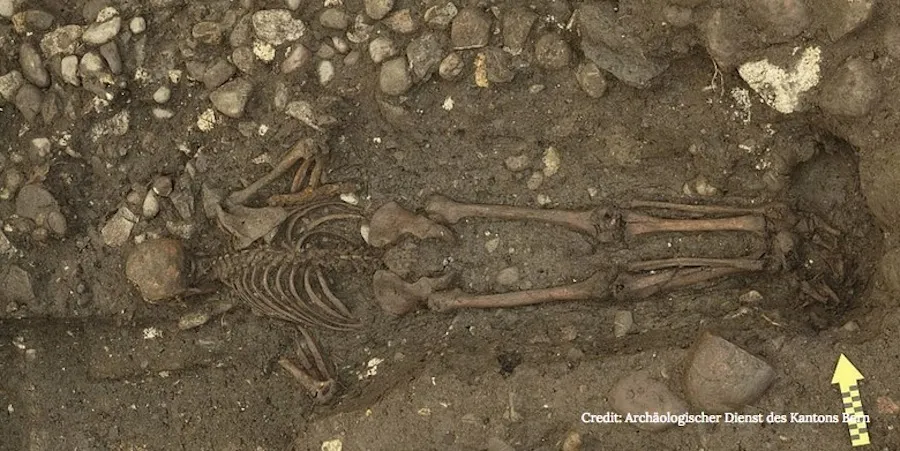
Swiss researchers may have solved the mystery over the identity of a 17th-century man who was buried face-down with a knife and purse filled with coins.
X-ray computer tomography of the coins has revealed the man was likely a merchant, but the reason for his prone burial continues to puzzle the archaeologists.
Unearthed in 2013 in the Bernese Lakeland region of Switzerland during the construction on a new underground garage, the skeleton was found along 342 bodies laid to rest between the 8th and 17th centuries. The individual was among the last 15 bodies to be buried at the ancient cemetery.
The face-down skeleton stood out from all the other graves.
"It is certainly a deviant burial, in the sense that the burial practices here seem to be very unusual for the time," Christian Weiss, a numismatic expert with the Archaeological Services of Canton Bern, told Discovery News. "The individual was facing to the ground; moreover, a knife and a purse were found within the burial where we normally don't find any grave goods in this time," Weiss said.
RELATED: Anti-Demonic Burial Found in Poland
Under the individual's chest, the archaeologists found what remained of a leather purse. Over time, the leather had decomposed and the coins it contained had corroded together to form a solid block of metal.
Get the world’s most fascinating discoveries delivered straight to your inbox.
Unable to separate the coins, the researchers turned to a powerful X-ray computer tomograph, a new instrument called µDETECT. Used in conjunction with a high resolution detector, the µDETECT revealed the presence of 24 coins.
"The astonishing fact about these coins is that they belong to three different coin circulation areas, the Fribourg-Bern-Solothurn, Basel-Freiburg in Breisgau and Luzern-Schwyz regions," Weiss said.
The finding suggests the individual was moving in these three areas, which had their own coins in local circulation at that time.
"It is possible he was a traveling merchant," Weiss said.
With one exception, a heavily worn silver coin from France, all the coins in the purse are of rather low value.
"They are really just small change," Weiss said. "The most interesting to me isn't really one particular coin, but the ensemble all together. We rarely get such a big ensemble of small value coins from this time."
RELATED: Medieval 'Witch Girl' Suffered From Scurvy
The latest among the coins in the purse dates from 1629, indicating the man must have been buried after then. The reason behind the face-down burial remains a mystery.
Like other deviant burials, in which the dead were buried with a brick in the mouth, nailed or staked to the ground, the prone burial aimed to humiliate the dead and prevent the individual from rising from the grave, since it was believed that the soul left the body through the mouth.
Usually these rare burials were meant as an act of punishment and in extreme cases the victim was interred alive.
In the case of the Swiss merchant, there is no conclusive answer.
"It is likely they buried the man intentionally facing downwards. Whether the burial was meant to prevent him from returning to the living, or to face him to hell is just speculation. There could be other, rather unspectacular reasons behind this," Weiss said.
Originally published on Discovery News.