













These Honeybees Have Mastered Twerking: How They Do It

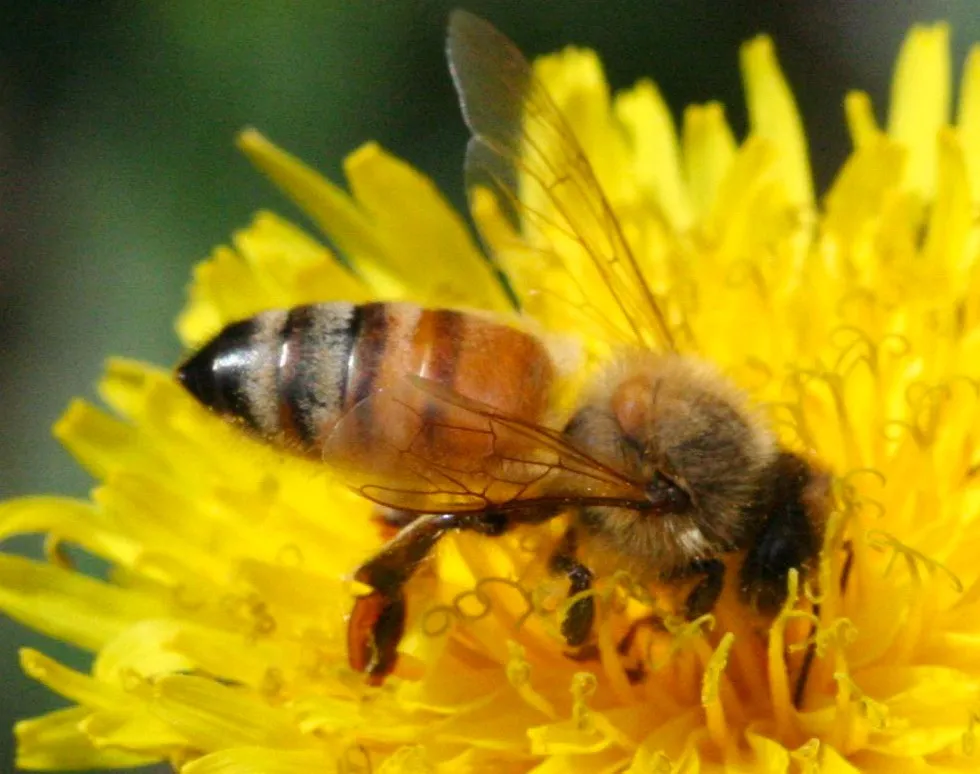
Honeybees are famous for their wiggling, waggling dances, which they use to communicate with others in their hives. Now, a new study reveals the anatomical limits to a honeybee's moves.
The bees (Apis mellifera ligustica) can curl their abdomens, the new research finds, but they can't flex them upward — no backbends for these insects. The reason is in the intersegmental membrane, the membrane that connects the plates on the bee's back and belly. The membrane along the animal's back is thicker than the one along its belly.
"Our research on the ultrastructure of the FIM [folded intersegmental membrane] is of great significance to reveal the bending and flexing motion mechanism of the honeybee abdomen," study researcher Shaoze Yan, of Tsinghua University in China, said in a statement. [Video: Watch Honeybees Twerking]
In 2015, Yan and his colleagues published a study in the Journal of Insect Science confirming that honeybees can bend their abdomen only one way. Their new research takes those findings a step further. Using a scanning electron microscope as well as high-speed video recordings of live bees moving, the researchers pinpointed the reason for this limited movement. The bee abdomen is made up of hard exoskeleton plates held together by the intersegmental membrane. The plates on the bee's back, or terga, are called tergites. The plates on the bee's belly, or sterna, are called sternites.
The thick, Z-shaped membrane also helps prevent the bee from arching its back, as its edges interact with the plates making up the bee's exoskeleton, the researchers wrote. Further limiting the bee's backward movement is the S-shaped sterna membrane, which stretches to its full extent across the bee's belly and prevents further bending.
The membranes do allow for other useful movements.
"During nectar feeding, a honeybee's abdomen does high-frequency respiratory exercises and assists the suction behavior of mouthparts to improve the intake efficiency," Yan said.
Get the world’s most fascinating discoveries delivered straight to your inbox.
The honeybee findings might be useful inspiration for mechanical engineers hoping to design mechanisms that can flex and deform, the researchers wrote.
Original article on Live Science.

Stephanie Pappas is a contributing writer for Live Science, covering topics ranging from geoscience to archaeology to the human brain and behavior. She was previously a senior writer for Live Science but is now a freelancer based in Denver, Colorado, and regularly contributes to Scientific American and The Monitor, the monthly magazine of the American Psychological Association. Stephanie received a bachelor's degree in psychology from the University of South Carolina and a graduate certificate in science communication from the University of California, Santa Cruz.