













Home-brew lava
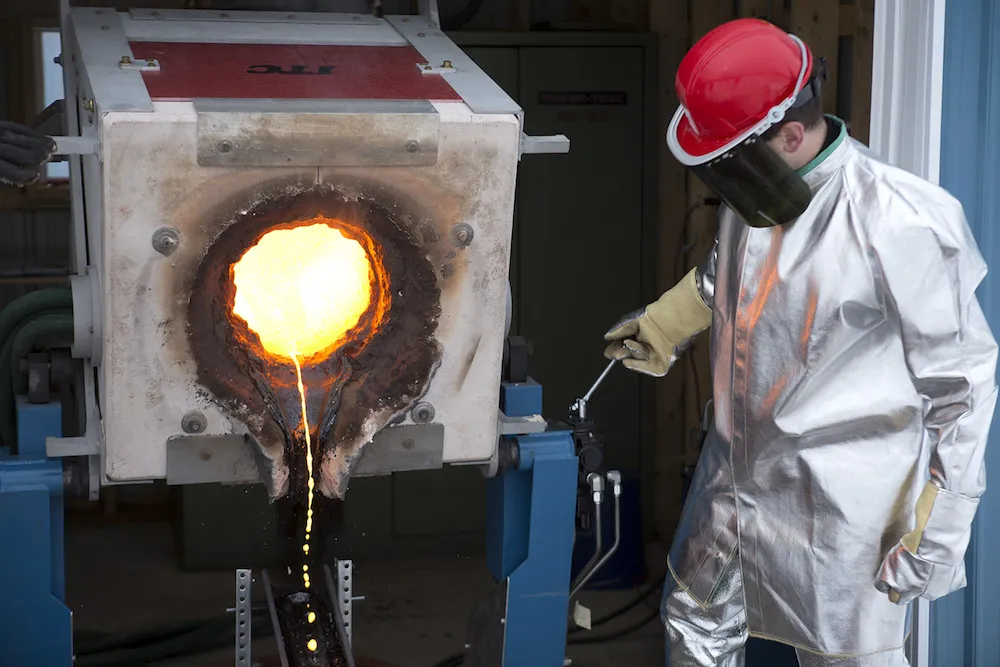
Scientists are creating their own "home-brew" lava and pouring it at a test station to understand how water interacts with hot, molten rock.
Heating the rock

The experiment starts with pieces of basaltic rock, shown here. Such rock can have explosive reactions when it interacts with water, but in other situations, water and lava cause no noticeable effects. Scientists want to understand why that is.
Heating up the rock

The rock is then heated up to 2,500 degrees Fahrenheit (1,371 degrees Celsius) and turned into molten lava.
Pouring the lava

The lava is then poured into a metal tube that mimics the subterranean channels through which lava feeds underneath volcanoes. From there, the team plans to add water and use an array of sophisticated sensors to understand exactly what happens.
Cleaning the machine

Here, geology student Andrew Harp chips residue from the furnace.
Testing water reaction

Here, experiment lead Ingo Sonder, a geologist at the University at Buffalo chips away rock residue on the furnace that is used to make the lava.
Get the world’s most fascinating discoveries delivered straight to your inbox.

Tia is the editor-in-chief (premium) and was formerly managing editor and senior writer for Live Science. Her work has appeared in Scientific American, Wired.com, Science News and other outlets. She holds a master's degree in bioengineering from the University of Washington, a graduate certificate in science writing from UC Santa Cruz and a bachelor's degree in mechanical engineering from the University of Texas at Austin. Tia was part of a team at the Milwaukee Journal Sentinel that published the Empty Cradles series on preterm births, which won multiple awards, including the 2012 Casey Medal for Meritorious Journalism.