















Desert Ponds Are Strange Sight from Space

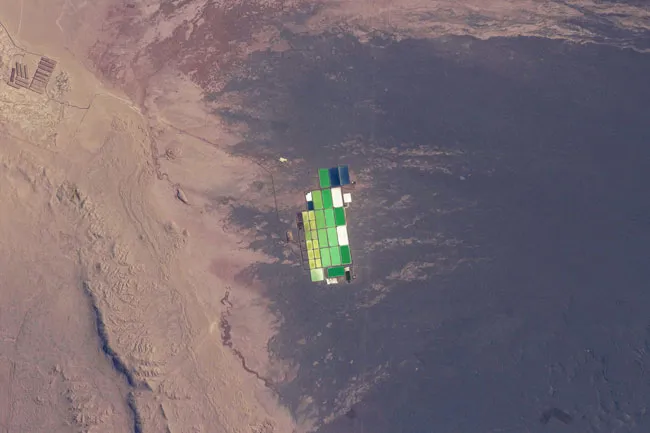
Brightly colored solar evaporation ponds in the Atacama Desert of Chile can be seen from space in stark contrast to their barren surroundings.
Astronauts aboard the International Space Station took an image of one such set of ponds on May 5 while orbiting overhead.
The ponds sit near the foot of a long alluvial fan in the Pampa del Tamarugal, the great hyper-arid inner valley of the Atacama, the driest desert in the world. The alluvial fan sediments are dark brown, and they contrast sharply with tan sediments of the Pampa del Tamarugal.
Nitrates and many other minerals are mined in this region. A few extraction pits and ore dumps are visible in the upper left of the image.
Iodine is also mined here. Waste liquids from the iodine plants are dried in the tan and brightly colored evaporation ponds to crystallize nitrate salts for collection.
The recovered nitrates are mainly used for fertilizer for higher-value crops. They are also used in the manufacture of pharmaceuticals, explosives, glass, and ceramics, as well as in water treatment and metallurgical processes.
- 101 Amazing Earth Facts
- Earth's Highest Microbial Ecosystem in Andes
- Images: Earth from Above
Get the world’s most fascinating discoveries delivered straight to your inbox.
