













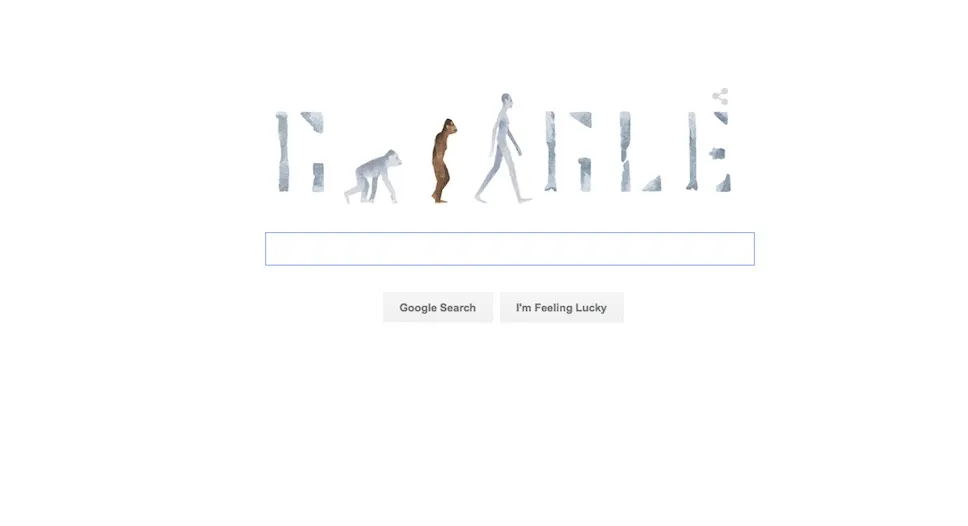
Happy 41st birthday, Lucy! Well, 41 give or take 3.2 million.
Today's Google doodle honors "Lucy," the famous Australopithecus skeleton that was discovered 41 years ago today, with a progression from ancient crawling ape to upright Homo sapiens.
In 1974, anthropologists Donald Johanson and Tom Gray unearthed the ancient hominin in the Afar region of what is now Ethiopia while taking a detour back to their camp. They noticed an arm bone sticking out of the ground and began excavating, according to the Institute for Human Origins.
Soon they had unearthed hundreds of bones and bone fragments, representing about 40 percent of a single hominin skeleton. At the time, Lucy was the most complete ancient hominin fossil ever unearthed. It turned out the fossil belonged to a new species, Australopithecus afarensis, who lived about 3.2 million years ago.
Lucy actually got her name from the Beatles song "Lucy in the Sky with Diamonds," which played on a continuous loop in the camp during excavations.
From her long arms to her small brain, Lucy has revealed many insights about early human ancestors. Lucy and her ilk likely used their arms to swing from the trees and used their upward-pointed shoulder sockets to climb, but they also had lower limbs and hips suited to upright walking, a 2012 study published in the journal Science found.
Follow Tia Ghose on Twitter and Google+. Follow Live Science @livescience, Facebook & Google+. Original article on Live Science.
Get the world’s most fascinating discoveries delivered straight to your inbox.

Tia is the editor-in-chief (premium) and was formerly managing editor and senior writer for Live Science. Her work has appeared in Scientific American, Wired.com, Science News and other outlets. She holds a master's degree in bioengineering from the University of Washington, a graduate certificate in science writing from UC Santa Cruz and a bachelor's degree in mechanical engineering from the University of Texas at Austin. Tia was part of a team at the Milwaukee Journal Sentinel that published the Empty Cradles series on preterm births, which won multiple awards, including the 2012 Casey Medal for Meritorious Journalism.